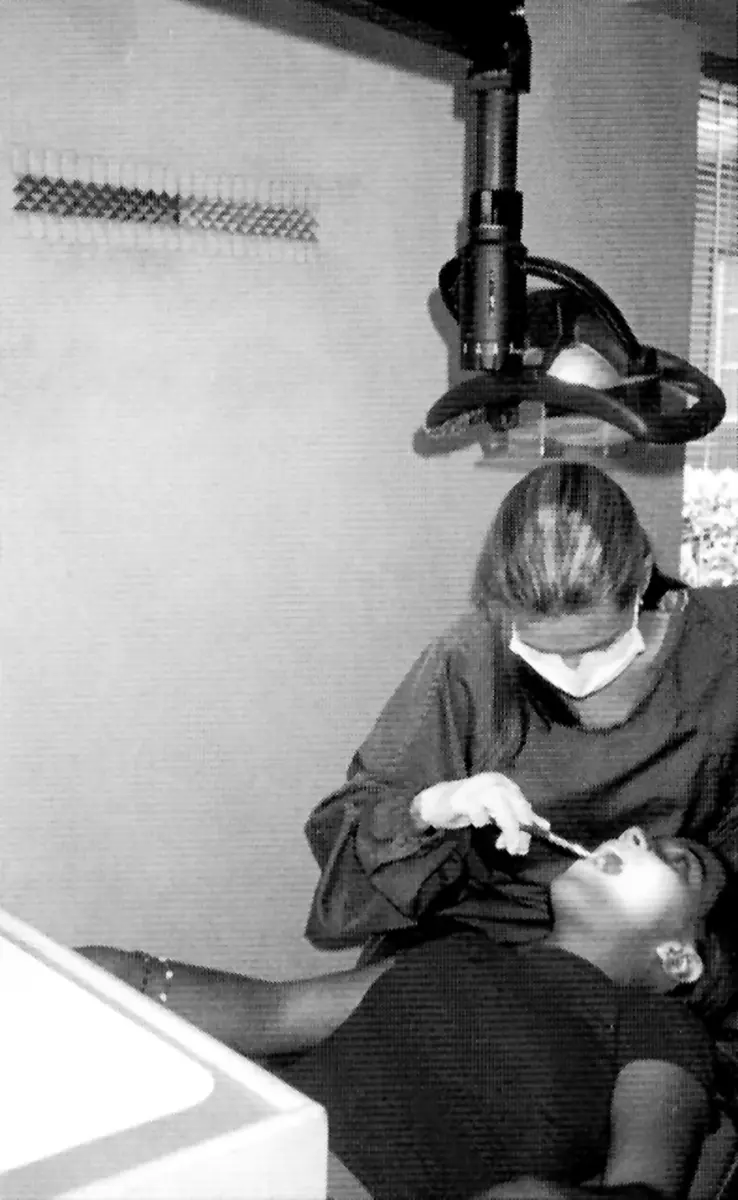
Rare is the dentist who hasn’t put up a few posters intended to soothe the ailing patient—scenes of the azure seashore, flower-strewn meadows, and such, sometimes tacked haphazardly to the ceiling where one’s eyes must invariably alight to avoid the coming and going of steely instruments. Not only do the offices of Miami orthodontist Arturo Mosquera lack any such visual bromides, but the walls are hung with actual drawings, paintings, and prints, a changing round of art by the Cuban expatriate artists whose work
Dr. Mosquera assiduously collects.
These rotating shows are not merely selections from Mosquera’s ample collection, however. In recent months the doctor has invited artists to create new works, especially for his professional domain. This past winter Glexis Novoa made several graphite drawings directly on the walls as part of an installation that originated with the artist’s own dental records and evolved into a sort of arcane office-wide signage. Though baffling in its exact readings, it seemed perfectly attuned to the business Mosquera carries out, which is part precision team mechanics, part interpersonal hoodoo.
Novoa’s works can look at once nostalgic and archly speculative. In one aspect of his varied oeuvre, he likes to depict fantastic cityscapes devoid of human presence: seaside panoramas seen from a great distance, or vast urban grids with buildings that resemble actual vanished landmarks or evoke his own futuristic inventions. The office exhibition had two parts: a small iconic drawing on each of the walls in the room where the orthodontist treats his patients, and in the waiting room a kind of treatise made of hand-drawn text with illustrations. Or at least there was much of the punctuation from a text, along with a scattering of single letters, some syllables, and the occasional word—all arranged in lines wrapping around the three walls of the narrow vestibule. The text’s illustrations—if that’s what they were —floated through the mostly absent sentences as if perched in bubbles. They were largely hazy depictions of palm-filled tropics along with a variety of other circular drawings on whiteboard, some of which reflected Novoa’s fascination with geometric and architectural abstractions.
His iconic pieces shared the conflation of the suggestive and the imaginary. Near one chair he drew a kind of scissors that effloresced like a baroque book decoration, appearing both wickedly bladed and soft. By another, an Oriental peaked roof hovered over a sphere that was suspended above a trapezoidal box floating in the air. However implausible, the drawings had the exactness of illustrations from books about nature or physics, and though you could detect in them the accouterments of dentistry—details reminiscent of tongue depressors, for example, that one a seeming tool for handling flesh or bone—they would have been equally at home in the neutral confines of an art museum. Novoa has been invited to draw on the walls before: In Barcelona, at the Center for Contemporary Culture, and at the Fort Lauderdale Museum of Art. In both instances, he made horizon line drawings thinly circumnavigating walls of entire rooms, and they played mischievously with notions of inside and outside, scale, and distance.
The installation at Dr. Mosquera’s office could be seen as a commentary on, and, at the same time, a complement to, what happens on a daily basis in the office. In short, it was meant to be about the work at hand. The artist as a handmaiden to the prole—or, in this case, the prof—is not a surprising role for Novoa. He came to Miami as an activist member of the 80s generation of Cuban artists, who, besides having been afforded by the Revolution a thorough and rigorous education and exposure to world currents in art, were well endowed with notions of social observation and responsibility.
Dr. Mosquera, for his part, is a gracious gallerist, inaugurating the shows at his office with opening galas. Novoa took full advantage, arranging the doctor’s tools and working environment to make it appear that the artwork, rather than the dentistry, was the point of the space. The interior part of the office was darkened, and each of the drawings was spotlighted with the intense white light of a dental lamp. In this combustive darkness, you could easily see that beside the reclining chairs, there were geometric arrangements of stainless steel implements looking sinister and fine, somewhat like the drawings and also reminiscent of a Damien Hirst cabinet full of medical instruments. Then there was the evidentiary trail of x-rays and plaster molds of Novoa’s once-crooked teeth that led back to Mosquera’s desk where several toothy photographs and a chart of the artist’s initial office visit lay.
This was an excellent idea, and a turnabout of art’s usual arrangement in contrast to museums, for example, didactic panels illuminate or expand upon the objects. The exhibition also raised issues beyond the conceptual ones intended by Novoa, one being that a beneficial synergy can exist between artist and collector, as well as the more prickly relationship that an atmosphere of relentless marketeering tends to provoke. But in the daylight, absent the spotlights and the contrived arrangements of things that artists like to indulge in, the theater of Mr. Novoa’s artwork was vastly overshadowed by the clockwork bustle of Dr. Mosquera’s practice. Dentistry is fraught with considerable drama of its own, and Dr. Mosquera presides over his patients with a spirited bonhomie. Though a reflexive ironist like Novoa might appreciate it somewhere deep inside, the elusive complexities of conceptual art played out faintly in this gritty arena of the fixing of teeth.
JOEL WEINSTEIN