Javier Téllez’s show at the Rufino Tamayo Museum’s Sala Siete, a showcase for contemporary art, was a visual and thematic tour de force that exemplified the antithesis of what has become video’s techno-dependency. This can be seen in a recent video that succumbs to a spectacle where technological dazzle becomes an end in itself.
But this was not the case with Téllez’s show that successfully mined historical video strategies into fresh configurations. The exhibition consisted of two video works that were tangentially linked via the couplings of sanity/madness and rationality/irrationality that are ideologically rooted in the Enlightenment’s philosophical dialectic of self/other. The two works exhibited, The Last Supper, and Bedlam: I am Happy Because Everyone Loves Me, both from 2001, approached their individual yet converging themes by way of disparate formal and conceptual modes.
The Last Supper was presented in a conventional video format and consisted of residents of a Venezuelan sanitarium that were grouped together in the manner of da Vinci’s work that the video’s title cited. Apart from the cast of New Testament characters, Téllez inserted another personage into the tableau whose role can only be considered as a sort of Greek chorus. Her stream-of-consciousness monologue sung a cappella became the disembodied Spirit or Word made flesh; reminiscent of what Jacques Derrida called the “transcendental signifier.” This character added an interesting counterpoint to the demur communicative gestures of the other figures. The remaining “actors” in the video were narratively split between their sublime ree- enactment of Christian narrative with that of their social condition: alterity. This existential dilemma was not presented condescendingly, but with a subversive air of the carnivalesque that is also an element of his other work.
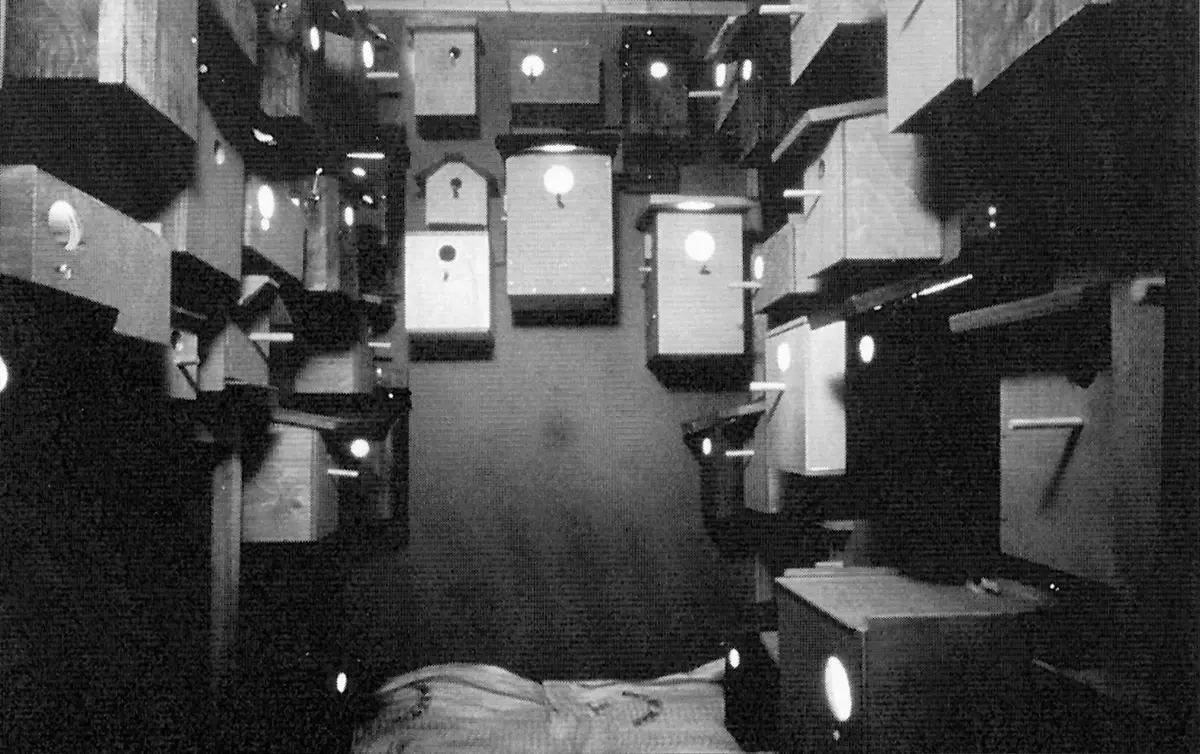
Bedlam: I am happy because everyone loves me, was based on the famous Bethlem Hospital in London from which the word "bedlam" derives. The installation consisted of a dark interior with video projection, and in the middle of the room was a giant birdhouse. The interior walls of the birdhouse were covered with smaller birdhouses made by residents of Bethlem Hospital. The holes in each of the birdhouses projected a small light, which was echoed by the bigger birdhouse’s aperture from which the viewer could watch the video played on the wall outside of it. The video consisted of training sessions on restraining techniques taught by Bethlem personnel. The video itself was slowed down, giving the contradictory appearance of violence or possibly erotic gestures. Along with the video was a soundtrack of the song Volare, which roughly translates to “fly.” The irony of such a strategy is emphasized within the context of the video piece, though the overall formal articulation of the work is brilliantly married to its conceptual thrust.
The installation focuses on the discursive construction of madness that is staunchly rooted in Western modernity. Bedlam implies that the historical manifestation of this discourse has appeared in various guises. Plato’s allegory of the cave, for example, now takes on a different meaning as the shadows cast on the cave’s wall that resonate a dichotomy of knowledge/ignorance, are now ideologically exposed as referring to sanity/madness and health/disease. Yet Téllez also implicates other theories of knowledge acquisition or epistemologies as equally problematic. The Renaissance theorist Leon Battista Alberti’s metaphor of painting as a window is not only about the eye as an aesthetic aid and that the notion that perspective is universal, but also about what the historian Martin Jay has called an ocular-centric view of the world. Ocular-centrism is also something that Marcel Duchamp contested, but he termed it as a condition of modernism and its bias towards what he called retinal-based art. The privileging of the eye can also be discerned in Bentham’s penal mechanism of surveillance called the Panopticon. In this surveillance technology, inmates are observed by a guard in a central tower, the design of which allows inmates to be under constant surveillance. Since the tower is in the shadows and the inmates’ cells are lit, the social effects of self-monitoring are heightened to the point of psychological torture.
What Bedlam seems to be conveying is that the tower is interchangeable with the Albertian window by way of vision. Likewise, Plato’s privileging of the eye and the metaphors that he uses to construct his model of humanity’s philosophical condition are analogies to the discourse of madness. In the end, Bedlam is a very complex work that is formally and conceptually compounded by a visually poetic vocabulary and evinces the intelligence of a seasoned artist. It will be interesting to see how the relatively young Javier Téllez will mature.
RAÚL ZAMUDIO TAYLOR