
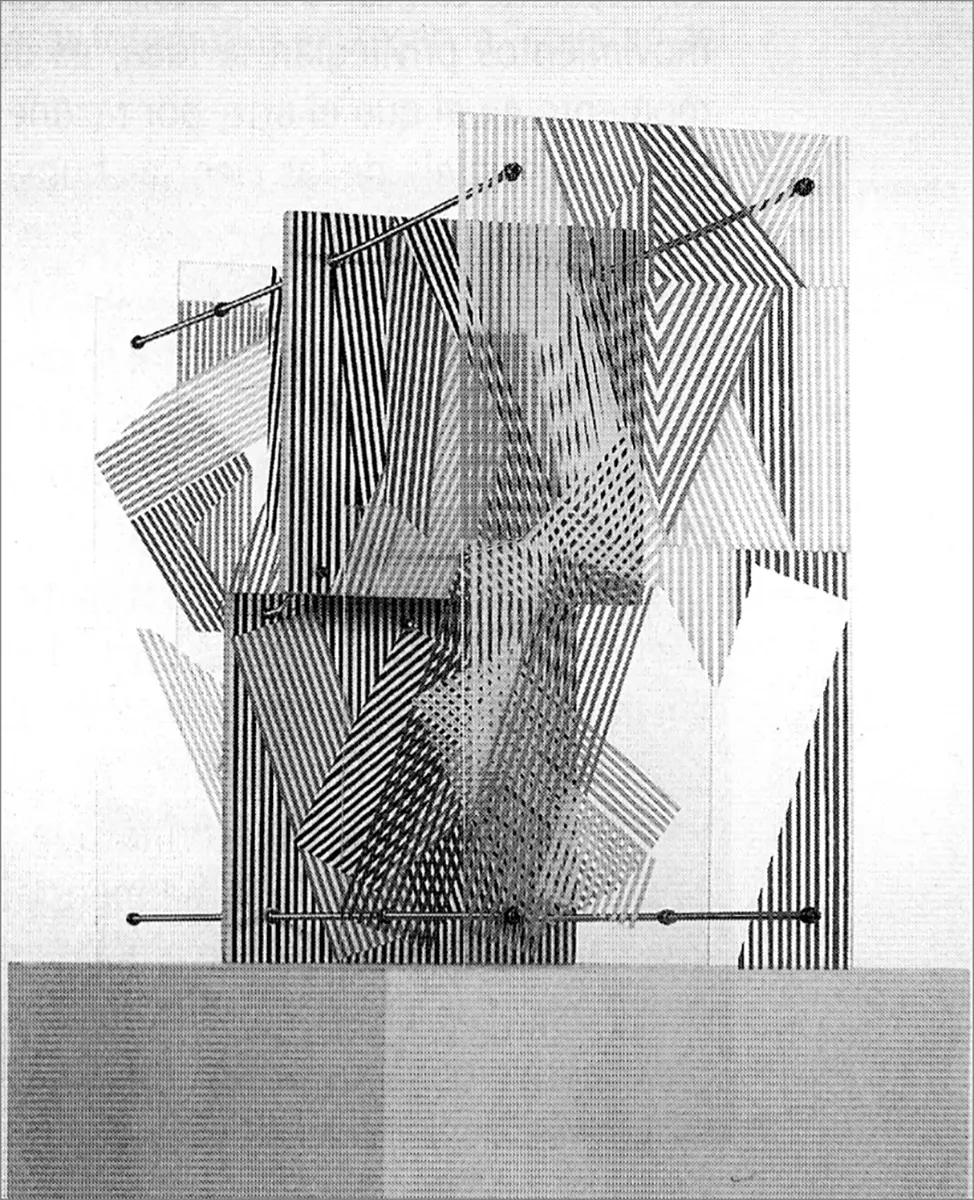
During February and March the Bogota Museum of Modern Art (now known as MamBo, and features white walls,1 presented a Jesús Rafael Soto retrospective. Curated by Daniel Abadie, director of the Galerie Nationale du Jeu de Paume in Paris, it covered works spanning from 1956 to 1999. It was possible to see how this Venezuelan artist started his artistic search with an exploration of matter that seems to be indebted to Informalism but that also distances itself quickly in order to consolidate a completely opposite language, one that erases the tracks left by the individual and where matter, by means of thoughtful, calculated work, is visually perceived as an insubstantial, immaterial fact. The Museum’s structure allowed for an arrangement of Soto’s work that took three moments into account. His early works were shown on the first level: paintings and three-dimensional pieces executed between 1956 and 1962. In the earliest pieces, it’s possible to see how the artist’s optical search—that requires exactness and geometry—supports itself on a materialized surface, organic and gestural, that, as I said before, reminds us of the language of Informalism. Something similar happens with the use of materials in his early three-dimensional works, in which wood and metal (sometimes rusted metal) hold a value as expressive matter. But also, on those organic structures begin to appear geometric lines, whose trace and distance have been calculated to the millimeter in an attempt to impose upon us a rational order. On the second floor, the level that welcomes the spectator, we could see early and recent works. Among them were two particularly significant pieces, Armonie Transformable, from 1956, and Sphere Concorde, from 1996. In both, we can see two moments in the search for the immaterial that drives Soto’s work. The first is a rigorous construction of transparent acrylic planes; on these, the artist has plotted with mathematical precision straight, sometimes diagonal horizontal, or vertical lines. In virtue of the transparency of the support, an optical game is generated appealing to flotation and the visual overlapping of the lines. In Sphere Concorde, a construction measuring 257 x 184 x 184 cm, the dematerialization of the image is not only absolute but happens right before our eyes. Fine red and white nylon threads form a cube with a sphere in its center. The effect is so that the sphere appears to be floating or suspended in the air like a magical and exciting apparition, while at the same time, we know that the illusion is supported by mathematical concepts, seriality, and geometry. The works done during the 1970s were placed on the third level. Two-dimensional surfaces dominated back then, intervened with fine metal rods. They were mostly monochromatic pieces based on the use of minimal lines that invite the spectator to move his body and his gaze searching for subtle movements that deceit, confuse, surprise, and entertain the eye which perceives lines and planes. But in virtue of the visual movement they’re generating, there is nothing certain in what’s being seen. A particularly interesting piece is Tres rojas y negras (Three Reds and Blacks), from 1974, an acrylic painting on wood and metal. Stand before it for a long time brings on an intense visual experience as the differently-hued red lines float and vibrate over the black lines, producing a process of visual dematerialization that is similar to the experience we have when we close our eyes and squint, and see how an immaterial light begins to produce quick effects in constant movement. On this level, we also find the great blue penetrable of 1999, where the spectator can have a body experience involving all the senses. On the top floor were his most recent works. In contrast to the previous pieces, color plays a major role here. The many colored planes advance and retreat before our own eyes thanks to the dynamics established among themselves, as well as to the support of exact and fine, black and white lines that make up a background that “tricks” the eye, the motor always activating Soto’s work. One of the many virtues of this exhibit is that it utilized some of Soto’s quotable phrases, extracted from his interviews in which he reveals the intentions behind each stage of his work. These quotes also confirm the close relationship his work has with mathematics, serial music, and science. Soto’s works and words put into evidence the rupture that took place in art during the 1960s with Op Art and Minimalism, which have a predilection for a rigorous language in geometrical abstraction. These two movements have several traits in common: they’re both interested in erasing the artist’s personal touch—an attitude that explains the little or no relevance of manual style. Consequently, with these aspects, both movements give greater privilege to the idea. It’s a moment in which art, for various reasons, distances itself from the humanities and enters into close contact with the exact sciences and mathematics. In this fashion, emotion, chance, and spontaneity are omitted during the process of production, and the work’s artistic procedure is much closer to calculation and logic. Despite their common traits, the works from either movement are quite different from each other. Didi Huberman, in his book What We See What Sees Us, claims that due to their hermeticism and austerity, minimalist works, more than objects being erected to be seen, they “look” and question us from their austere and hermetic form. In Soto’s works, their reason for being and their reality are possible only through the spectator’s gaze. This is an active, playful gaze that seduces our eyes, it captures us, sometimes bringing out the child inside us, other times taking us through an intense, perhaps magical or spiritual experience. Soto’s words make us understand that in order to make possible that visual experience, he who has made the work of art—the artist—has had to reach an agreement with science, the essence of music, and the rigor of mathematics. These topics gave rise to a series of conferences on Soto’s works. With this show, we have before us another of art’s multiple possibilities: to be based on other languages (even if they’re considered antagonistic to art by many) in order to create art that reaches out to all public, from the most profane to the most erudite, moving our faculties from an encounter sustained on a purely visual basis.
NOTES
1. From its opening, the museum caused great controversy due to some of its architectural features which, according to many, competed with the works shown. One of those factors is the grey-colored concrete walls. The walls were covered by a completely white sheet, which turned the museum into a more appropriate exhibition space.
MARTA RODRÍGUEZ