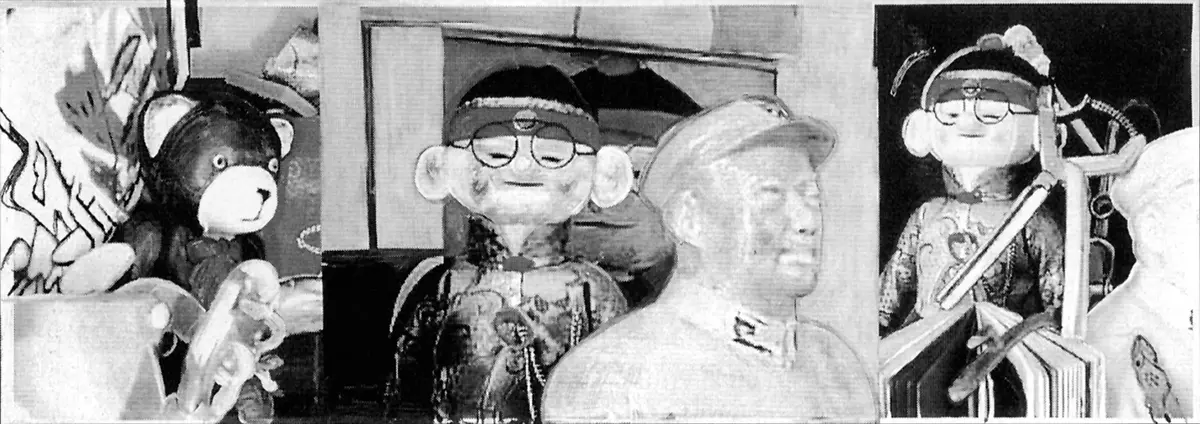
After Limoges (Manfredo de Souzanetto), Le Crestet (Ricardo Brey), and Montbéliard (Buenos Aires In and Out), just to mention three places, the French province has shown its enthusiasm and openness toward Latin American art. Inaugurated in 1990, Bar-le-Duc’s acb is a mixed institution (state, county, and local organizations) whose objectives are geared foremostly to the promotion of contemporary theatre and art. Central in its policies is the search for new audiences, as well as its willingness to decisively support young artists. Together with Nils Udo, Gloria Friedman, and Jean-Pierre Raynaud, the acb aspires to widely promote emerging creative expressions like those of Argentine Julieta Hanono, who the institution commissioned to do an exhibition with an accompanying video. Having lived in Paris for more than ten years, Hanono has worked primarily as a painter, though she has ventured quite successfully into urban sculpture (All That is Solid at New York’s Socrates Sculpture Park in1998, for example). A frequent visitor to the studios of Felipe Noé and Antonio Seguí, Julieta Hanono has for a long time assumed the pictorial inheritances of strong narrative and expressionist personalities, from which she has been able to distance herself just recently. The progressive regression of these influences has allowed her work to open itself to other universes, styles, and materials, and has led her to formulate a new discourse. But Hanono’s past—her adolescence in Argentina of the dictatorships—as attested by the virulence of her pained memory (and work), sends contradictory images alternating between violence and sweetness in a continuous and inevitable creative feedback. The show’s scenography, which has a linear sequential montage as its axis, can be read as a comic strip or a storyboard without text, where only the image has the word. The technique and regular format of the pieces stand out while one apprehends the work as a whole, facilitating this continuity of meaning and form by introducing a flexible reading—thanks to the artist’s and the museograph’s options. The reworked photograph is her main support, which the artist has pasted onto aluminum plates and then blown up or pixelated. Hanono intervenes with great liberty, using her paintbrush to cross-breed numeric and traditional photography with painting. The artist also works on the notion of time, since she uses old works (paintings), which she photographs and reintroduces in the new pictorial space at the desired size. In terms of form, this work on the material grants her a great degree of liberty of tone and execution. But it also acquires a true meaning over the content, which can be linked to the artist’s double identity as a mother and political activist. Hanono has always conceived her work as the liberation from deep anguish. An answer to her doubts, a questioning integrated into a living thought disguised as metaphor or poetry or as a more direct language with explicit images. But always an act of balance, a constructive duality that allows her to look for what’s hidden at the bottom of herself and then exorcise her inner torments and liberate their underlying tenderness. The artist seeks to escape from her dark side and at all times look for the light —the two sides forming her as a human being and as an artist. The Young Dionysus is oriented toward the meaning of this structuring duality. But it also works towards an ambiguity that reveals the essence of her artistic energy—that which moves or shakes her—pushing her forward from doubt to hope. Hanono paints a cruel world, so as to keep it at bay. She describes it with numerous aggressive details, utilizing emblematic instruments such as the scissors, the revolver, the family utensils (used as tools of torture), showing severed or dismembered body parts (teddy bears), a porcelain doll, mutilated, cracked, or broken altogether. She also resorts to the introduction of frightful characters, such as the “cute” piglets wearing ties, and their hair combed, as if they were inquisitors, executioners, or henchmen. But amidst this chaotic and unsettling child’s world comes a ray of hope. On several occasions, an enigmatic figure appears at the center of the image, a benevolent witness, a sort of professor Nimbus or Sunflower, tender and surprised, an adult and at the same time a child, a witness or a voyeur, a participant or a philosopher. Perhaps Julieta herself is in the middle of her own story. Through Dyonisus, that double god represented by happiness and drama, Hanono identifies herself with freedom, happiness, and supreme inspiration. The artist combines the figure of the child (referring to her own children) with her own childhood, propitiating an ambiguity in which both brutality and sublime feelings express themselves. The child is deified by the artist as a sort of tribute to femininity derided. In this violent side of sweetness, by specifying her conceptual intentions, shrinking in space the image of a fragmented esthetic discourse, and accentuating the dynamism of color, the artist has reinforced the iconography and the form’s explicit density by means of over-impressions and the game of doubles. She seems to be less involved in a purely aesthetic challenge than a way of being before her own story. She searches inside herself, then adapts and recomposes. Her strength lies in this shining narrative discourse in which she permanently mixes her past and present. A metaphor for today’s world, this juxtaposed vision of two worlds (cruelty and innocence) is a visual manifesto whose reason for being is happiness and whose justification is time. In the gilded book at the show’s entrance, the public speaks of “obsession, perturbation, introspection, drama, madness…” but they also mention “light, warmth, the sun,” referring to the feeling at the heart of a body of work that knows how to joyfully communicate the permanence and the fragility of all things.
CHRISTINE FRÉROT