Fundación Provincial
Though sculptor Lía Bermúdez has had only a handful of solo shows her work deserves attention. Since the 1980s, Bermúdez’s creations, revolving around the concept of spatiality, have garnered attention thanks to their semi-curved, expansive planes and strong primary colors. As early as 1976 Hugo Figueroa Bret pointed out that Bermúdez’s work was recognizable for its “levitating character, its simple, composed wings . . . what we have called her butterflies.” Certainly, the artist’s work refers back to Nature, particularly to the figure of wings, but it also approaches spatial rhythms, lines, planes, light, and shadows, in structural terms. Shadows are a fundamental element in Bermúdez’s sculpture, and perhaps this lightens their physical presence. Even though her pieces can be large, 1.5, 1.8, or even five meters in length, and made of welded iron, they seem light. They are light.
The concept of flight is associated with these works. The flight of natural elements, like a bird or a leaf, which are synthesis, or concept, rather than figurative form. For Lía Bermúdez, matter is winged form, form drawn and lifted.
El vuelar de la materia (The Flight of Matter), a show of 12 pieces by Bermúdez at the Fundación Provincial, offers a good opportunity to consider the role of geometry, color, and iron in this artist’s work. Her pieces hang from the ceiling, stick to the walls, stand alone on the floor, and only the smallest [for instance, Roja Vertical (Vertical Red)], 100 x 60 x 30 cm) have a base.
Bermúdez’s pieces tend to be bodies in two or more parts, with just one of the ends functioning as a base. Bélgica Rodríguez, writing in the show’s catalog, is right in saying that “there is no theme” in these works. Everything focuses on the very fact of volume and its ability to move in empty space. In fact, the very titles of some of Bermúdez’s works, such as Inventando el vuelo (Inventing Flight) and Horizontal azul (Blue Horizontal), suggest bodies in elevation. The artist achieves this effect using planes and triangles (some acute, some obtuse) in which figures are devoid of rhetoric and gain value thanks to their own qualities.
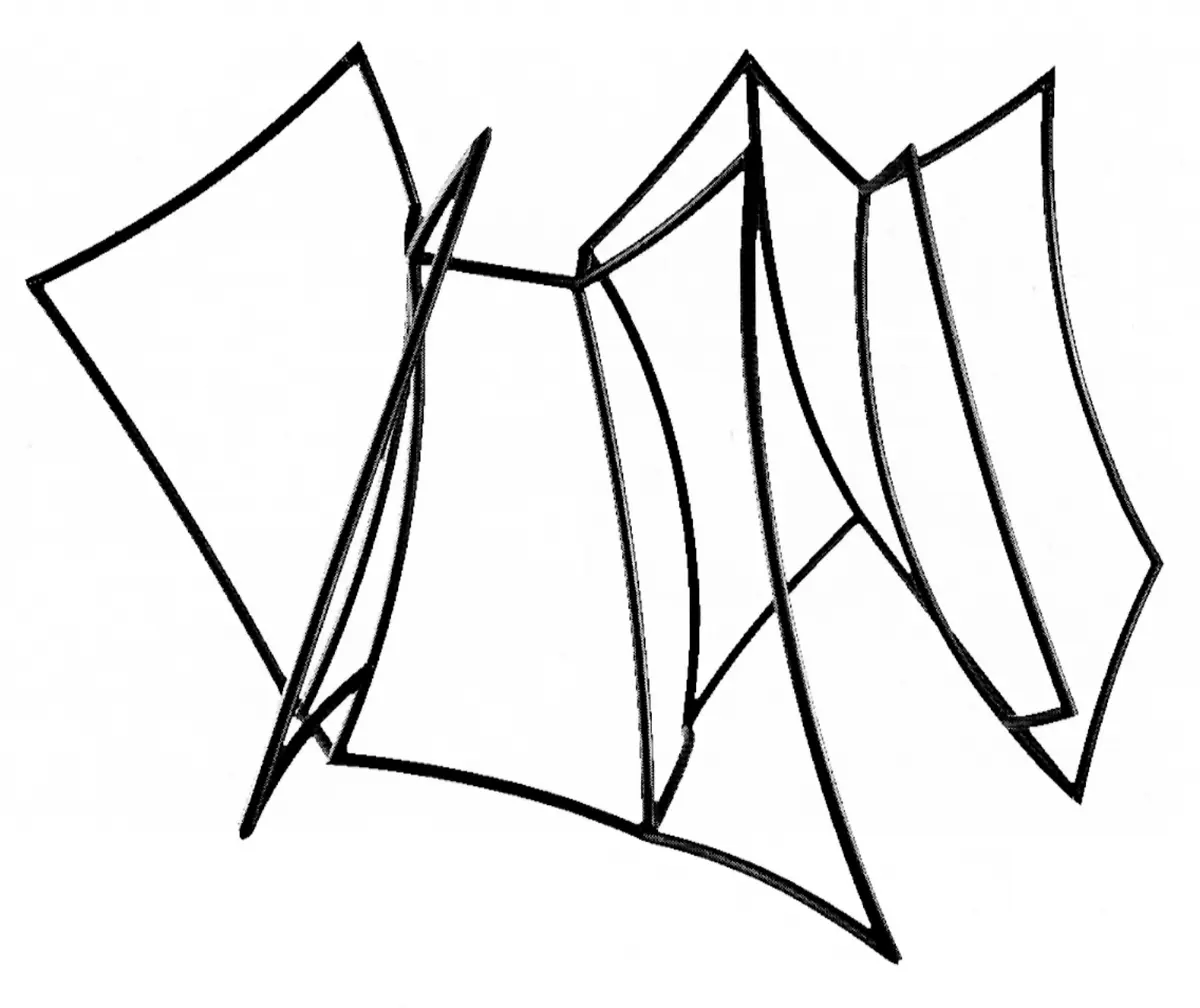
Two pieces in particular stand out from the rest. First, Petrolia, an invented word referring, perhaps, to petroleum (we need to remember the artist hails from Maracaibo). Petrolia is a dark sculpture in several shades of black and presents in its center a semi-circular body maybe related to the figure of a tower. Then there is Dibujo en el espacio (Drawing in Space), which denotes even more profoundly the sensation of emptiness, of intertwined forms and, in this particular case, of conceptual sculpture; without its characteristic body, this piece remains alone, and alone it chooses and presents its constitutive lines. Thus, this work experiments with itself, and goes in search of new expressive paths.
JUAN CARLOS PALENZUELA