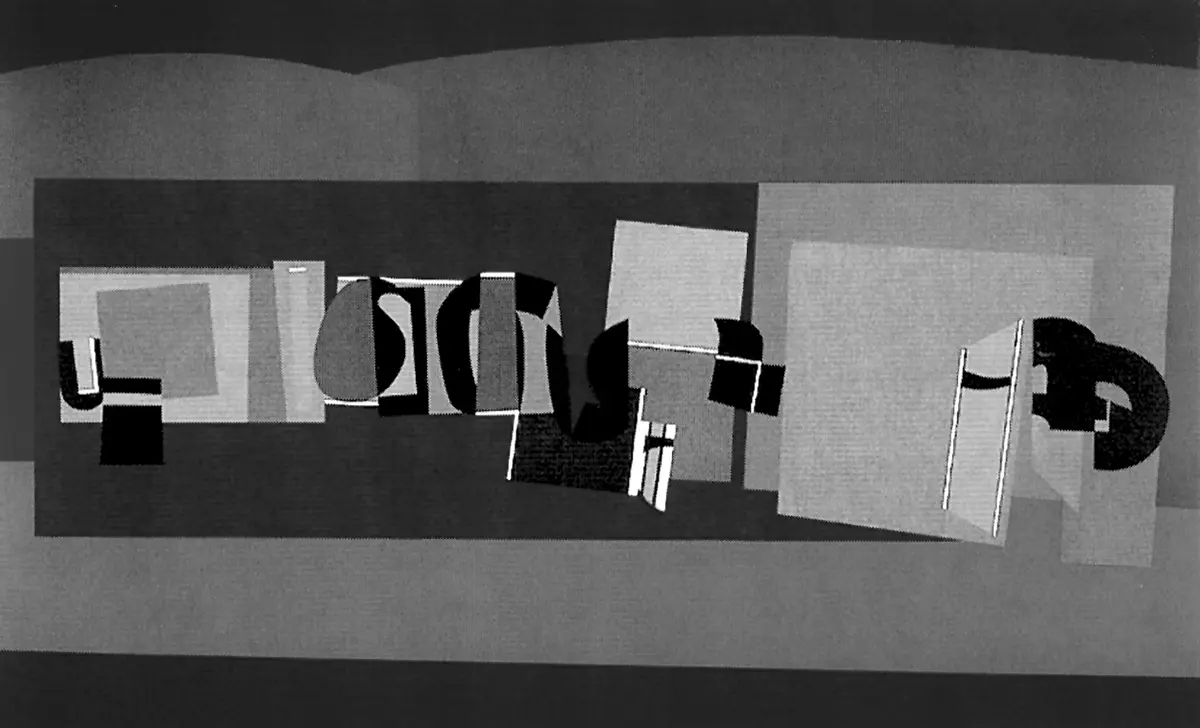
The Alejandro Otero Museum presented last November 26th an anthology of Mercedes Pardo’s work. Thirty paintings, ranging from abstract pieces from the 1950s to her most recent work, are grouped in two large museum halls. We are greeted by an epigraph by the artist herself, which reads: “I would say the path of an artist is made not of searching, but of finding…” This sentence is, indeed, a clear indication of what Pardo’s artistic development has been.
Having studied in Caracas, Santiago de Chile, and Paris, France, Pardo has always explored the possibilities of color. Already in her earliest works, one appreciates the impulse to make chromatic surfaces the protagonist of her art, an exercise made more effective by abstraction. In many of her pieces, color planes are saturated and contrasts are truly radical. Pardo’s palette is unpredictable. She achieves peculiar atmospheres; even in her bolder paintings, we notice the dialogue between saturated colors and more opaque tones, or even between varying degrees of the same tone. We are also faced with strange, unusual combinations. Looking at the colors before their application we could think such combinations impossible.
Pardo’s command of color, however, allows her to run such risks, since she understands contrasts, harmonies, and atmospheres deeply. Her pictorial proposition tends toward a lyrical geometrism where elements are less volumetric, and in that sense her work is neither orthodox nor rigid. In fact, it could be said that the artist offers the viewer a gentle interpretation of geometric abstraction’s great principles. In that polychrome game, planes are displaced on their axis and the predetermined order suggested by the representational canon is broken. Oftentimes, the fragmentation of volumes rises to the level of the organic; in that sense, harmony gains space to detriment of mere geometry. Color trumps everything. It cannot be tricked and it always gets what it wants. Therein lies the magic of Mercedes Pardo: she explores the insides of the chromatic circle, she demands from color the full deployment of its possibilities and puts it to work in the service of her marvelous paintings.
The professional staff at the Alejandro Otero Museum has done an excellent job with the exhibition. The works selected for the exhibition summarize fifty years of creative labor, without giving in to the understandable temptation of including too many pieces—quite a challenge, and a good example to follow, particularly when dealing with artists with an extensive oeuvre. The Mercedes Pardo exhibition is in that sense a treat for the visitor, with a classic, elegant mise-en-scene and a museography that respects the canvas, allowing for a direct and fluid appreciation of this important artist’s trajectory.
ANITA TAPIAS