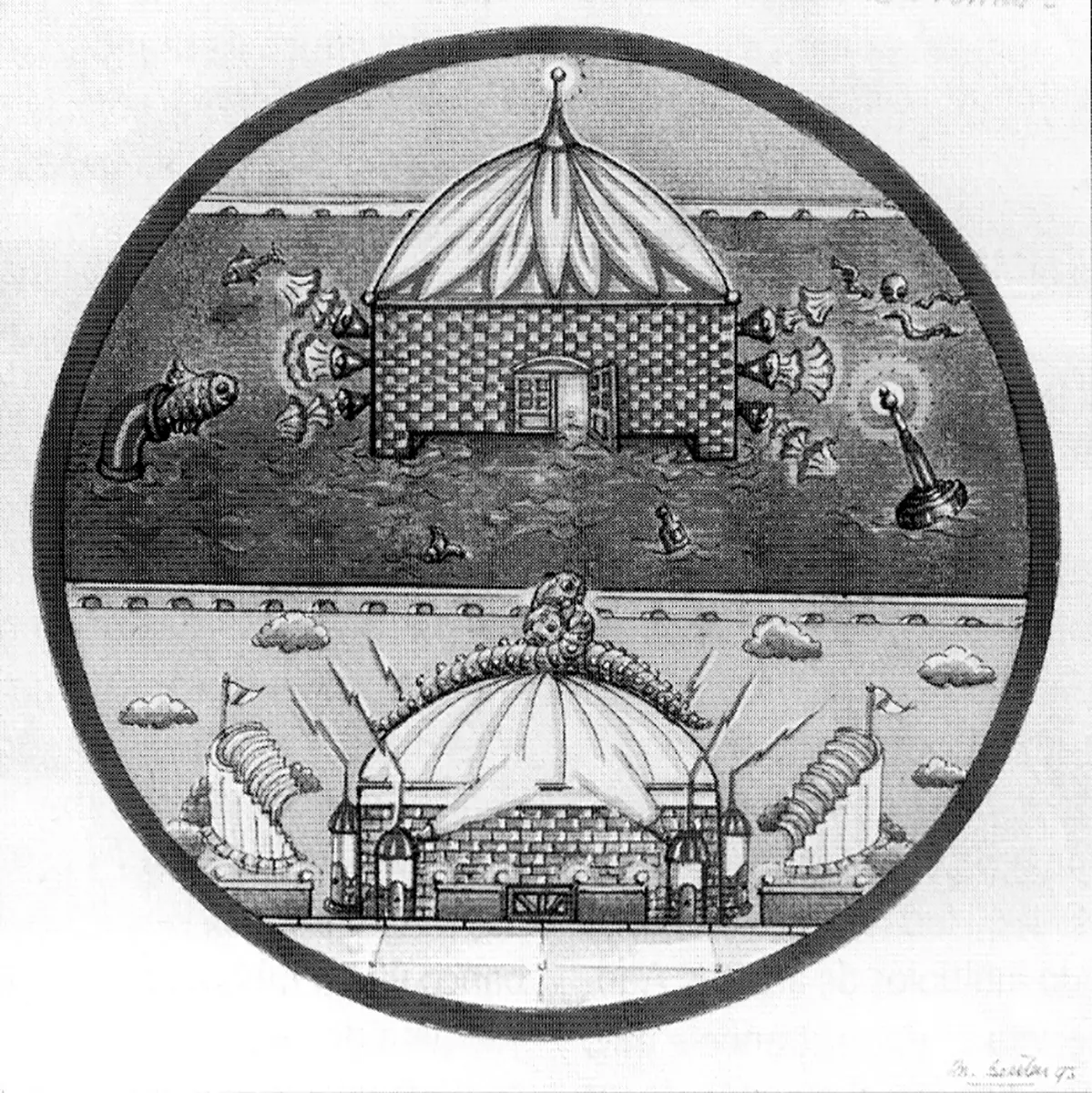
Perhaps due to the fact that her name is not associated with the legendary Instituto Di Tella, the center of the Argentine avant-garde thrust of the 1960s, Mildred Burton is not sufficiently recognized today for what she really is: an authentic pioneer of conceptual art. Gifted with an amazing imagination, and armed with an acidic sense of humor, Burton (Entre Rios, 1942) has multiplied her natural artistic talent into drawing, painting, and engraving. The Museo Nacional de Bellas Artes, whose contemporary collection holds some of the artist’s “family portraits” (solemn faces altered with sinister elements), has invited her to show a selection of works she has named Proyectos y proyectoides (Projects and Projectoids). It’s a group of supposedly architectonic drafts in which the artist shows her habitual mordacity. These apparent contributions to the urban landscape insinuate themselves as a satire of the social organization controlling the good operation of cities, the corporate side implicit in all institutional structures, and the microphysics of power (to use Foucault’s term) and the way it manifests itself in the rules of daily life.
Each project is composed of images and text. Burton draws her buildings/artifacts with millimetric precision and in very small format, then writes down their descriptions on cards. On one of them, we can read: "Habitat for collecting, reducing, and controlling the country’s gold. Possesses a great ingot in constant boiling point, receptor of the liquid gold. Inhabited by 'The Great Economist' equipped with a sampling spoon, ministerial chair, telephone, and briefcase. (...) Has a set of antennas to emit high or low sounds, depending on the nature of the crisis." Filled with invented creatures and unusual nomenclatures, the clearly literary tone —her love for fiction has been pointed out many times—belongs to Borges’ classifications. Always making fun of technical terms and the pretentious formal complexity of “experts,” she creates an elaborate machinery of political criticism out of her art. Her gestures of resistance, subtly screened through a lucidity present in all her works, is atypical among her generation’s local artists, who many times oriented their efforts towards a pamphleteering that Burton, with her amazing wit, has succeeded in avoiding altogether.
The images adopt a seemingly archaic style, establishing a kinship with old maps filled with fantastic creatures imagined in scientific terms. As any of those sailors would do back then, but today submerged in the urban seas, Burton painstakingly diagrams a territory and its monsters, known or otherwise, without neglecting the smallest trim or decoration. In one of her prints, she produces a device that recycles the “ugly, gray, and sad characters” of the huge office fauna treading the streets of Buenos Aires’s financial district. The whole series points against the imperatives of order, routine, and boredom.
Some of the projects included in the show have been submitted to public contests. Others were boxed in bureaucratic offices, and never realized their highly conceptual contents. To make this show, the artist had to track down several personal papers that got lost in the limbo of the very same control society they parody. In any of their expressions, the devices for collective subjection have a central place among the artist’s preoccupations, who’s decided to ridicule them in order to neutralize their all-pervasiveness. Can it be said then that a “delirious” impulse runs through her work? Yes, but only when we ratify her digressions in relationship to the logic of predictability and correctness. In her efforts to put in evidence the web of horror and absurdity in which we are trapped, Mildred Burton’s works overflow with lucidity—a fact vouched for by the selection of projectoides.
EVA GRINSTEIN