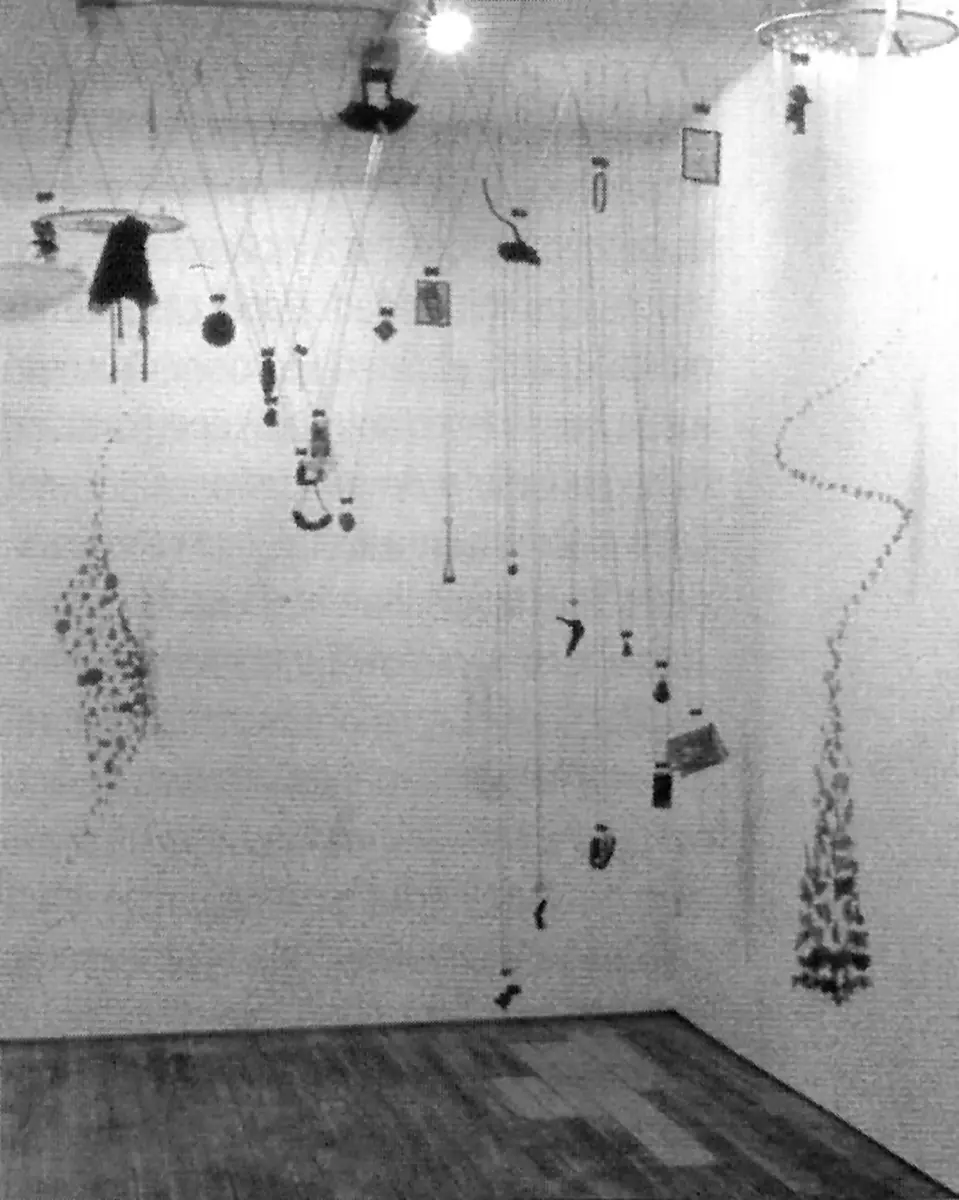
Milton Rosa-Ortiz’s installation Objects of Desire, 2001, was created with audience participation on opening night. He reversed the usual roles, the viewer became a participant and the work of art existed only after the audience “created” it. Sixty-six individuals from throughout the world were asked to bring their “object of desire,” which he suspended from blue chords hanging from the ceiling, one item after another in precisely calibrated, parallel blue arcs snaking through the gallery into the hallway. It loomed overhead like the ribcage of a beast. Rosa-Ortiz united the disparate objects that ranged from Playboy magazine and lingerie to an orange, a sand dollar, a chocolate bar, and a tooth, by using the color blue. Non-blue items were painted or encased in blue plastic. Finally, the individuals who contributed their desired objects were told to wear blue underwear to the performance and were encouraged to don translucent painter’s coveralls at the gallery. They then became “objects of desire” with their blue underwear revealed suggestively. Little is left to chance in this artist’s precisely orchestrated creations as demonstrated by his Vieques is Burning sculpture series. Rosa-Ortiz was born and raised in Puerto Rico and these pieces—painstakingly constructed mobiles of broken glass found upon the Vieques beaches—are jarring but hauntingly beautiful testaments to the island’s current state. Each mobile extends vertically six feet and contains over 250 transparent lines, each holding a piece of broken glass. The shards hang in an astounding order displayed in Map, Vieques is Burning I, in which each piece is plotted on a diagram superimposed over a black and white aerial photograph of the section of Vieques that is occupied by the U.S. Navy. In the sculpture delineated by the map, Vieques is Burning I, the shards are milky in tone, their edges softened by the sea such that the mobile appears like a gentle cloud of translucent shapes that taper off in tiny fragments to the floor. A delicate curve of pale green shards cuts across the soft mass of white on which shimmers a single chip of amber glass. Vieques is Burning 3 is a rough but enchanting mobile that incorporates jagged brown shards that create a swath of brown with scant few pieces tapering off above and below, like wisps of smoke. Hanging parallel to the brown mass, a delicate trail of pale, blue-green glass sprinkles to the floor. Rosa-Ortiz’s sculptures, despite the warnings emblazoned on the gallery walls, invite one’s touch with their ethereal beauty. It is precisely the marked contrast between the delicate image of cascading glass and the danger posed by the shard’s sharp edges, that the Vieques series addresses. The tranquil beach community harbors hazards wrought by the U.S. naval presence, just as Rosa-Ortiz’s sculptures convey the surface beauty but physical danger encompassed in their fluid but lacerating forms. Rosa-Ortiz’s fastidiously constructed façades, belie the complex ties behind them, in terms both technical and thematic.
MARY SCHNEIDER ENRÍQUEZ