
The work of Patricia Belli (b.1964) is registered within the context of postmodernity, where a linear history of art no longer exists, where the freedom to develop a style inspired by the art of any period is normally accepted, where there are no restrictions when it comes time to adopt any handmade technique, as well as other themes, materials, or techniques not related to “high art,” high culture, or the culture that is traditionally imposed upon us.
Like its historical context, her work is highly multidimensional and versatile: she is a drawer, a painter, a sculptor, a user of assemblage, and the creator of surprising installations. Through the work of art, she faces the ethical and aesthetic problems that concern contemporary art in a world where everything seems to have been invented, and where the myth of originality has lost its grip. But she also draws, paints, and sculpts in search of her own identity. “Why does one write,” asks Eduardo Galeano, “if not to link pieces of himself?”
In a similar fashion, Patricia Belli seeks her female identity and the essence of things in order to link her pieces. The cultural and political conflicts that divided a generation of Nicaraguans in the 1980s find an echo in Belli’s work, but the form of expression is not tied to traditional styles. Her personal experiences and her aesthetic creed are represented with poetry, magic, and mystery through her paintings, sculptures, and installations. She presents in these pieces current problems such as violence, sexism, and the uses and abuses of power in order to involve the viewer and supply both reflection and participation, with the ultimate goal of establishing an active dialogue and questioning the traditional borders between the work of art and the viewing public.
The fact that she is an artist in the heart of a patriarchal society—like Nicaragua—far from becoming a limitation, has instead proven to be a challenge at the moment of assuming an attitude of protest in order to defend her female condition. She has refused to accept a passive role with respect to the dominant discourse centered exclusively on man as the creative subject. In this sense, Belli is one of the first Nicaraguan artists to rebel against the preestablished. She consciously explores the expressive possibilities in the representation of the human body, "not only as an instrument of perception but also as a space where the mechanisms of domination have exerted control."1 The body turned into a subject of resistance, is the bearer of new meanings and ceases to be that obscure object of desire.
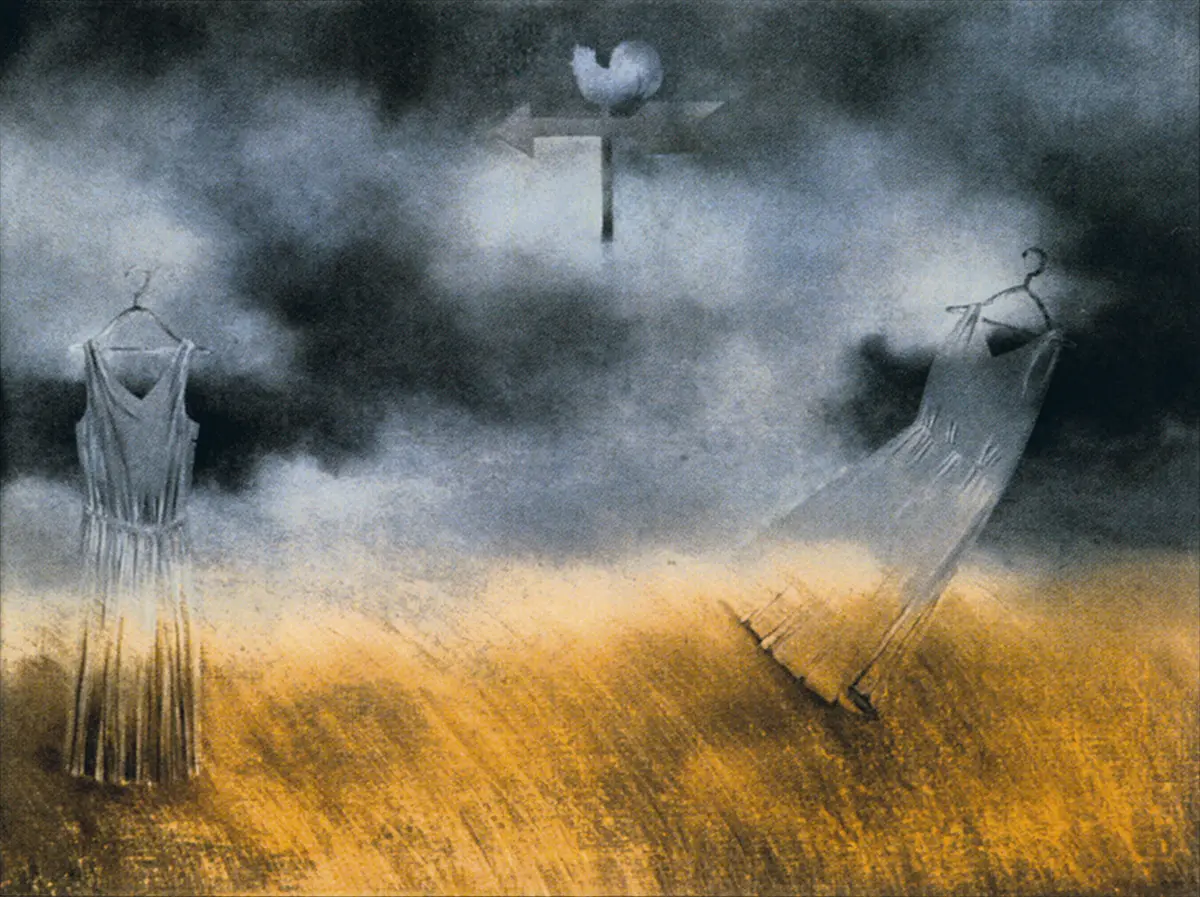
Tackling the work of this artist presupposes the examination and de-codification of the internal mechanisms of her artistic discourse through which—and without falling into the trap of hackneyed feminist rhetoric—she questions the phallocratic and monolithic reality that has conditioned art history, and particularly, that of Nicaraguan art. In order to achieve this goal, she begins with phenomenology and theories of perception as she considers that the human body is not only a biological structure but it also belongs to a culture and a time period. Of the possible messages and languages that can be developed based on the body itself, the dress supplies a wide array of meanings since it is the aesthetic object closest to the individual, the most immediate substitute of the human body as well as its second skin. Since 1990, this artist has used the dress to define a very concrete female iconography in which clothing becomes a container for self-definition and identification. One of her fundamental works, Traje y paisaje (Dress and landscape, 1991), refers to a symbolic figuration through two painted dresses. With the same security used by Frida Kahlo in painting Mi vestido cuelga ahí (My dress hangs there, 1933), Belli, in order to present the meaning hidden under the fabrics, uses these two dresses, one still and another blown by the wind, in order to express a new form of social communication through the garments. With the dress that floats, impelled by the wind, she alludes to a lack of identity inside a patriarchal society that establishes all norms of conduct. With the motionless dress, she conjures up the affirmation of female idiosyncrasy. The weather vane that marks the direction of the winds is a clear referent to male power, which determined the position of women in relationship to the dominant discourse, arbitrarily considering it as a symbol of caprice.
Through symbolic language, Belli firmly reclaims her own space, in spite of cultural prejudices. She thus understands the expressive value of clothing, and when she decides to use textiles instead of painting them, she openly questions the paradigms of representation by using the same values that the patriarchal society had decreed as exclusively female. The substitution of the painted object with assembled, sewn, mended, and embroidered clothing, which she initiated in 1996 with her exhibition Velos y cicatrices (Veils and scars), continued to be an open rebellion in the face of existent conventionalisms in Nicaraguan art. Her work transformed cultural myths by introducing women’s practices and points of view in order to question the cultural myth of creativity that had repeatedly been considered a prerogative exclusive to men.
The general cry of Patricia is sewing! became synonymous with the unusual almost turning into a stumbling block.2 It is through the tasks and labors (sewing, embroidery, weaving) to which women had traditionally been confined and relegated that an affirmation of the female body itself operates, inasmuch as it elevates those chores to the category of art.
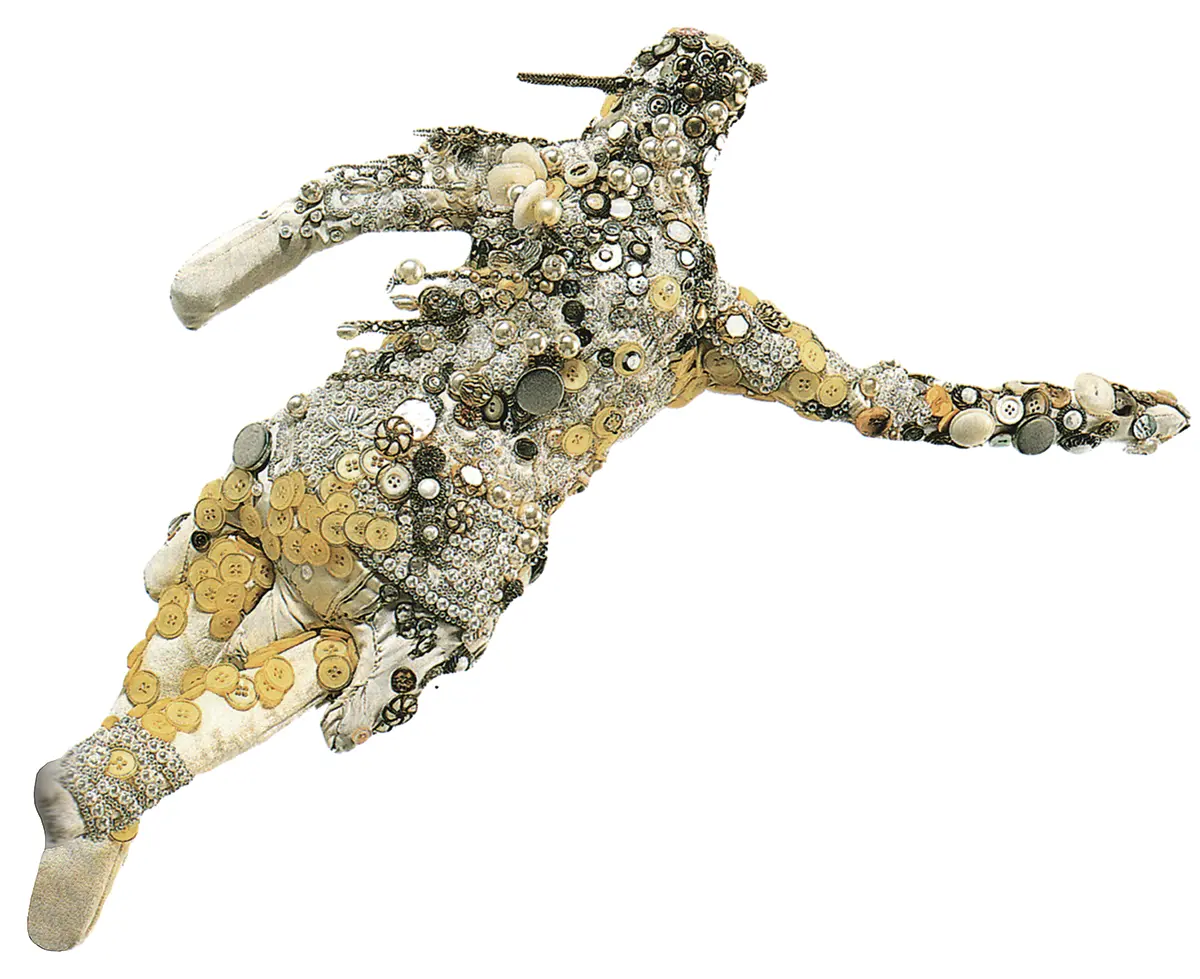
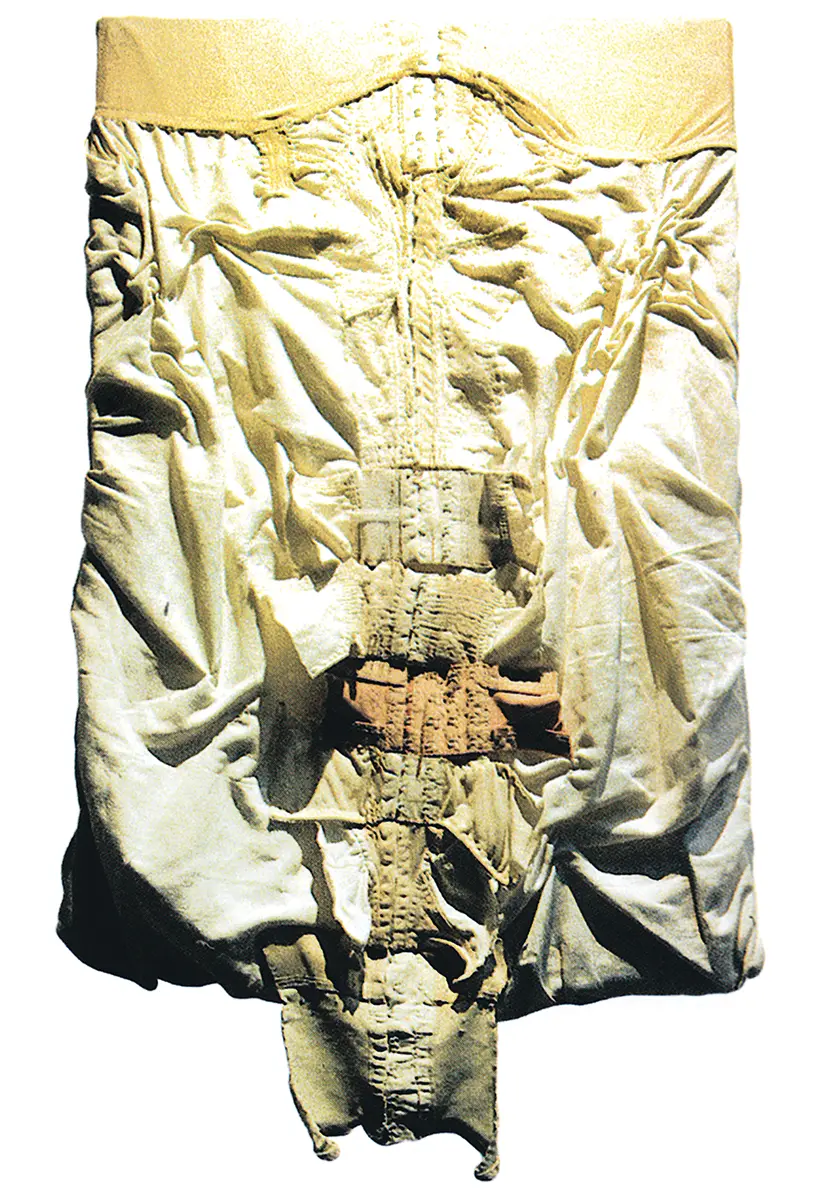
Scorning both paintbrush and oil, and with the help of a sewing machine, needle, and thread, Belli creates sculptures and installations that become an exploration of the body and of the intimate: love, pain, couple’s relationship violence, loneliness, fear, and dreams. Within this category, we find the Homenaje a Frida Kahlo (Homage to Frida Kahlo, 1996) in which she makes an exploration into her own vulnerability as well as pain, her own pain as well as the pain of others. The allusion to La columna rota (The broken column), painted by Frida in 1944, is explicit. The human body named through absence is represented by the gathering together of different female bras, whose discontinuous union symbolizes the fractured column. The variety of fabrics creates a diversity of textures. The fabrics that are overlapped conceal old scars, and the seams and repairs refer to the process of curing and healing. All of these images become an effective means of establishing her own identity, based on the determination of the identity of another.
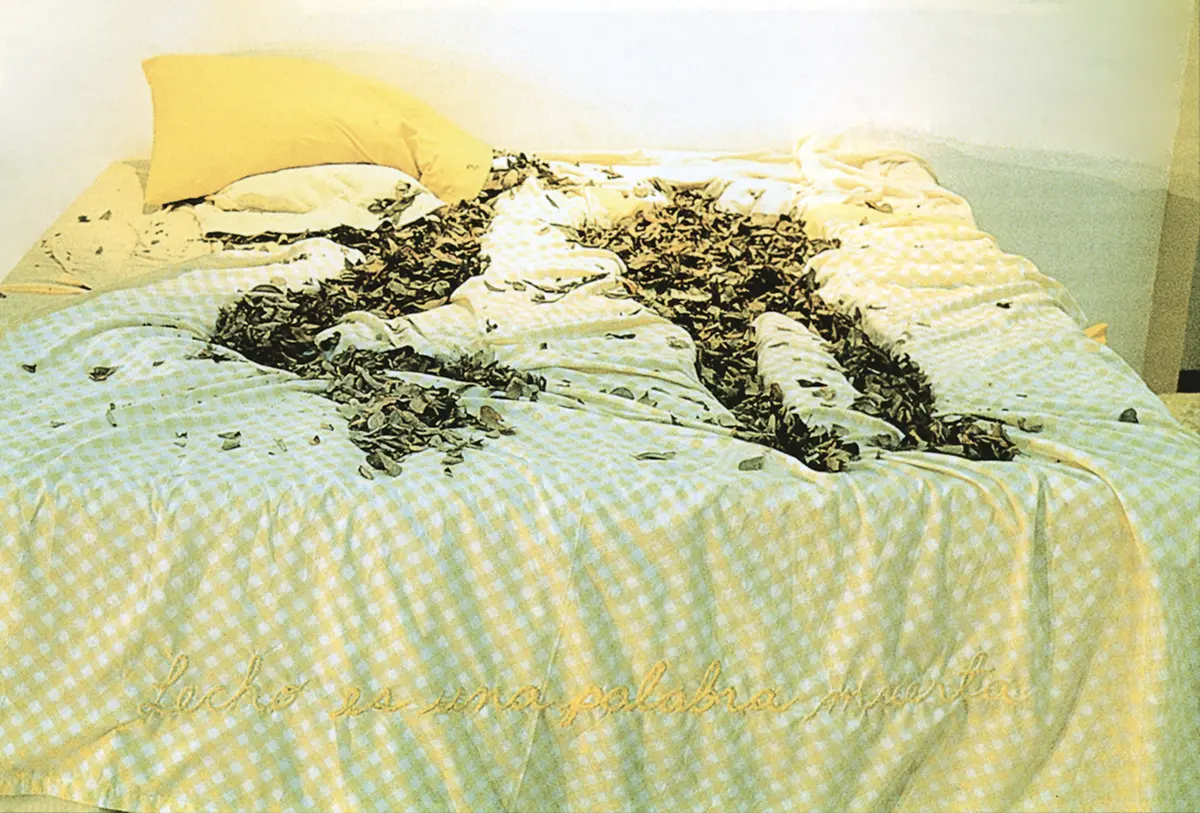
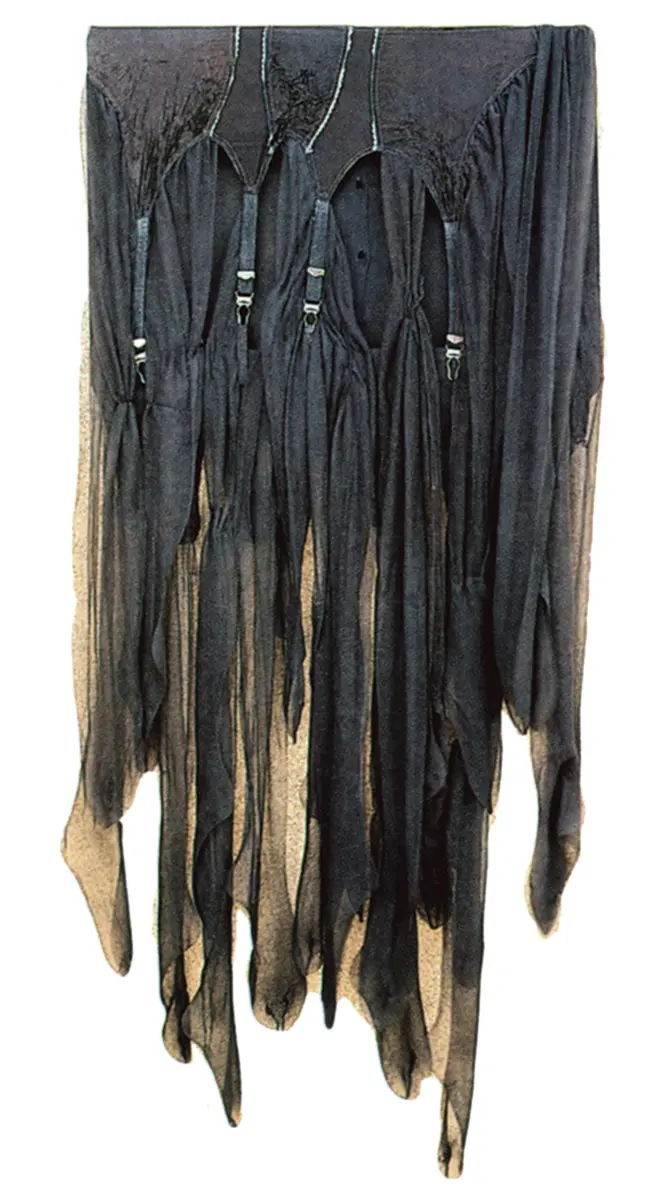
Making use of various expressive strategies, this artist supplies the couple’s relationships in works like Trampas (Traps, 1997) and Lecho II (Bed II, 1999). The stockings and garter belts, in the first piece, are clear symbols of seduction, and they bear an obvious allusion to the role of the woman as a lover since they are used with a liberating connotation, challenging a prudish and puritan moral. In the second piece— Through installation, she presents affective separation — metaphorically questions the illusion and reality of marriage or the romantic idea held of it.
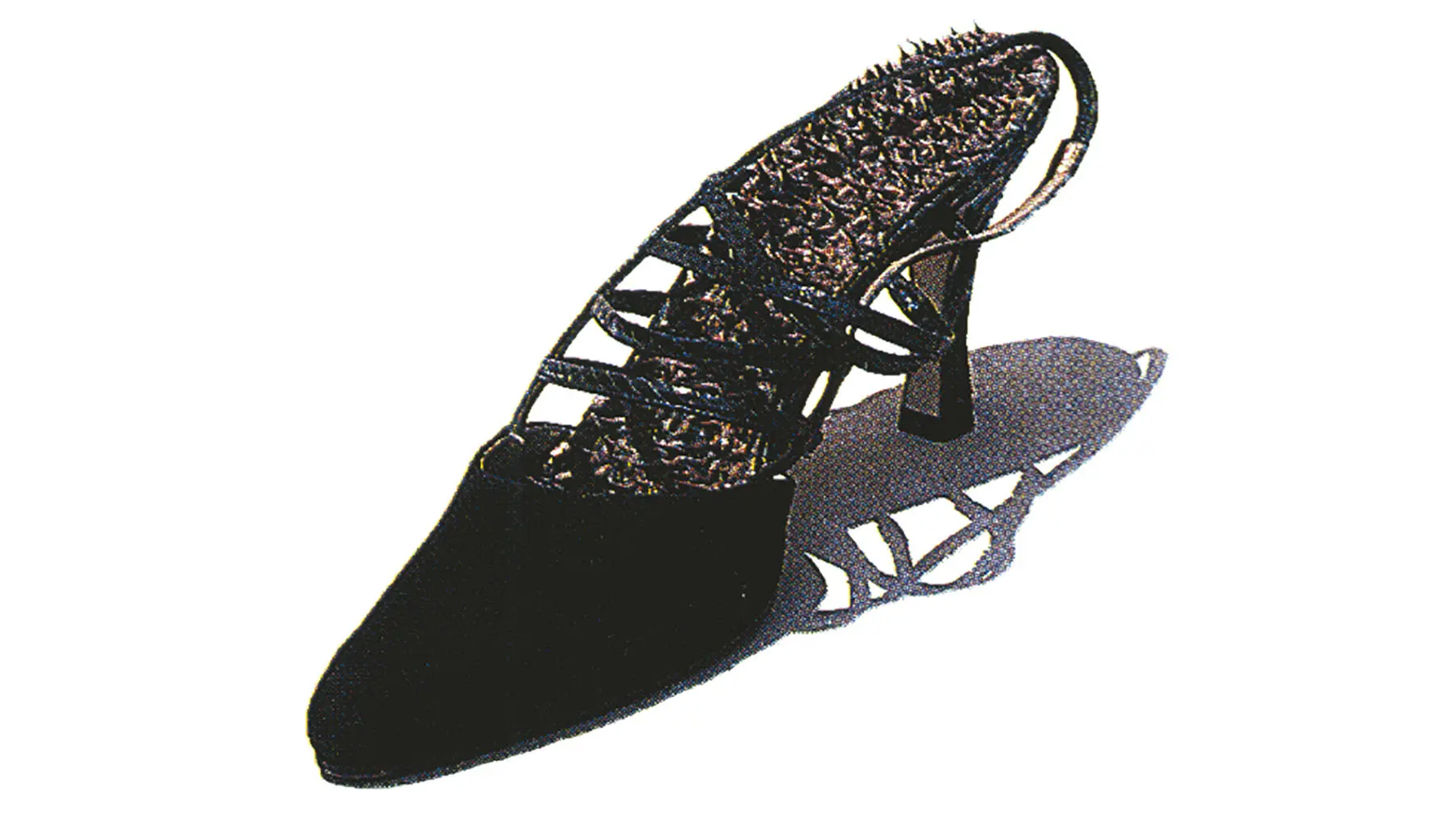
The contrasts of languages presented by the artist, rather than create a formal contradiction, formulate a new stylistic and conceptual focus in such a way that the fiber sculptures and installations share the space with the found, decontextualized, and transformed object in order to criticize the icons of femininity and to construct its own liberating discourse. Zapato (Shoe, 1998) is an example of the found object manipulated by the artist in order to refer to the cruel dictates of fashion where high heels turn into a sophisticated evocation of graceful walking. The thorns that cover the shoe’s lining materialize the discomfort and the high price of wearing a torture instrument that occurs both in a masochistic practice and as a symbol of adaptation and submission to the male gaze.
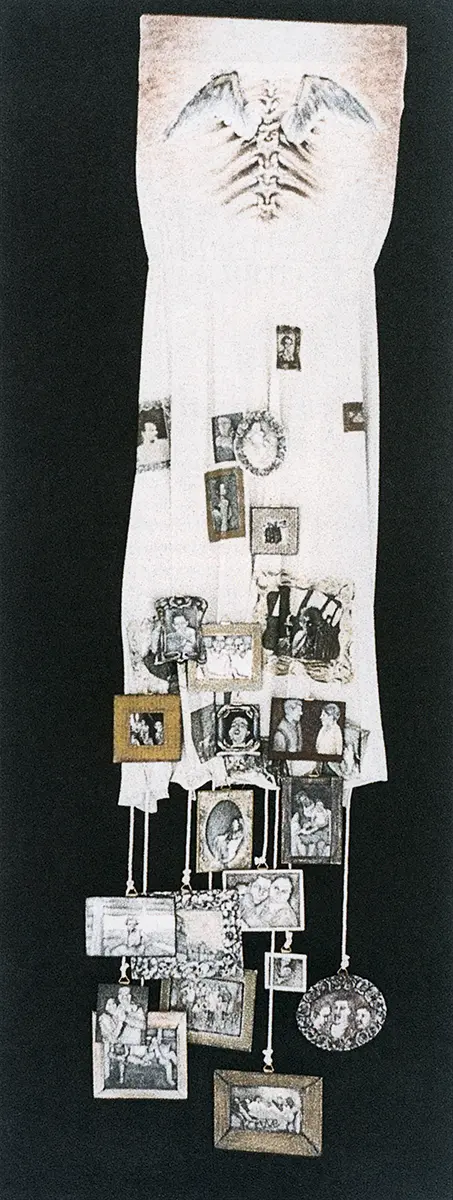
From the found object Belli turns to the painted object and chooses, as an expressive tactic, a garment that has been subjected to a process of transformation in order to restore communicability and overcome the borders between art and life. This is what occurs in Vuelo difícil (Difficult flight, 1999), where the dress, in addition to being a metaphor for the body, is also the garment that most appropriately represents us before the world. The transformation, in this case, departs from a cyclical process that began with the 1991 oil painting Traje y paisaje, taking advantage of the multiple meanings and associations that may be achieved through clothing. The dress, liberated from the oppressive law of the frame and of the secular tyranny of the stretcher, hangs freely like a bland sculpture creating fields of tension between strings, folds, and colors.
Thread, fabric, and painting turn into a metaphor that weaves and unravels different meanings. Through the accumulation of various languages, Belli reclaims her own space and uses most skillfully combined painting, photography, and electrographs in order to place us before her personal questions. On one hand, her particular reality and her inner struggle; on the other hand, the weight of memories, symbolized through photographs, hinder her from flying. It is an autobiographical piece that records her personal experiences, through which she claims her heterogeneous identity in spite of the pressures that surround her.
The criticism of cultural myths, especially the taboo of female sexuality, is clearly exhibited in Caricias (Caresses, 1997), where the veils that conceal and substitute the body become erotic containers of touch. The theme of a woman’s otherness, expressed through the different representations of the human body, has been centered on imagery oriented toward exalting her sexual difference and showing pride in her own eroticism and sexuality. As Luce Irigaray has pointed out in her writings, a woman finds pleasure in touch, and in Caricias the veils that subtly hide the body contribute to unveiling a de-alienated image of the female condition without abusing the stereotype of sexuality.
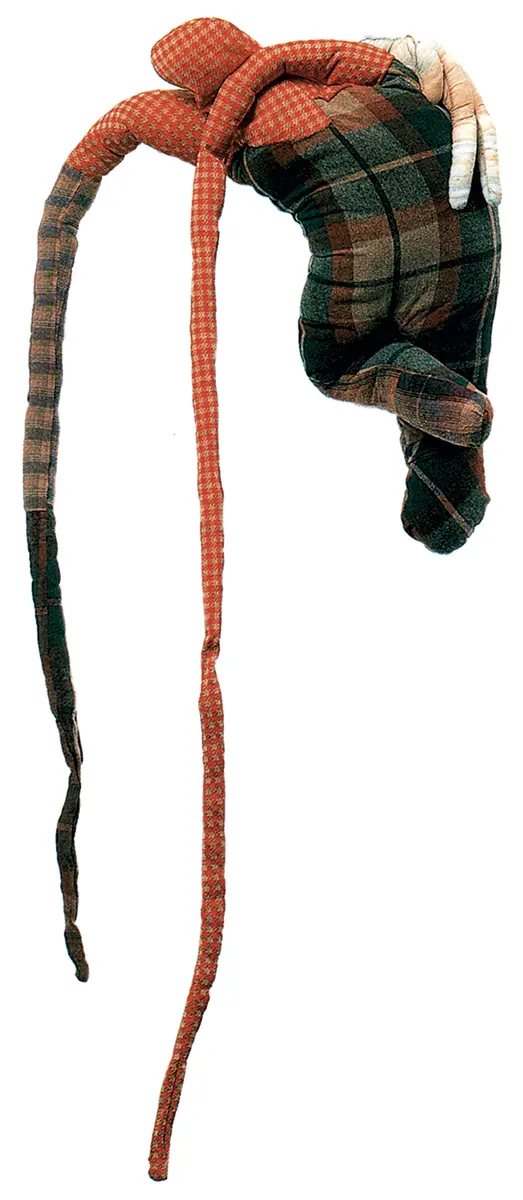
At the same time, she plays with the semantic wealth of the material—gauze, and latex hands—in order to transmit pleasant and sensual sensations to us. In her last two series, Muñecas de trapo (Rag dolls) and El circo (The circus), both from 2000, Belli formulates a dialogue between the characters of her oil paintings and the characters of her most recent installation. They are the same dramatis personae; what is different is the scenic strategy: in one case, painting, and in the other, textile sculptures. In El circo, through the installations and assemblages of dolls created with used clothing, the artist carries out an ironic criticism of the cultural symbols and myths, such as the myth of power, the myth of domination, and the myth of the instrumentalization of the human being. It carries with it a double claim: that of the fabric with sculptural material, and the creation of a new form of communication between space and spectator. These dolls held up and fastened with strings and pulleys, project shadows and gather life. They are also representatives of the fear and violence exercised by those who control power. Some hide their fear behind grotesque masks and, as in ancient theater, they incarnate states of being or loss of identity. Macabre creatures, tied up and repressed, are exponents of the drama of our time as they simultaneously involve us in their drama. In the artist’s own words, these dolls "personify the tragedy, the humor, and the precarious balance of the daily spectacle. The different attitudes of the dolls describe different persons: some tortured dolls passively hang from the pulleys, active acrobats manage to survive before the dangers of the spectacle; others disguise their pain through masks, and the bravest, at the limit of their strength, challenge the laws of gravity by walking on stilts. All of them, active or challenging, are dolls when all is said and done, and as such, they are objects of manipulation."3 In this case, the artist sounds out the bordering territories of art by appealing to a childhood imagination that undermines the traditional narrative, thus discovering the arbitrary conduct of adults. The transgressive nature of the signifieds also supplies multiple interpretations and meanings. The toys and rag dolls are something more than symbols of domination and mechanisms of resistance. They are also symbols of abandonment and displacement because after having been the object of love and affection, they wind up falling into oblivion. The only way to remember them is by making them present, by bringing to light the most hidden weaknesses of the human being and exposing their existential drama.
Navigating between the autobiographical and the supra-real, Belli achieves a discourse of great poetic and symbolic charge. On one hand, she presents the female condition by manifesting the ideologies that tend toward its concealment. On the other hand, she speaks to us of a situation of power and repression provoked by social systems based on authoritarianism. Through her artistic production, she goes against the grain in facing the stereotypes imposed by a patriarchal and colonial society in order to construct her own “I”, not only within the textual territory of the canvas but on the other territories; for art is never created in isolation, because it is an act of humanity for humanity.
NOTES
1. Artist’s statement, taken from the chapter “Influencias,” and conversations held in June 2000.
2. Many contemporary artists—just like Patricia Belli, and on the margin of the controversies raised—have explored representation through textiles, especially the dress. Such is the case with Argentine artists Silvia Gai and Nicola Constantino, Costa Rican Priscilla Monge, the Spaniards Elena Torrado, Antonia Valero, Elena del Rivero, and the North Americans Judith Shea and Regina Frank, just to name a few of the relevant names.
3. Artist’s statement on her most recent work, El Circo and Muñecas de trapo, after her exhibition at Artefactoría. Managua, June 2000.
MARÍA DOLORES TORRES