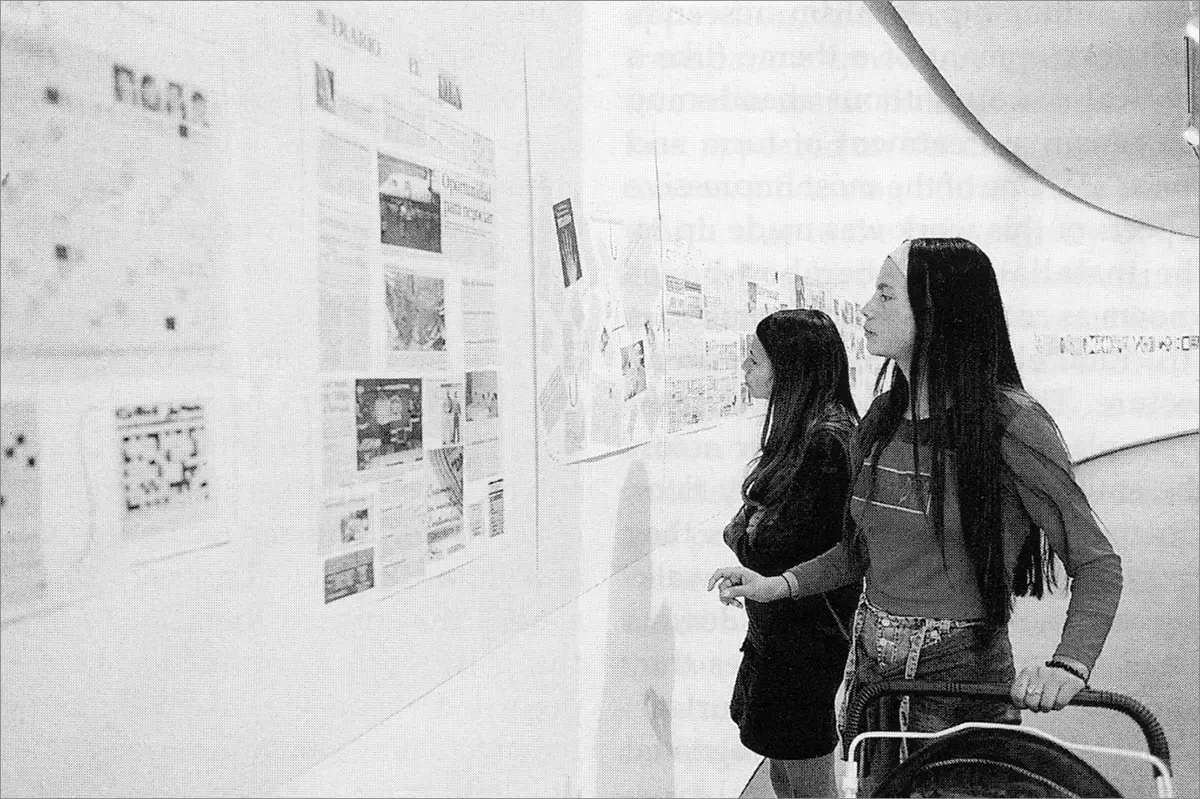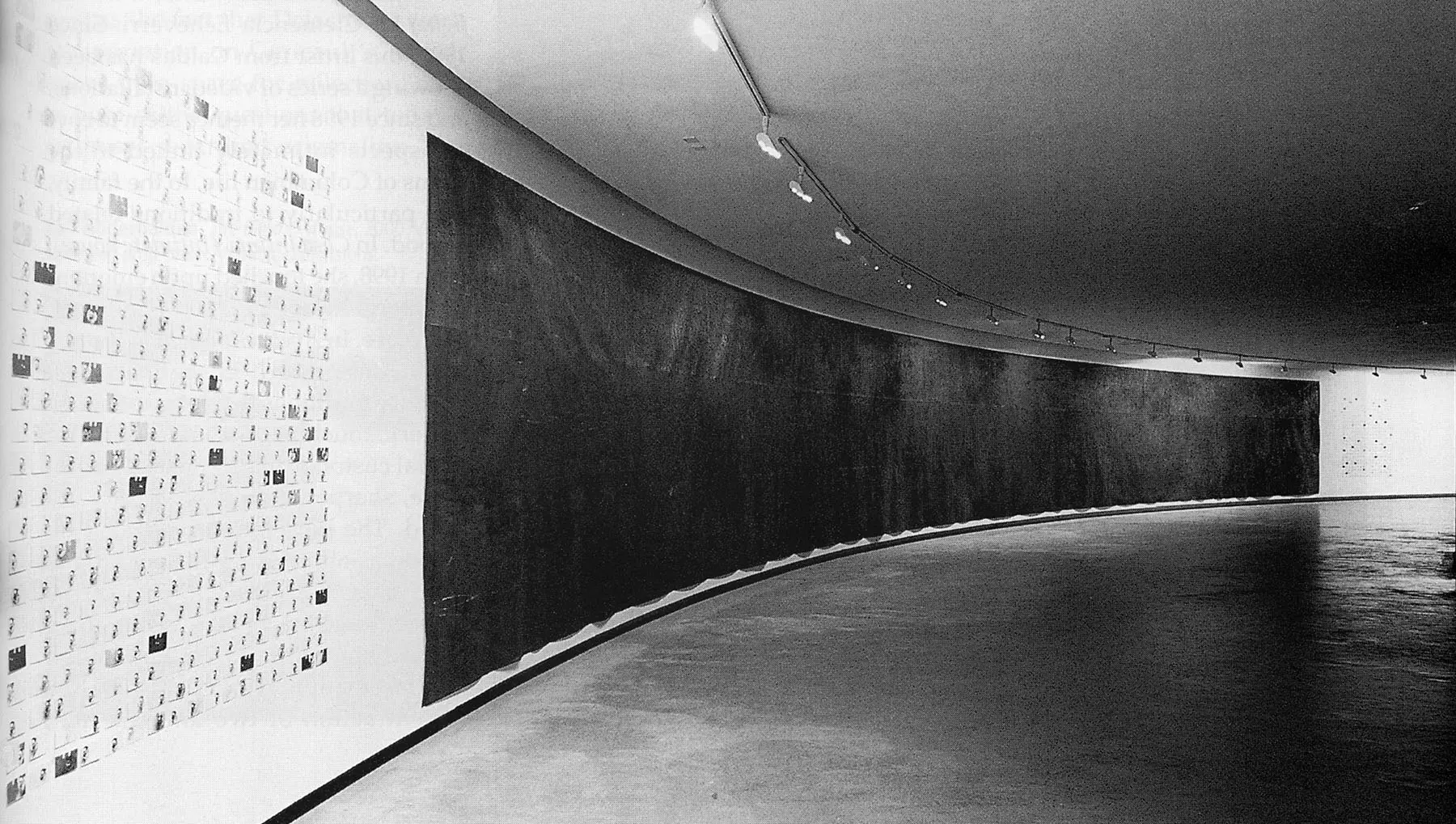
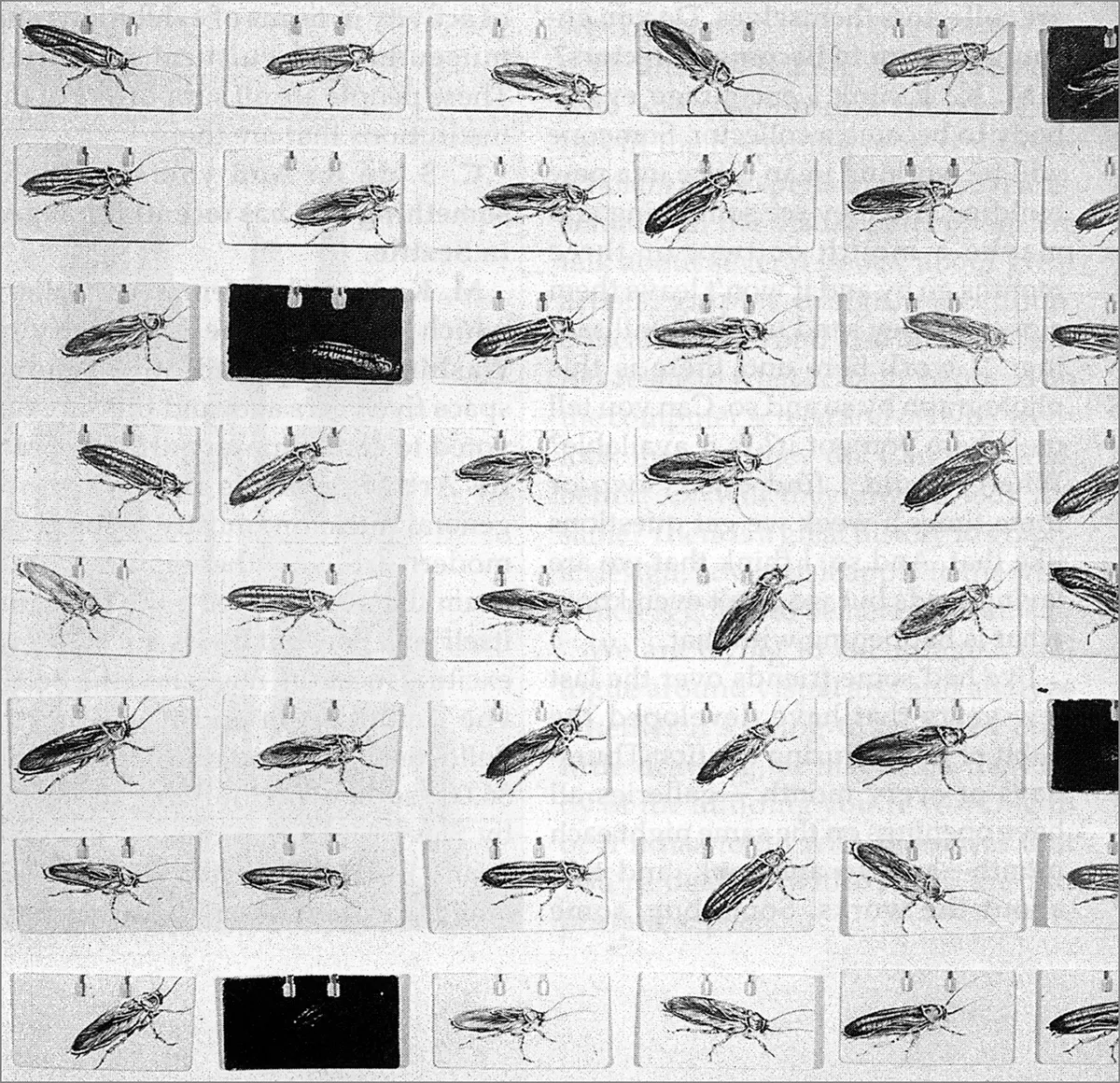
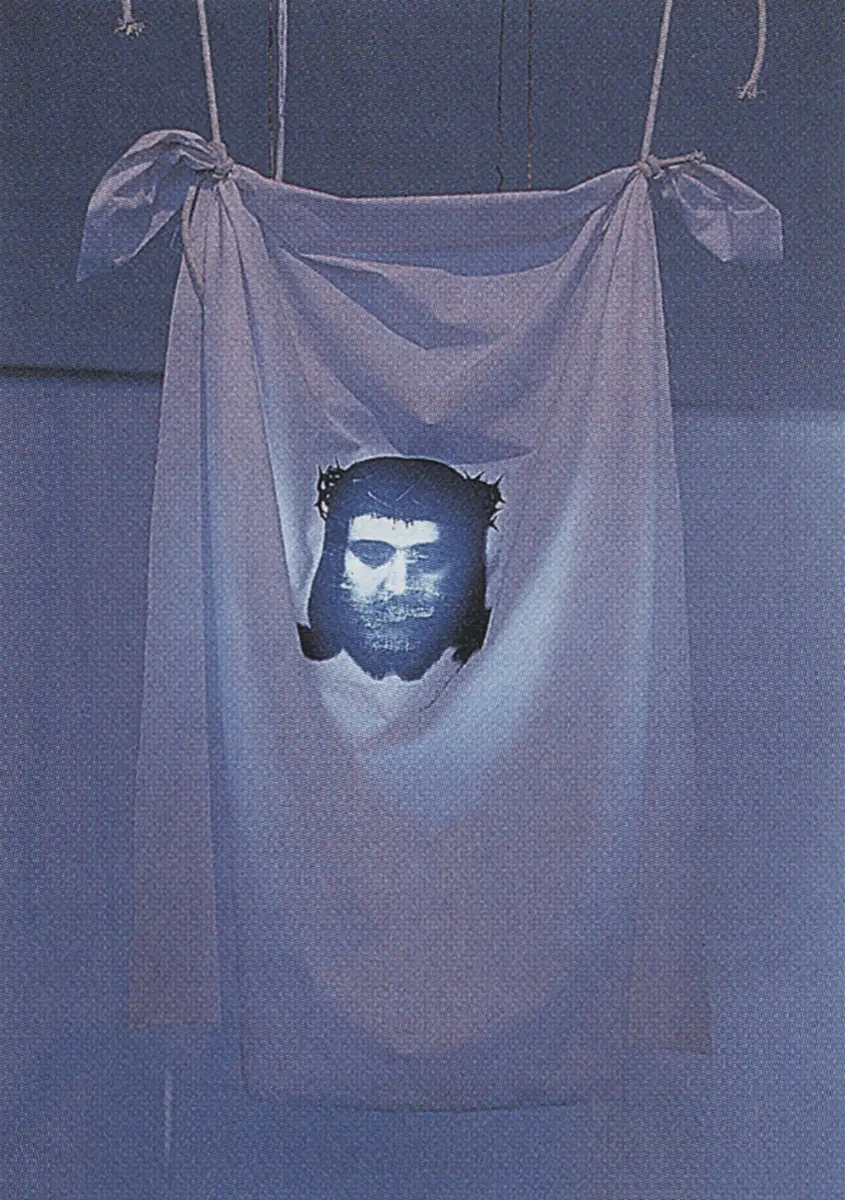
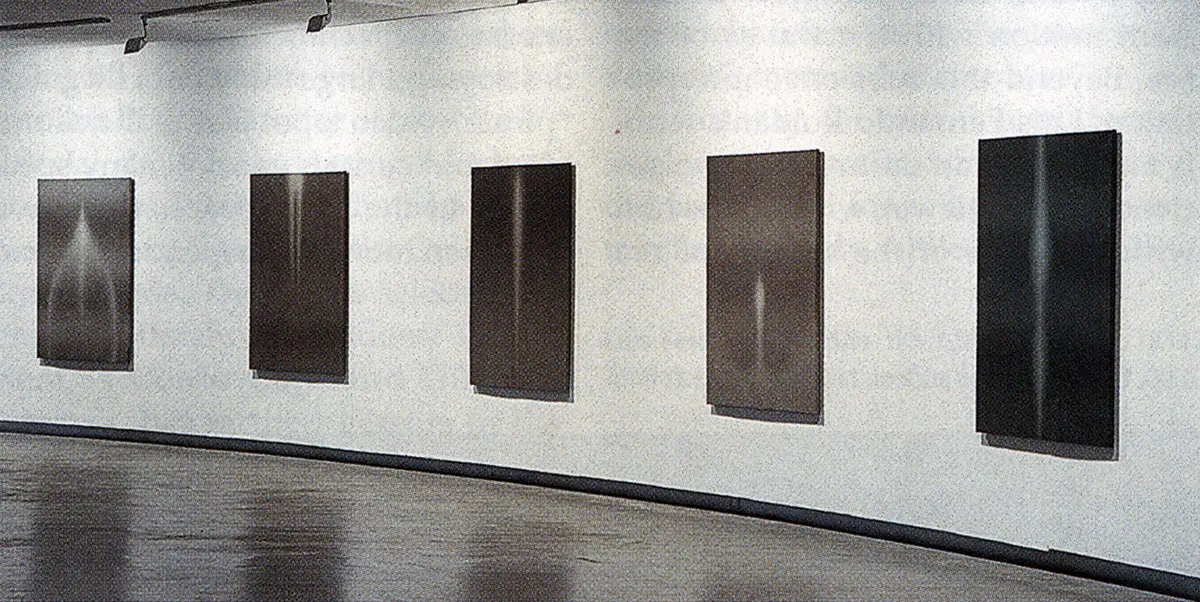
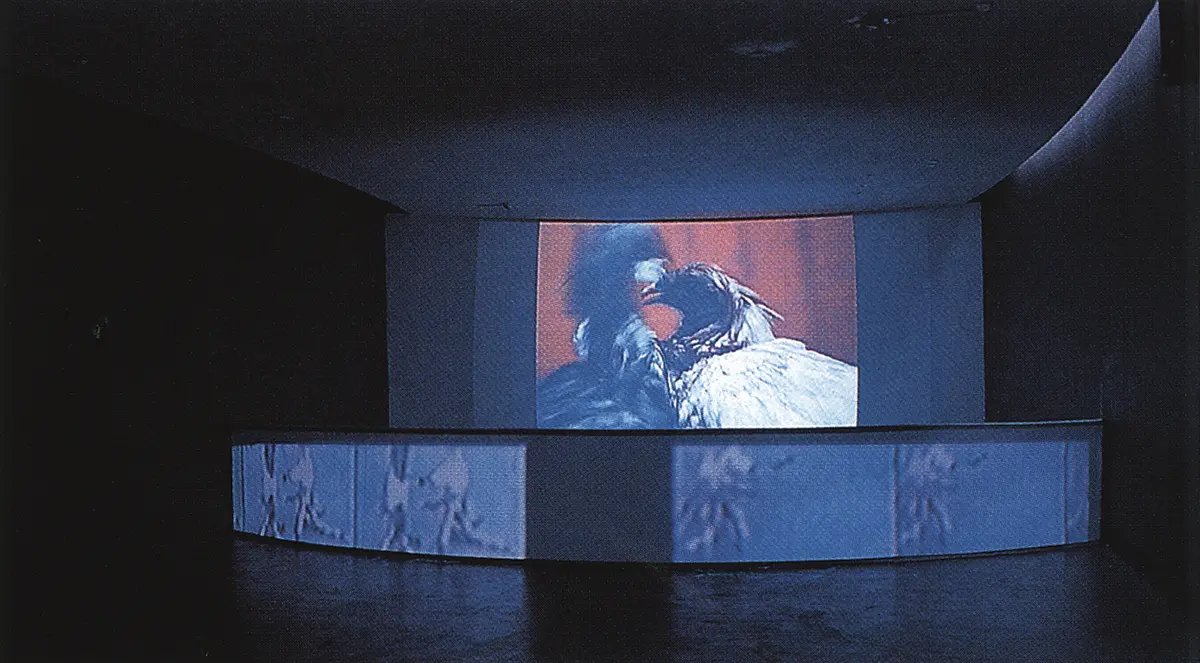
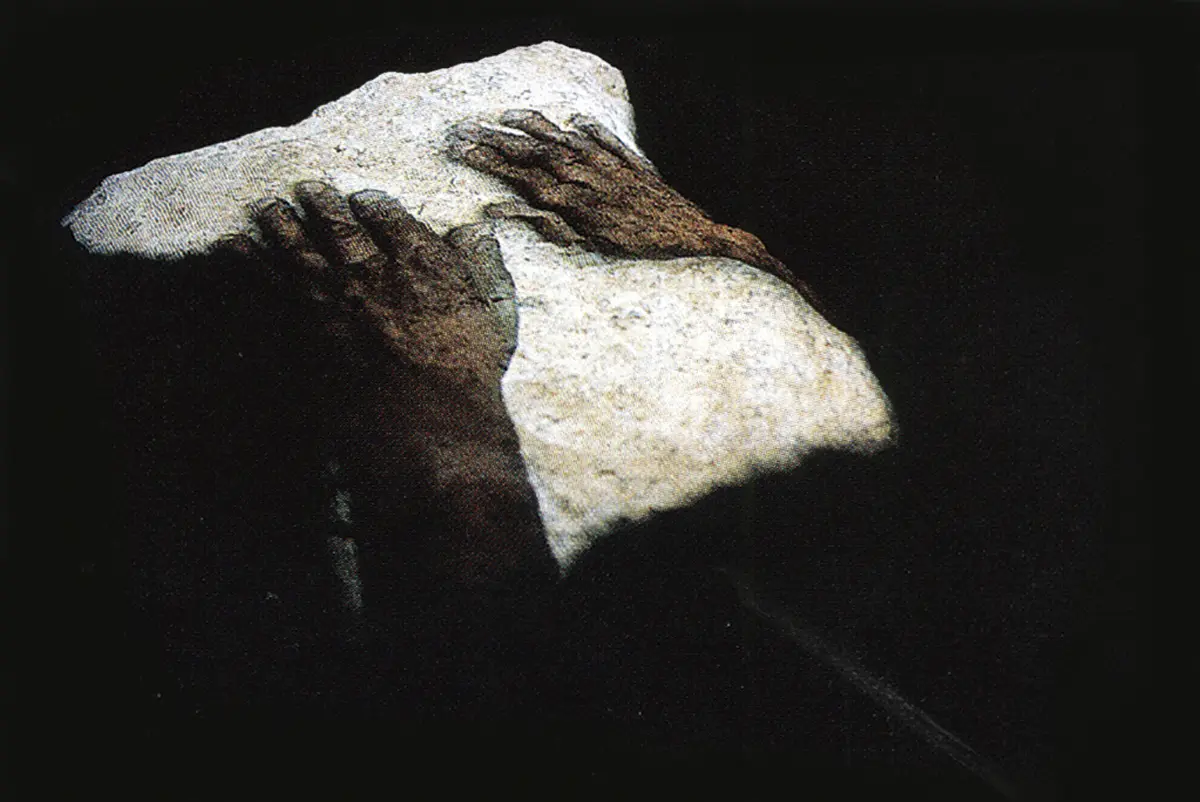
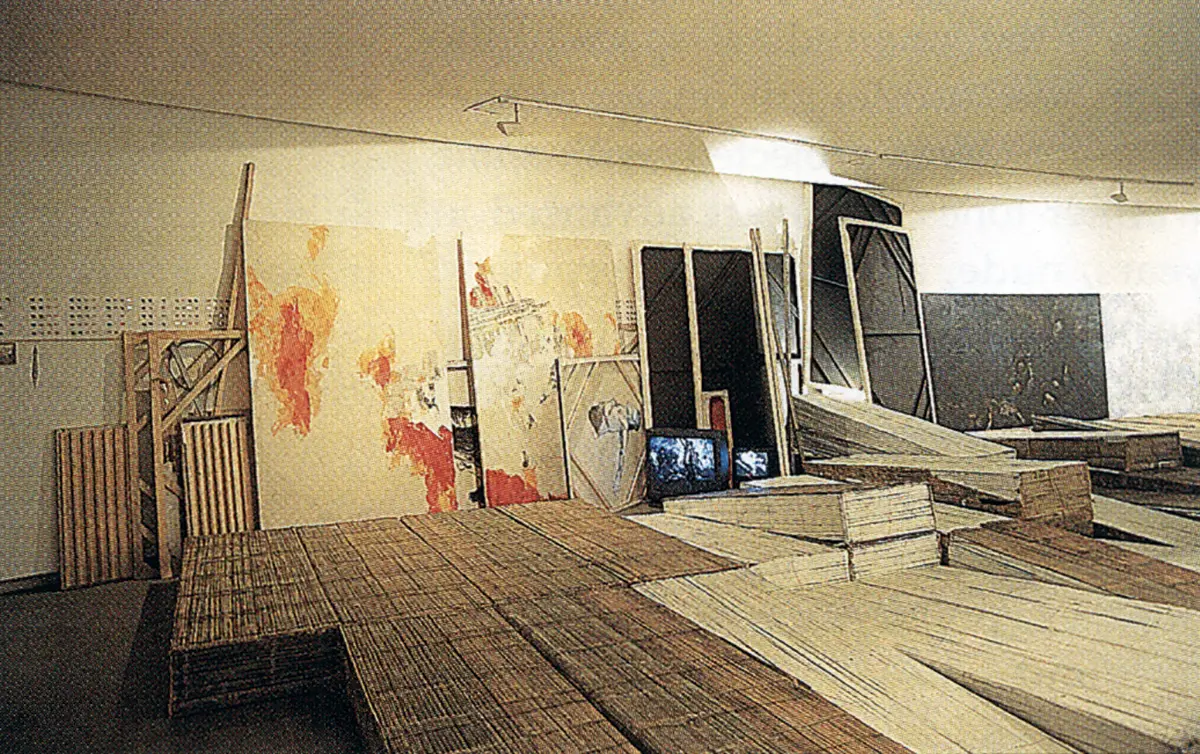
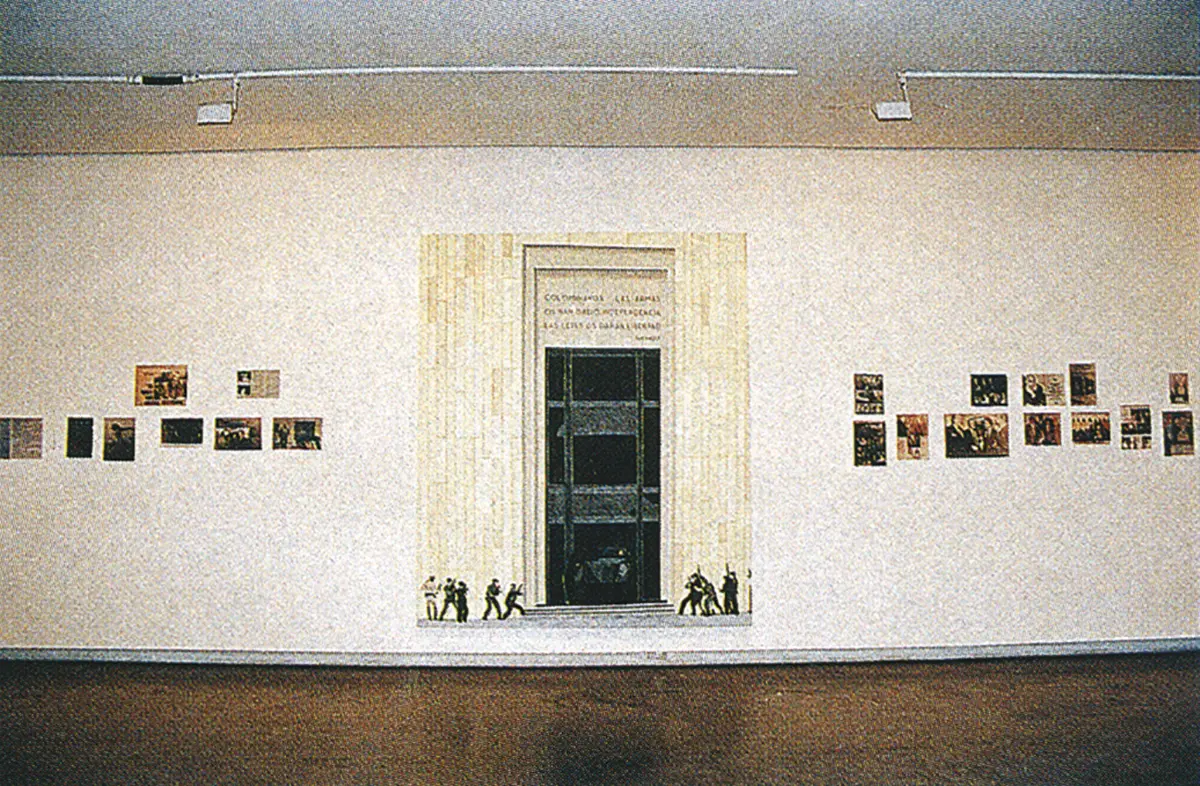
From September 2000 through April 2001, exhibitions took place that comprised the second version of the Premio Luis Caballero at the Planetarium of Bogotá. Ten artists were chosen by Carolina Ponce, Director of New York’s Galería de la Raza, Arcy de Amaral, Director and judge of the São Paulo Biennial, and Chicano artist Guillermo Gómez Peña. The artists selected belong to different generations. Two of them, Antonio Caro and Gustavo Zalamea, began their careers in the ‘70s; the others emerged in the ‘80s and ‘90s. All have a prominent track record. The winning project was that of Luis Fernando Roldán, and the honorable mention went to the works of José Alejandro Restrepo, Clemencia Echeverri, and Beltrán Obregón. Acting as judges in the awarding of the prizes were Natalia Gutiérrez, professor and art critic, artist Bernardo Salcedo, and José Ignacio Roca, current Director of the Section of Plastic Arts of the Banco de la República. Luis Fernando Roldán’s work, Qué estoy haciendo yo aquí (What am I doing here), was made up of a large asphalt canvas, which was placed lengthwise on the wall in the center of the space, and of two series of small-format drawings placed symmetrically at the ends of the space. The presence of the canvas seemed truly striking. In order to be taken in, given its large size, it forced the viewer to walk the entire length of the room, where he or she would perceive traces, lines, and strokes that were created by the artist, who moved on skates over the entire length of this surface—an act that immediately refers us to the process of Pollock’s memorable canvases. In this way, the canvas is reinforced as a large abstract drawing, realized by the action, the force, and the movement of the body, while the two series of drawings, each of which made up a painting, worked variations, one on the figure of a monkey, and the other on a spoon. The two groups indicated another more traditional form of drawing that is grounded in the close observation of its model, in a minute handicraft that records the slightest variations of the hand’s pressure on the paper, whereby the finest details of the animals’ anatomy are captured like old illustrations, thus unfolding the multiple possibilities of drawing. At times, the hoarse body of the insect stood out clearly over the white of the paper. At other times, it would disappear over a dark surface, barely leaving a light fluttering of wings that was recorded by the action of the sketch that captured the traces of its wings over a black surface worked with graphite. Something similar occurred with the scared eyes of the monkey that hid in the corner of the paper, sometimes peeking out from the other extreme drawn with defined and contrasting lines that turned him into a figure subjected to the violence of the chiaroscuro. On other occasions, his face fused with a gray surface delicately comprised of fine lines that reveal the slight brush of the graphite point on the paper. As happened with the wings of the cockroach in some drawings, the eyes of the monkey illuminated the darkness of the paper like two fearful and intermittent spotlights. This reflected the tenderness and mobility of the animal which, according to the story introduced by Luis Fernando Roldán as part of the show, was a marmoset that traveled from Brazil to Scotland on a ship and lived, for four or five weeks, when his provisions of fruit ran out, exclusively on cockroaches: "When he grabbed one of those large cockroaches, he held it with his front paws and then, invariably, he would open them up. First, he would tear off the head and then he would remove the guts, putting them to one side, and finally, he would devour the rest of the body, rejecting the dry elytron and the wings, as well as the insect’s legs, both covered by some hard bristles."1 The minor detail of the story corresponds to the minor detail of the drawing, for in these small cards the essence of these animals is captured, the almost human gaze of the monkey, as well as the somewhat repugnant presence of the insect. And, I believe that the great canvas corresponds to that long and dark voyage in which time, sunk in the ship’s hold, comes and goes in constant motion with the waves of the sea. Beyond this subjective interpretation, Luis Fernando Roldán’s work is made up of an unforgettable experience for the viewer, which traps him with the force of the strokes of the large black canvas and with the delicateness of the drawing. José Alejandro Restrepo’s video installation, titled Iconomía, highlighted a reflection on the properties of the image in which two aspects are taken into account. On one hand, the ancestral prohibition of images, the iconoclastia that, according to the artist, continues today and, as always, "is a problem about power, the gaze, and truth: the images do not have power because they are true, they are true because they have power and that is why they are coveted spoils of war."2 Moreover, the Iconofilia refers to the adoration and consumption of images. These two opposing aspects structured the installation in two spaces. In one, at the back of the room, a large video image was projected which took up the entire wall on which we could see, through slow motion and repeated rhythm, how an enormous machine in the street was destroying a large number of illegal or “pirate” video tapes before the astonished and curious gaze of many spectators. In the other space, we saw a television monitor, suspended like an apparition, hidden by a somewhat transparent canvas. A gesticulating face with coarse factions and a fearful look appeared on the monitor. On the canvas, a drawing of the “Holy Face” which, due to the transparency of the light, was subjected to constant changes so that the “Holy Face” was at times transformed into a fearful and threatening figure. In both spaces, a television monitor was placed which emitted fragments of news broadcasts and programs in which people, in diverse ways, give evidence of their attitude before the image, thus proving the two aforementioned extremes. Beltrán Obregón’s work, Mach, was comprised of a series of impeccable, nearly monochrome, paintings in whose center appeared a figured that seemed made of a shaft of light. "The paintings that make up this show are the result of a simple and repeated procedure. First, a clear figure, with defined contours, occupies the center of the canvas, while the background is darkened to the sides. Over this image, the artist places adhesive tape in the form of a grate and then paints the original image on it once again. Finally, he pulls off the tape, which is not the first or second one that he has removed, but an entirely different one. This confinement extends to the use of color. White, raw umber, and five tones of blue in different proportions. This double variation of quantity and tone makes the colors, when the blues dominate, appear shadowed, at times nocturnal. Some blue tones turn off the color; others awaken a silvery brightness. The same variation occurs at the other end of the spectrum. When the earth's color is imposed on a certain composition, a golden veil shines."3 This description accurately reports the fine elaboration of these canvases, and of the fascinating effect that they produce before the eye of the viewer. This was a show conceived with great professionalism and seriousness, which allows us to understand that painting depends on the mind and hand of its executor. The other video installation that received honorable mention was Exhausto aún puede pelear (Exhausted, he can still fight) by Clemencia Echeverri. Since 1997, this artist from Caldas has been showing a series of video installations, and since 1998 her themes seem to cover aspects intimately linked to the forms of Colombian life, to the family, and particularly to traditions related to food. In Casa íntima (Intimate House), from 1998, she touched upon emotional aspects linked to objects, memory, and place. In Apetitos de familia (Family appetite), also from1998, she touched on culinary traditions that refer to the use of pork, touched upon zones of our ancestral customs that are related to violence, sharpened knives, death, and blood. The installation presented on this occasion refers to the traditional cockfights that make up part of the fairs and festivals of many Colombian towns, where the public’s attraction and fascination is nourished by the violent action of two animals that, placed in a central arena, wage a fight to the death. Following the structure of this setting, Echeverri placed two concave screens on each side of the gallery. The viewer thus found himself in the usual place of the cocks and surrounded by two impeccable projections where, on a white canvas, the bodies of the animals are insinuated, and on which the sharpened spurs of the fighting cocks would appear from time to time. This was a carefully conceived work, equipped with a refined language that contrasted with the violence of its theme. Gustavo Zalamea is an artist who moves across different stages of art: artist, professor, and curator. In all of them, a reflection on art, its problems, and its history is made evident. On this occasion, his interests are directed, as the title of the show points out, toward painting, cloning, the copy, and their variations, and these interests refer back to two key paintings in art history. According to the artist: ”The central pieces of this show are Gericault’s The Raft of the Medusa and Delacroix’s Freedom Guiding the People, reproduced—and slightly reworked—in their natural size using photomechanical techniques."4 What interests him in these images is their situation between classicism and romanticism, as well as the fact that Delacroix’s work is a variation on Gericault’s, which opens up a space for reflection, seen in light of the questions that today’s art poses regarding originality: ”the copy, authorship, localism, research, and development of a theme (like a musical score), without abandoning the sensitive treatment of form and space."5 One of the most impressive aspects of this work was made up by the installation of bamboo boxes known as cacetones, which are used as structural elements in popular architecture. These rectangular cacetones were placed one after another across the entire length of the gallery floor, creating irregularities. At times they created diagonal planes, so that walking over them implied sliding down a small ramp, while other times they implied walking over a flat surface. The smell of the bamboo impregnated the space and generated a total experience for the visitor, who had to move from one side to the other in order to appreciate the variations that go from Gericault to Delacroix. This all took place in the midst of an “enraged sea” that, more than this, made me think of what happens with a piano keyboard when the pianist raises and lowers the keys faithfully following the movements of a score. Rolf Abderhalden created a video installation, La mirada ciega (The blind gaze), in which the tactile dimensions of the image are explored. As the viewer entered the room, he found himself occupying a space in semidarkness resolved through a series of irregular objects, carefully arranged in the space and illuminated with lights of variable shades that turned them into something like apparitions. As we approached them, we discovered that they were hard, medium-sized stones of a light color. On each one a projection was cast in which a man’s body fragments appeared, his hands, his face, his torso, and his feet, which covered the entire surface of the stone, thereby creating with the projection a strange symbiosis between the skin and the stone, between the visual and the tactile. In the background, finishing off the longitudinal space of the room, the full-length image of that same man was projected, with some warmer tones; a subject advanced in years, nude, anonymous, corpulent, heavy, who apparently slept a deep sleep while a stone slowly changed position; at times hiding his face, other times appearing under his hands, or even his feet. In this image, the room’s floor was prolonged so that the viewer found himself sharing the same space in which the man’s body rested. Thus, the viewer’s experience was intimately engaged with each one of the elements that comprised the installation, which allowed Abderhalden—who has a great deal of experience in the theater—to break away from the habitual distance that is sketched between the viewer and the setting. This paves the way for a direct experience through slow motion, determined by the duration of the image in which the visual reaches our touch, involving the skin through the gaze that rests on the rough and wrinkled surface of the stone. Wilson Díaz presented a version of the recent history of Colombia which is constructed out of a look at Cromos—perhaps the magazine with the longest tradition in our country—and of a series of paintings in which images extracted from newspapers are gathered, which record different incursions into rural zones of the military, paramilitary, or guerrillas, in which a clean technique of flat colors and clear tones is used, neutralizing the violence implicit in them. These paintings were spread out along the side walls while the central wall of the gallery was taken up by a strip of sepia-toned photographs placed at the visitor’s eye level. These images captured the central pages of the magazine Cromos that were dedicated to culture and politics. A meticulous reading of them allowed us to learn what had happened in Colombia from the ‘70s—when the gallery in the Planetarium was founded—until today. A large painting was placed in the middle of this long line in which the façade of the Palace of Justice was presented. This is where, in 1985, another ill-fated moment in Colombian history occurred which, just like April 9th, became one of the significant points of the conflict and violence into which the country found itself plunged. This was one of the most interesting works of this event, grounded in an investigation that was carried out in the newspaper library of Cali, which allowed us to see how the gaze of art is fused with the new visions of current history. Antonio Caro’s exhibit closed this cycle of shows. He presented a group of works realized in the creative studios where he has been engaged during the last five years, which have earned him two important grants, one from Colcultura (1996) and the other from the Guggenheim Foundation (1998). These studios, which have been realized in different parts of the country, center on the theme of creativity, a concept intimately tied to the artistic activity that Caro notably extends as he works with a diverse and numerous public whose daily and work-related activities are not linked to this field. The goals of these studios, according to the artist, approach Beuys’ ideal of inserting art into the social realm.6 The works by the participants were presented within a space dedicated to the exhibition of art, like the Museo de Arte Moderno, in 1998, and now in the Galería Santa Fe, as part of this contest that includes within the discourse of art a plurality of languages that breaks away from the frontiers firmly established by tradition. The other participants were Jaime Iregui, with an installation placed on the wall, titled Del cielo (From heaven), and Alejandro Castaño, an artist from Antioquia, with El volar es para los pájaros (Flying is for the birds), a piece in which the use of photography recurs.
NOTES
1. Ciro Roldán Jaramillo, in the catalog that accompanied the show Qué estoy haciendo yo aquí: Luis Fernando Roldán, Galería Santa Fe, Planetarium of Bogotá, June 2000.
2. José Alejandro Restrepo, Iconomía, video installation, Galería Santa Fe, Planetarium of Bogotá, 2000.
3. Sergio Jaramillo, “El espacio imaginario,” in the catalog that accompanied the show, Galería Santa Fe, Planetarium of Bogotá, January 2001.
4. Gustavo Zalamea, La exposición de pintura: clonación, copia y variaciones, Galería Santa Fe, Planetarium of Bogotá, September 2000.
5. Ibid.
6. Interview with Antonio Caro by María Clara Cortés (unpublished).
MARTA RODRÍGUEZ