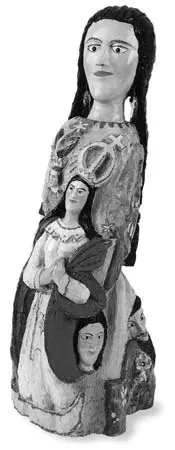
The Rafaela Baroni exhibit held at the Sofía Imber Museum of Contemporary Art in Caracas was important as it contributed to the redefinition of art and showed the public just how wide this field is. Baroni was born in the Andean town of La Mesa de Esnujaque in 1935. At first glance, her work could pass as “popular art.” But the coordinates she’s established throughout the years—her character which, if not biographical, is at least a representation of herself; her mysticism and Catholicism, her baroque style, her polychromy, her sense of the collage, her scales, and the solutions she’s presented as a sculptor—are all tell-tale signs of an artist who goes beyond small judgments that give no room for her installations and performances. In this latter category, Baroni has repeatedly acted out the ritual of her own burial, with herself resting in the coffin. All with an emotional intensity and honesty of expression that make her authorship an original gesture. Thus Baroni, who in origin is a popular artist, should also be considered avant-garde.
Rafaela Baroni is fundamentally a carver who has been active since the mid-1960s. Her repertoire deals with the sacred, hagiography, and divine passages. Another vein is Simón Bolívar, where she sees herself in the role of Manuela Sáenz; when not, her face becomes the Libertador’s. There are carvings, reliefs, and polyptichs of intense colors and multiple details, where the figures are usually found in a garden and are surrounded by birds, especially parrots and macaws. From the onset of her artistic and three dimensional production, Baroni has represented herself. In Rafaela en apariencias con sus crinejas (Rafaela in Appearance with her Crinejas [a type of bush]), a scholarly bust and a civic portrait from 1983, we find the face that will resurface throughout her work. She’s a virgin, an angel, a heroine.
At first, her sculpture-carvings followed the example of colonial carving (abundant in Andean churches). The figure is like a puppet that is assembled, painted, and given certain attributes and attitudes. She’d say that she has spent “part of [her] life carving stick after stick, watching its color and allowing the love for nature to enter me.” This reveals a conscience that links popular culture with the conscience of the great solitary figures of the 20th century. During this stage there’s sobriety and a sense of the decorative. We also begin to see her individual traits: her earrings are parrots, her dress is stamped with flowers, the face is hers, the scale is natural. Aleafar y las flores (Aleafar and the Flowers) is a singular example. Aleafar is “Rafaela” spelled backwards. Then her volumes become carved tree trunks, worked on every side, thus her points of interest are many and wide-ranging.
Among the many pieces done by the artist, El poder de la imaginación (The Power of Imagination) (1999) is surprising for its capacity for metamorphosis: the woman’s face is also a parrot, and her body is the Garden of Eden. The mythical space is persistent. La guacamaya del nacimiento (The Birth’s Macaw) (1995) includes a successive, increasing tale until everything is covered, as in the façade of a cathedral. Years before, during the mid-1970’s, she had created two versions of Virgen del espejo (Virgin on the Mirror) laden with stones, completely covered with fake jewelry, and one of them with natural hair.
Two older Baroni pieces allow us to reassess both her popular tendencies as well as the vanguard and more radical posture she often assumed. El rostro de Aliz (Aliz’s Face) appearing as if it were a colonial carving, with a combination of hair and agave fibers, and the eyes, cut photographs of her own organs. And El zapato de Aliz (Aliz’s Shoe), a woman’s half-heel shoe, found who knows where, on which she carved the detail of her foot. And finally, her performances, some of which were done for the museum, and others for which she needed scores of extras, be it for her weddings or funeral wakes. These are dramatic, intense representations, with exquisitely-crafted dresses made by herself, in events that Nelson Carrido has photographed on several occasions.
JUAN CARLOS PALENZUELA