
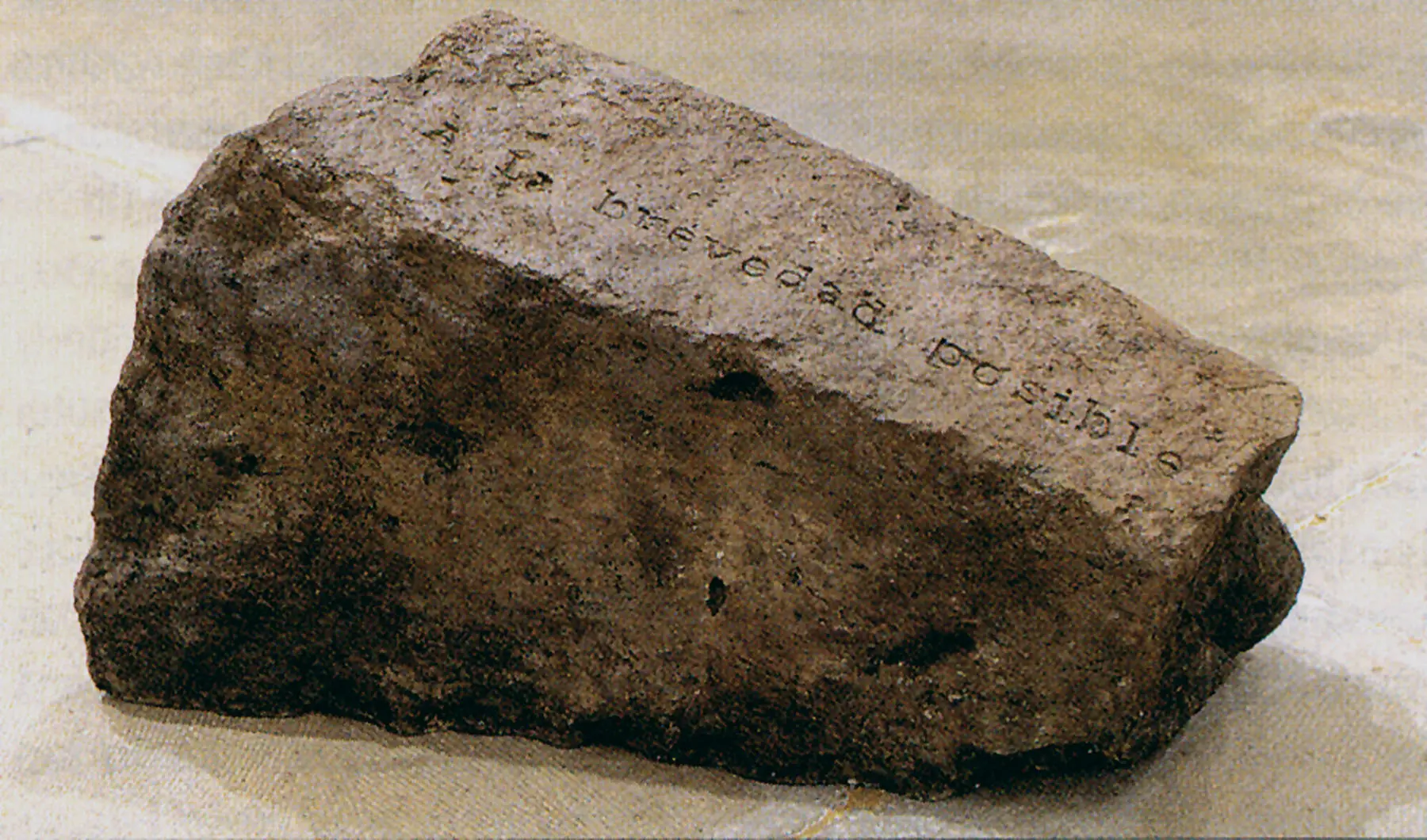
c/o La ciudad: trabajando en Ciudad de México (c/o The City: Working in Mexico City) presented the work of seven artists from the Canadian cities of Ottawa and Mississauga. When I entered the show space at the Blackwood Gallery, I encountered Untitled (a la brevedad possible) [Untitled (as quickly as possible)] from 1999, a huge fiberglass rock made by Gabriel Kuri, who placed it at the gallery entrance. The words ‘as quickly as possible’ were written on the rock’s surface. This colloquial expression was transferred from the simplicity and evanescence of daily speech to the permanence of this monumental sculpture.
¡Qué extraordinario que el mundo exista! (How Extraordinary that the World Exists!) 1996, by Daniel Guzmán, consisted of a group of plastic buckets piled up on the floor, forming a tall column. The artist had made a single plastic bucket with a logo and the piece’s title both in Spanish and English printed on it. There was a set of instructions indicating the institution to search for similar buckets in neighboring areas. In this fashion, the piece was an invitation for the show’s hosts to visit their own environments and look for the appropriate buckets, and experience anew their surroundings.
The image of search continued with Jonathan Hernández’s Se busca recompensa (Reward Wanted). A series of found photocopies of announcements for lost pets was tacked haphazardly onto the gallery’s wall as if on a bulletin board. Since there was no possibility that the pets lost in Mexico would be found in Canada, the piece could be interpreted as a sort of inventory of an emotional flip and its expression in contemporary graphic means of popular communication.
Three photos by Luis Felipe Ortega belonging to the Los cuerpos dóciles (Docile Bodies) series showed him contorting his body while marking the placement of two plant pots on the street, reminding us of the works by Denis Oppenheim, Valie Export, and Erwin Wurm.
Galia Eibenschutz’s Sedentario(a) (Sedentary) consisted of a wood and leather back seat placed beside a group of photographs. The artist included a belt with a plastic buckle so it would resemble the seat belt on a car seat. Arranged as instructions, the photos showed how one could fasten the seat belt, walk around comically with the seat attached, and use it to wait for the bus or rest amidst a patio filled with people.
Bar-Code Stickers Service was the version done locally of a project by Mejor Vida Corp. (A Better Life, Inc) (Minerva Cuevas). The piece consisted of a series of adhesive bar codes copied from the ones we see in supermarkets; the spectator could take home as many as he wanted. Thus, Mejor Vida Corp. gave the opportunity to the public to go to the local supermarket and replace product bar codes with “mistaken” codes and buy groceries at a discount price.
The video Poli I (Cop I) (1999) by Joshua Okón, was filmed during an altercation between a policeman and the artist. It showed, from the perspective of the camera, the policeman’s face, gestures, and words while he yelled and finally assaulted Okón for filming him without his consent. The piece showed, in a visceral and emotional way, the dialectic between the policeman’s abusive authority and the artist’s impertinent and privileged position. The impact of this piece stayed with me.
Germaine Koh, the show’s curator, succeeded in her efforts by selecting works that presented diverse possibilities of social commitment among people from different countries: people who belong to the local and international art world, but also to a wider world, both local and international.
LUIS JACOB