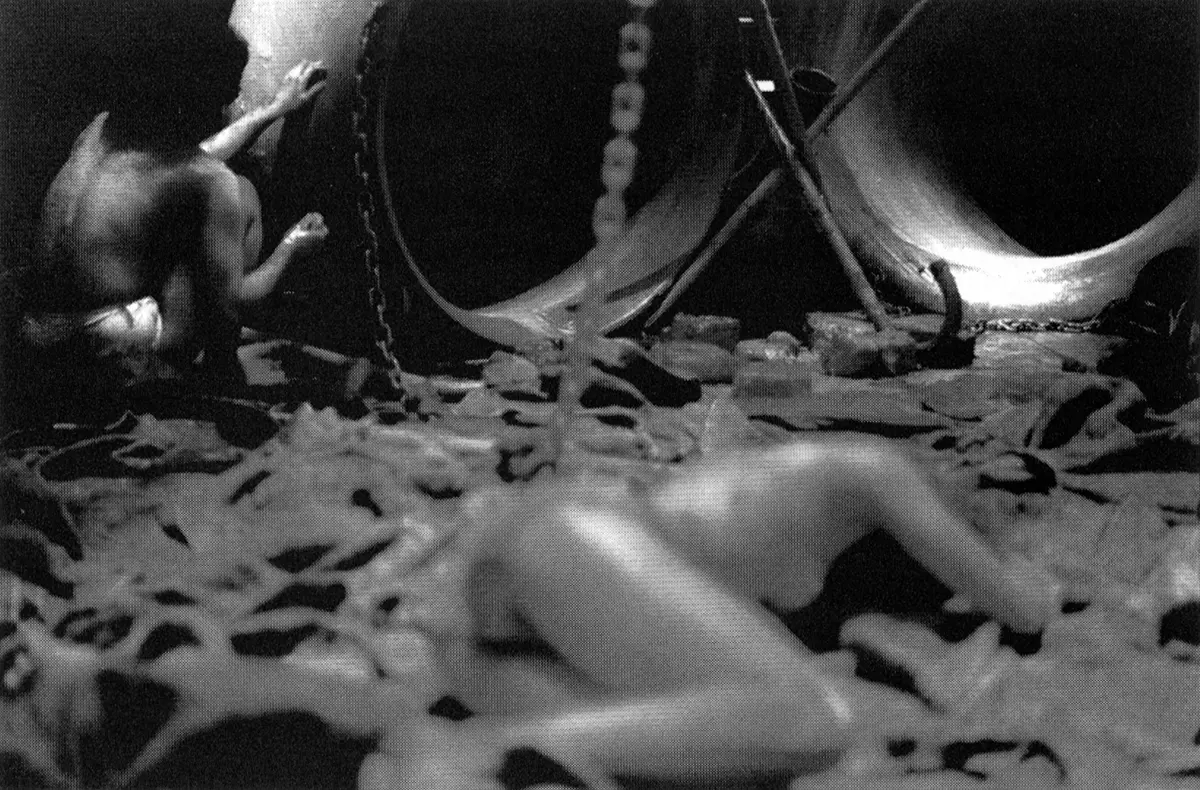
It was almost impossible to walk through São Paulo’s Centro Cultural Banco do Brasil (CCBB) on opening night, this past April 21st. The Tereza performance, which is part of the Rescate (Rescue) event conceived by Tunga, invaded the building’s three floors, spreading through its halls cheap bed covers, aluminum plates, musical instruments, and noise boxes. A colorful and watery soup boiled in cauldrons, and it was distributed among those visitors who dared to drink it. On the central patio was a stage, and on it, dancers and actors engaged for nearly eight hours, smearing with lipstick the huge sculptures/bells occupying the space illuminated by the theatre’s spotlights. Several braids made out of sheets hung from the heights of this patio. Inflatable forms floated against the skylights. The noise was deafening.
The language that Tunga has been working on in his installations and performances since the 1970s reaffirmed itself with each step in this exhibit. That way we found the bells and the braids —two forms constantly rearticulated through the artist’s career in materials such as iron, felt, and glass. Likewise, his whole intervention seems to have a clear and literal objective: to introduce, in the cultural institution, the chaotic scenes we find every day on the streets around the city that disgust us or make us uncomfortable. It was the spectacle —live and in full color— of social exclusion, of the disloyal, cruel battle waged every day for survival in the streets of São Paulo. But, as misery and degradation turned into a spectacle, the meaning of Tunga’s work seemed to get lost.
As one walked through hallways, staircases, and halls, the proposal’s radicalism and vehemence began to lose strength. At the CCBB, the protagonists of the misery found in the city’s streets were personified by well-fed, good-looking actors wearing ragged clothes, sitting on the pavement, or rolling in blankets. The central patio of the beautiful, late 19th-century building that turned into a theatre box only allowed us to see the mise-en-scene in the same fashion we go and see a play. In the end, it gave the impression that after the initial shock, everything remained the same; we were all at ease, protected by the institution’s walls, comfortably strolling about with our spouses or friends, participating in an event with a tone of social denunciation. Afterward, it was a matter of simply walking a bit through the deserted, unkempt streets of São Paulo, reaching the car, getting out of there, and leaving everything behind.
The most vivid memory is the one of music blasting uninterruptedly, altered by the noises the “wretched” made by banging the aluminum plates with spoons. Although the song’s lyrics were not always understood, a verse repeated the expression, brasa acesa (poke and enliven the coals), a possible rhyme for Tereza. A good metaphor for the recently-inaugurated cultural space. A “coal is poked and enlivened” in the city’s heart. We’ve yet to discover whether or not there will be enough fuel to maintain it and let the institution fulfill what it set out to do: be a nucleus for transformation and recovery to that region that has been degraded but at the same time with so many references for the inhabitants of the city.
VALERIA PICCOLI