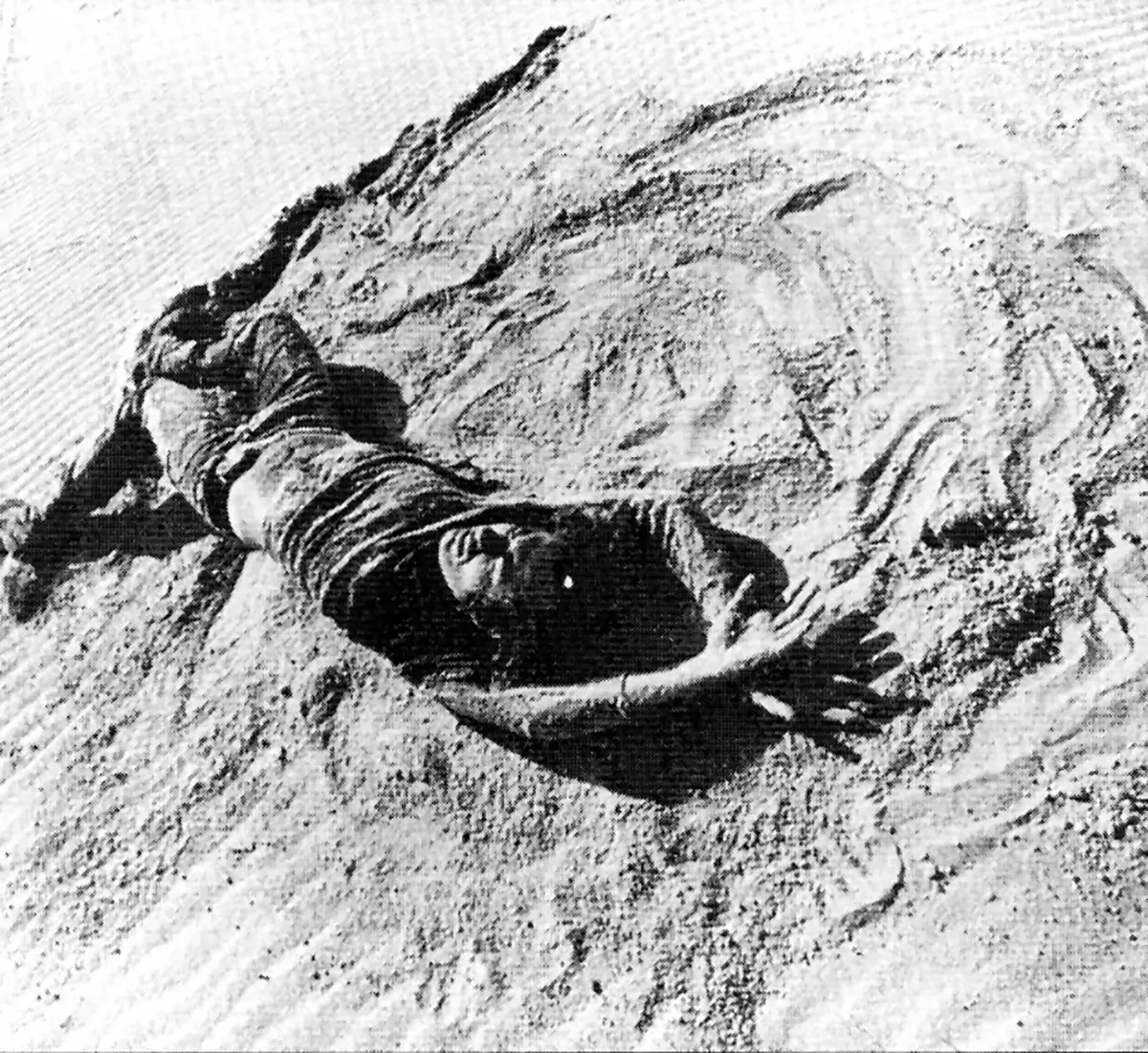
The joint exhibit of Vito Acconci and Ana Mendieta’s performance works illustrates an interesting series of conflicts to which the current revision of the radical art produced during the 1970s is subjected. It is worth noting that although the show isn’t “signed” by a curator, the precision in the selection of works and the quality with which the works were assembled meet the expectations that the public might have of museums.
The first natural problem encountered by presentations of performance works, which by nature are relatively dependent on a specific time and place, is that they fluctuate between the document and the work itself. And here begins the inevitable game of similarities and differences proposed by any comparison. The Italian-American artist produced, among other things, panels blending photographs and text, conceived as an oeuvre/document with the clear intention of circumscribing some of the piece’s parameters. Of the Cuban artists remain films and photographs with no text. The gallery’s presentation of works by both artists covers all the strategies used to present the period’s known works: projections (of film transferred to DVD and slides), screens, photographs, and clarifying texts. Through one of the texts, we find out that Mendieta and Acconci met at the University of Iowa in 1971-1972. Mendieta, eight years younger, was a student, and Acconci was a resident artist at the same campus.
The second obvious problem of a comparative exhibit is the nature of the comparison itself. In this case, there is nothing new. It’s about establishing a relationship between an artist whose practice is central and world-famous, and a Cuban artist coming from the periphery who was recognized or rediscovered late. Perhaps what makes a paradigm out of this comparison is the fact that we could describe both Acconci and Mendieta with the dubious label of “New York artists,” and that gender, national origin, and political posture have played a determinant role in their individual if not uneven development. The rescue of an artist such as Mendieta is something that must be praised, more so when it has been done with such consummation. Distant still is the day that comparisons can be established between two peripheral artists while eluding the center-periphery tension and concentrating on other possible definitions of identity.
The similarities between both works are evident. Their common denominator is the activation of space by means of the body, be it with repetitive, quasi-ritualistic, sexually transgressing, and continuously modifying actions of public-private relationships. The discourse established on Acconci claims that his performances explore psychology through the body in order to establish a quality or definition of the being. There’s also a consensus on the problematization of the feminine gender proposed by Mendieta in the practical activism belonging to the powerful feminism of the 1970s, as well as on the use of elements of syncretic religion, santería, and Afro-Cuban rituals. What’s notable in the evidence of similarities or continuities between both works, is that, ironically, their differences shed critical light on the meaning of both practices.
The clear source of Acconci’s performance work is the influence that Principles of Topologic Psychology, written by the German Kurt Lewin and first published in the U.S. in 1936, has had on him. A glance at the book’s index could pass as a precise description of Acconci’s work. Chapter XV: “Vital Space as a Limited Structured Space”, “Coordinating Environmental and Personal Definitions,” “Dynamic Properties of Personal Regions,” “Internal Personal Regions and the Motor-Perceptual Region,” “Differentiation of Vital Space in the Real-Unreal Dimension,” etc.
Acconci’s interest in presenting and defining the self (or the being-in-itself) in various ways, through the sheer physicality of the definition, opens the door to an ineludible sociocultural analysis: it’s a mise-en-scène —critical, if you wish—of the American obsession with the individual and his extreme manifestation—the hero.
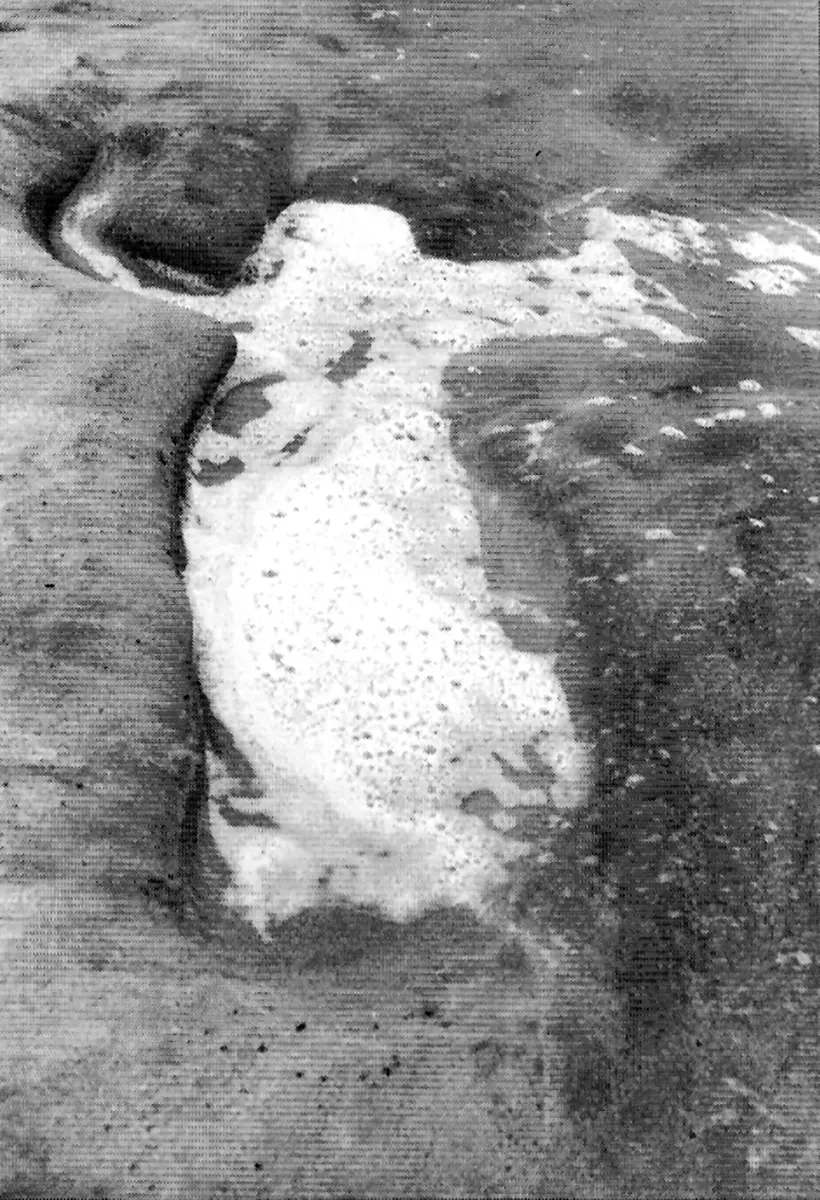
Mendieta’s performances, some of which were unequivocally titled, such as the Rape-Murder series, point toward the injustices committed in gender relations that are so prevalent in Western culture. Without excluding this postulate, the relationship that Mendieta proposes between her body and the environment is not only this problematization, but also a radical opposition of the self proposed by Acconci. There’s a manifest fusion between body and nature, whose first reading is mystical in function of the search for a “universal energy.” But underneath Ana Mendieta’s body abandoned to the soft waves, lies the promise of a highly complex subjectivity, risky from within and from without, of the Western and anthropocentric problem of the self, outside also of the delimiting and clarifying text or proposition, outside almost of language itself.
All the photos documenting Drifts (1970), Acconci’s groundbreaking seaside performance, show his physical body. The documentation of Mendieta’s untitled performance at Salina Cruz, Mexico (July 1976), shows the hollow shaped as a human silhouette that her body left on the sand.
NICOLÁS GUAGNINI