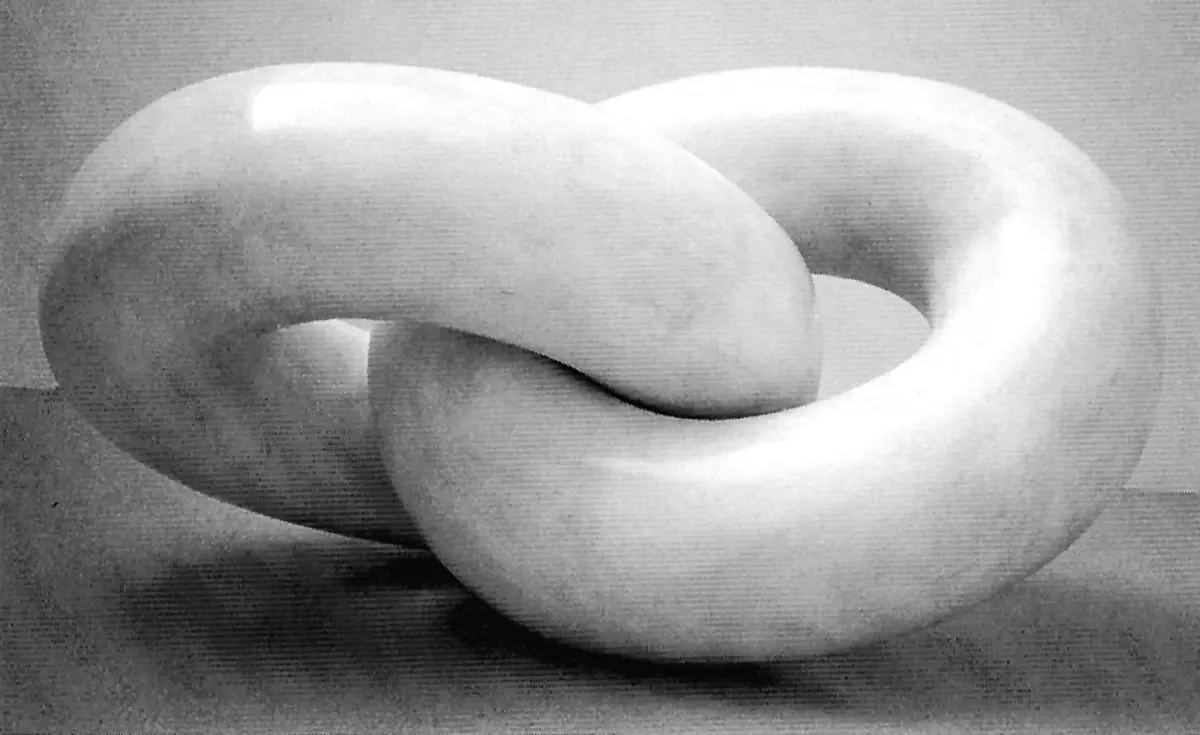
Duchamp used to say that a work of art without impact wasn’t worth doing. Magritte said just the opposite: a work of art should go unnoticed and have little visibility.
Xawery Wolski’s work was presented from Magritte’s perspective.
Born in Warsaw in 1960, Wolski has a great interest in the pre-Columbian ceramic tradition, and for that reason, he has traveled through various Latin American countries. He lived in Peru and now lives in Paris and Mexico.
His work is far removed from the spirit of Duchamp’s Anti-Art academia, which aims to impact the spectator, surrounding him with noisy insinuations. Wolski, on the other hand, seeks time’s silence. His works gather in corners, on the border between floors and walls, leaving the hall’s emptiness to the spectator.
The humility of his work is achieved through the use of clay and its ancestral techniques. With it, the artist is interested in sculptural and architectural spaces, especially in the works he’s done for the urban environment. As Wolski says about clay: “Clay is the poor folk’s material. It suggests durability and the existence of an eternity defined by geological cycles. It has to do with life’s precariousness and social reality, so hard for some. Modern urban life eliminates imaginary reality. There’s no time energy or space. There’s one single effort that unifies men and women, children and stray dogs: to resist, even though they may not be aware of its magnitude and magnificence.”
The sculptures shown at the Diana Lowenstein Gallery were done during the late 1990s, and they all seek the space of the installation. Their whiteness converges with the white hall.
Wolski gathered different soils for his works while traveling around the world. In Peru he consolidated his interest in light, thus his white and luminous coloration. In South Korea, he learned the ancestral technique of bricklaying, in which sand, hay, and limestone are mixed to guarantee durability. Mexico became, for its urban agglomeration and pre-Columbian history, the ideal site for the mysteries he’d unravel between past and present.
The remaining mystery that Wolski has to develop is the integration of his work into Mexico’s social contrast, especially by introducing his work Where Art Never Goes: To Recover the Lost Souls of Street Kids and to Erect the Silence of the Past Before the New Urban Spaces.
The base of his sculptural problem refers to the affirmation of form as essence, to the perfection of its roundness, and to the internal energy of its volumes. Wolski seems to search for the sublime or the absolute in circles and rings, and in all the variants that human parts such as the liver, kidneys, lungs, hearts, arms, and torsos can possibly generate. Also, his shapes originate in botanical elements, such as leaves, roots, trunks, seeds, cells, etc.
The terracotta chains are his most challenging work. They’re presented as heavy rings interwoven with one another, piled up as new pyramids, or stretched the length of the floor. Almost all of the sculpture’s recent trends seem to converge in his work, from arte povera to Minimalism. But also, with great austerity, it seems to erase all vestige of an immediate past to project itself into other millenary eras and return to the light of our days.
Wolski does not demystify the sculptural tradition, as is done continuously in contemporary art. On the contrary, he emphasizes the mythical qualities and tries not to obstruct the enigma breathing from the past. He has a great interest in the monumentality and hierarchy of architecture, and his sculptures seem to integrate as monoliths in their social context. The sculpture as a site has been a preoccupation for many artists. At the end of the 1960s, Carl Andre spoke about the transformation process that modern sculpture was undergoing, developing first as form, then as structure, and finally as site. At the beginning of the sixties, sculpture as a place remained virtually unexplored, but later on it was tackled intelligently by minimalist and Land Art artists. Wolski seems to understand the organic spaces that Eva Hesse’s sculptures-installations left behind. The “asthmatic” quality of Hesse’s sculptures needed to feed off the place in which they existed. That’s how that sculpture-site configuration was established, and to this day it remains vital.
Wolski’s works cannot be divorced from the expectations generated by the site. To this add his interest in solid and heavy matter, and we have the soil’s solidity that he takes from Pre-Hispanic art. His yearning for the durable and the stable contrasts sharply with the mechanical, the weightless, and the immediate derived from modern technology.
Light is another interesting aspect of his work. His engravings and sculptures radiate luminously, not as a result of external pigmentation, but from the coloration that seems to come from inside, from the same matter originating it.
EUGENIO ESPINOZA