
Alberto Greco is an almost mythic character. His intense and extremely brief life, which at first sight looks like a mixture of faith, candor, will to power, and fraud, contributed to creating the legend. When we see the photos of his actions, when we contemplate his drawings and paintings, when we study his writings, we perceive both his up-to-dateness and the subversive and radical aspect of his work, as well as the repercussions that it had, both in Argentine art and in Spanish art. In barely a decade, Greco quickly and intensely, almost with desperation, went through poetry and informalist painting in Buenos Aires, São Paulo, and Rio, the Vivo Dito in Paris, performance theater in Rome, the Manifesto of Living Art in Genoa, the picture-texts and the objets vivants in Madrid, the action of New York’s Central Station, the delirious confessions of Besos brujos (Enchanting kisses) in Piedralaves, and the suicide in Barcelona. The inventory of the brief but chaotic drift is, of course, incomplete.
Between 1958 and 1961, in Buenos Aires, he was one of the main supporters of the advance guard tied to informalist poetics comprised of, among others, Kenneth Kemble, with collages of decrepit and unpleasant objects, Luis Wells, with cardboard objects and residues, Rubén Santantonín, with “enclosures,” Emilio Renart, with “Integralism-Bio Cosmos,” Jorge de la Vega, with expressionist neo figuration, and the group of destructive Art (Barilari, Kemble, López Anaya, Roiger, Seguí, Wells), with the first version of the “Duchamp effect.”
In 1961, with a provocative and ironic disposition, Greco announced the initial proximity to conceptualism, anticipating by several years the pioneering experiments of Edgardo Antonio Vigo, Oscar Bony, Lea Lublin, Nicolás García Uriburu, Víctor Grippo, and Luis Benedit. To be sure, he began very early to ask about the manner of existence of the work of art, as can be read in the Manifesto dell’Arte Vivo-Dito.
He coincided in Europe with the experiments of Yves Klein, Daniel Spoerri, Arman, Ben Vautier, and Piero Manzoni. Like Wolf Vostel, he believed that “each man is a work of art.” He could have adopted the German motto: “Art = Life and Life = Art.” Like Restany, he was convinced of the “passionate adventure of the real perceived in itself and not through the picture.” But Greco believed that “a work makes sense when it is made, like an adventure, without knowing what is going to happen. Once finished, it no longer matters. It has become, in the best of cases, a holy corpse. ”1
Greco’s first public appearance recorded by the press was the 1950 presentation of Fiesta, a plate of verses in an artisanal edition of 150 copies. During those years, undecided between poetry, theater, and painting, he had briefly passed through the classrooms of the School of Fine Arts of Buenos Aires in order to carry on his studies, between 1947 and 1948, in the studio of Cecilia Marcovich. Around the same period, he was also guided by Tomás Maldonado, one of the founders of the group Arte Concreto Invención.
In 1954, with barely $3,500 and an old copy of Joyce’s Ulysses, he settled in Paris. In order to survive, he improvised all sorts of jobs, from painting a mural in a restaurant in exchange for food to selling South American meat pies or drawings to North American tourists. Just a year later, he obtained a more or less fixed job designing sketches for the printing of fabric.
Although he never had a studio in Paris, he began to paint regularly, however, he could, in his hotel room. The works from that period reflect the influence of lyrical abstraction, with features stemming from Klee, Fautrier, Hartung, and Vieira da Silva. In March 1955, Greco exhibited a group of gouaches in the La Roue Gallery, which was directed by one of Paul Eluard’s ex-wives.
He returned to Buenos Aires at the end of September 1956, and barely a month after his arrival he showed his work in the Antígona Gallery. He tried, unsuccessfully, to show some monochromatic pieces (pieces of thin cardboard in red, green, yellow, and blue, placed on glass). The Castellano brothers, owners of the gallery, dissuaded him so that he would change the monochromatic pieces for some gouaches created in Paris beginning in 1954.2 And again in 1960, in the show of the Asociación Arte Nuevo, he exhibited monochromatic works: two rags for mopping floors stretched over canvases like traditional paintings.
Distressed by the disinterest in the new things that he found in Buenos Aires, where geometric abstraction dominated, he traveled to Rio de Janeiro in 1957. He soon showed his work with another Argentine artist in the Petit Galerie. At the beginning of the following year, he moved to São Paulo, and in April he had a solo show in that city’s Museum of Modern Art. He presented the results of a sort of “action”: a piece of Canson paper that he had randomly stained by throwing eggs full of Indian ink, later cutting them into twenty squares. He added to them a scrap of rusty can found at a junkyard.
Informalism
Greco returned to Buenos Aires after two years of absence. A little later, in 1959, he showed his work in the two exhibitions of the informalist movement, which he had founded together with Kenneth Kemble, Mario Pucciarelli, Luis Wells, and a few others.
Greco’s informalist painting was characterized by large, almost monochrome, textured surfaces that recalled old, peeling walls. The solo show at the Pizarro Gallery in 1960 was integrally made up of his dark, tarred canvases with highly elaborate adhesives. Obsessed by the quality of the material, he exposed the night canvases to the outdoors in order that the soot and rain “might charge them with a force.” At times, he urinated on the paintings (inviting his friends to do the same), alleging that the organic reactions of the material would enrich the surface in a random way.
In a discourse on informalism at the Argentine Society of Plastic Artists in 1961, he affirmed that he believed “in vital painting, in scream painting, in painting as a great adventure from which we can come out dead or wounded, but never intact, something like entering a large forest without preconceived ideas.”
In October of the same year, in his last exhibition of paintings in Buenos Aires, titled Las monjas (The Nuns), he presented five or six pieces of an informalist-neofigurist conception. All of the works showed barely perceptible, black, dramatic, and heartbreaking nuns. In La monja asesinada (The murdered nun), the religious habit was a dirty shirt fixed by horseshoe nails to a wooden stretcher. Also exhibited in the hall were jewels created with horseshoe nails welded with silver.
Vivo-Dito in Paris
Greco’s disenchantment with the tendency that he had helped popularize in Buenos Aires was evident. He used to repeat: “When I got to Brazil, my dream was to create an informalist, terrible, strong, aggressive movement against good customs and formalities. The worst of informalism prevailed: the decorative, the facile, that which cannot stand to be seen twice.”3
He returned to Paris and, in February 1962, he participated in the show Curatella Manes and 30 Argentines of the New Generation at the Creuze-Messine Gallery.4 He presented his first proposal of Living Art: Treinta ratones de la nueva generación (Thirty mice of the new generation), which consisted of a glass container with a black bottom, inside of which were thirty white (Argentine) mice. The work only lasted a day due to the foul odor that it gave off.
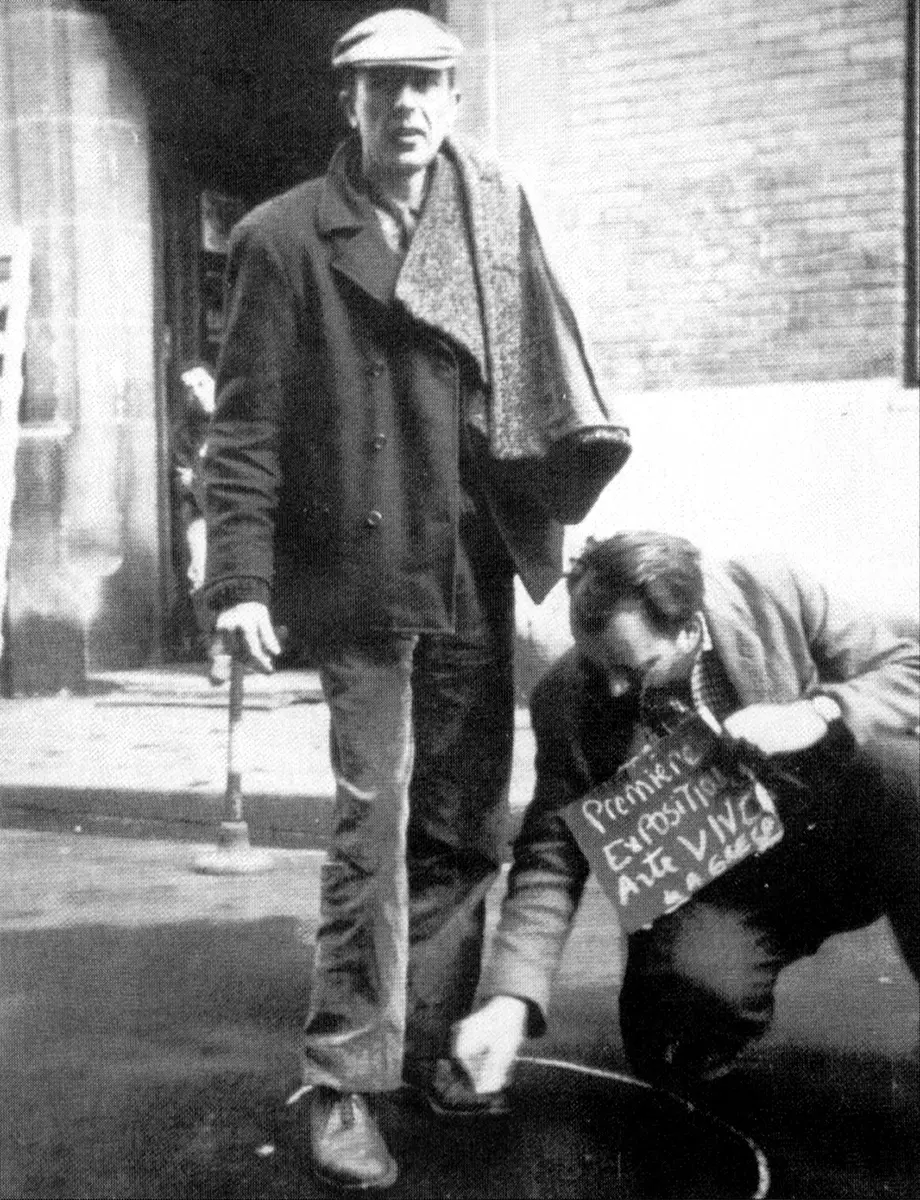
After that exhibition, he began to carry out the “actions” that he called Vivo-Dito, a sort of conceptual-vitalist action, full of humor, at times parodic or sarcastic. On 12 March 1962, on a street in Paris, he presented the First Exhibition of Living Art, closing off the sculptor Alberto Heredia in a chalk circle, and “signing.” He repeated the actions on his pilgrimage through Europe and America, marking and signing old people, "clochards," antique shops, and lamb heads from the Les Halles Market in Paris; street vendors, beggars, the blind, peasants, and burros in Spain; shoeshine boys and other characters in Buenos Aires. Some of the actions were realized for the photographic camera, without an audience.
In 1964, with a certified autograph, he designated Ben Vautier “continuer number 6 of the Grequismo Vivant (or of the Vivo-Dito in the world).” For his part, Ben declared Greco a “genuine work of art,” with a certificate dated 4 January 1964. Greco was considered a “disciple” of Klein and he affirmed that some of Ben’s works stemmed from his experiences.5
In the show Antagonisms, dedicated to the theme of the object (Museum of Decorative Arts of Paris, March 1962), without having been invited, he exhibited himself as a “sandwich man” with a sign that read: “Alberto Greco, work of art not in the catalog.” As he wandered around the exhibition halls, he distributed a personal card with the text: “Alberto Greco. Objet d’art.” Participating in the show were Arman, César, Fontana, and Matta. Yves Klein, who was showing the Projets architecturaux, “signed” Greco. It was the only encounter between the two artists. Klein died in June.
In Genoa, dated “24 July 1962, 11:30 hours,” he published in Italian, as a poster printed on pink paper, the Manifesto Dito dell’ Arte Vivo. Among other things, he declared: “Living art is the adventure of the real. The artist will teach how to see not with the picture, but with the finger (It., dito). He will teach anew how to see all that happens in the street. Living art seeks the object, but it leaves the found object in its place, it does not transform it, does not better it, it does not take it to the art gallery.”6
At that time, he did not believe too much in the future of painting, although he never stopped painting or drawing. In a letter to Lila Mora y Araujo, he stated: “Painting will disappear [...]. That’s why I say with all certainty that painting finished its cycle with Ives Klein’s blue picture.”7
Cristo 63 in Rome
Greco settled in Rome in 1962. There he carried out an action that consisted of covering the walls of the historical center with graffiti: “La pintura e’finitta. Viva el Arte Vivo-Dito. Greco.” He had already realized two similar urban actions in Buenos Aires in 1961 with posters fixed to the walls of the city center. On the first occasion, the poster started with large characters: “Greco: the greatest informalist painter of America.” On the second, “Greco, how great you are!” These actions in Buenos Aires, direct antecedents of the “media art” developed in that city around 1965, were the first urban actions. In the Gran Manifiesto-Rollo, upon discovering the succession of his actions, Greco noted that, in 1961, he had signed “the city of Buenos Aires.”
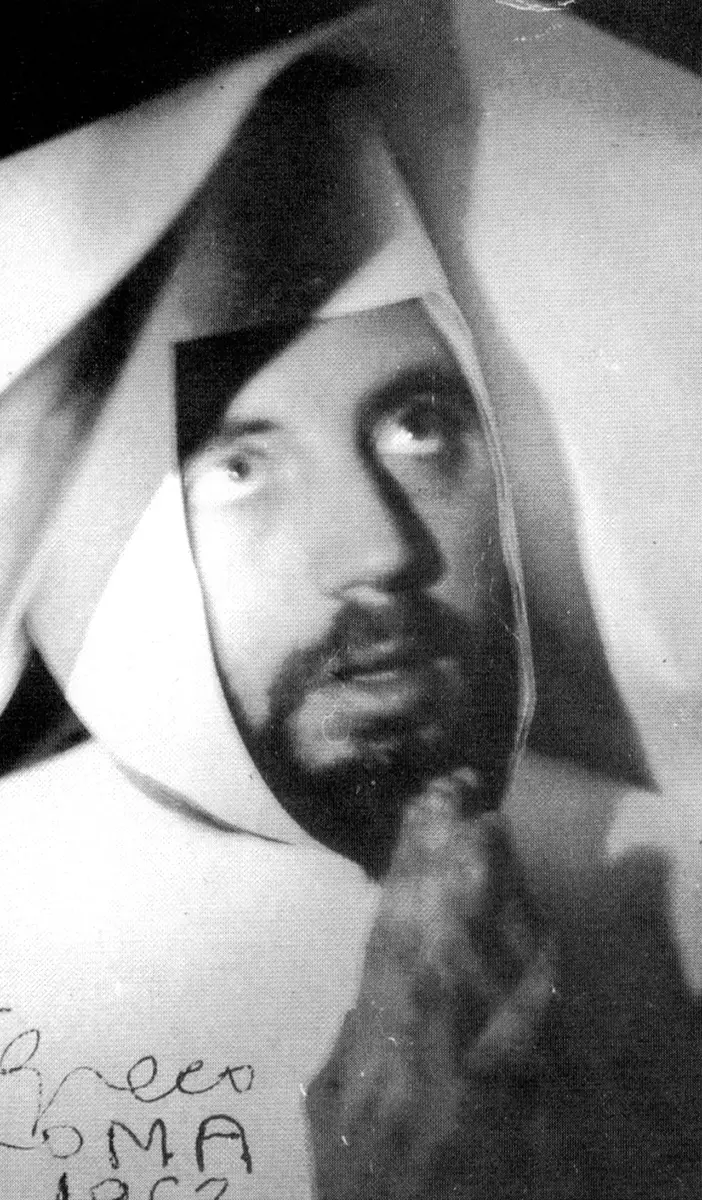
At Rome’s Teatro Laboratorio on 4 January 1962, installed in an old garage not very far from the Vatican zone, he presented the action titled Arte Vivo Cristo 63. Omaggio a James Joyce. He carried it out with the collaboration of two Italians, Giuseppe Lenti and Carmelo Bene (a prestigious supporter of the Italian scene). The Vivo-Dito parodied the life of Christ with a pastiche of texts by Joyce (Ulysses) and tales of situations of the intimate life of the artists. The representation produced a great scandal and Greco was accused of blasphemy and pornography. The police gave him il folio di via and he was forced to abandon Italy in great haste.
In a fragment of the Gran Manifiesto-Rollo del Arte Vivo-Dito (unedited), written en Piedralaves in 1963, Greco points out some characteristics of Cristo 63: “At any moment—he says in one of the paragraphs—a good, fat man, with a mouthful of nails and looking at his watch, a little shaken, enters and says to him (to Christ): hurry up and get undressed, I’ve come to crucify you. The character should be likable and make us laugh. Meanwhile, Carmelo (Christ) begins to slowly undress [...]. But he never nails him to the cross because it gets late and his meal is getting cold, and he leaves it “for the next day.” Actually, Cristo 63 never had a definite text. On stage (full of old objects gathered in the Trastevere market), each person said whatever came to mind, and several people were even speaking at the same time. The goal of abolishing the definite text was explicit. In the Antimanifiesto-Rollo he declares: “Christ finishes the work saying to his drunken disciples: ‘We have to write the text.’”
In a letter written to the Portuguese artists René Bertholo and Lourdes Castro, Greco described another plot: “Judas is a painter. Christ too. Judas sells Christ for thirty boninos (a reference to Alfredo Bonino, a prestigious dealer in Buenos Aires). But in the end, Christ forgives him and, laughing, says to him: “You’ve even taken away my color (with tango in the background). And Judas hands over a black man to him.”
The Madrid Subway
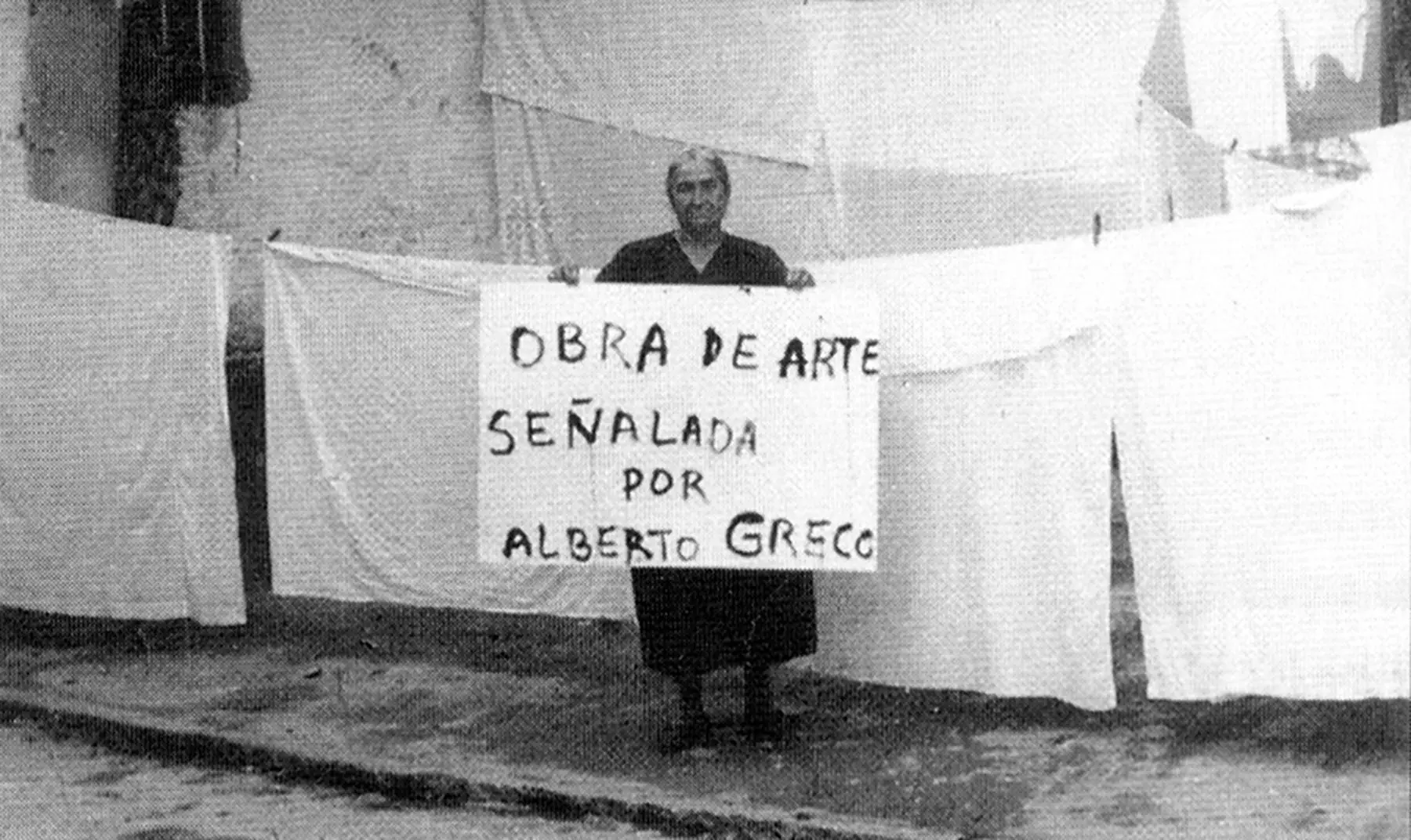
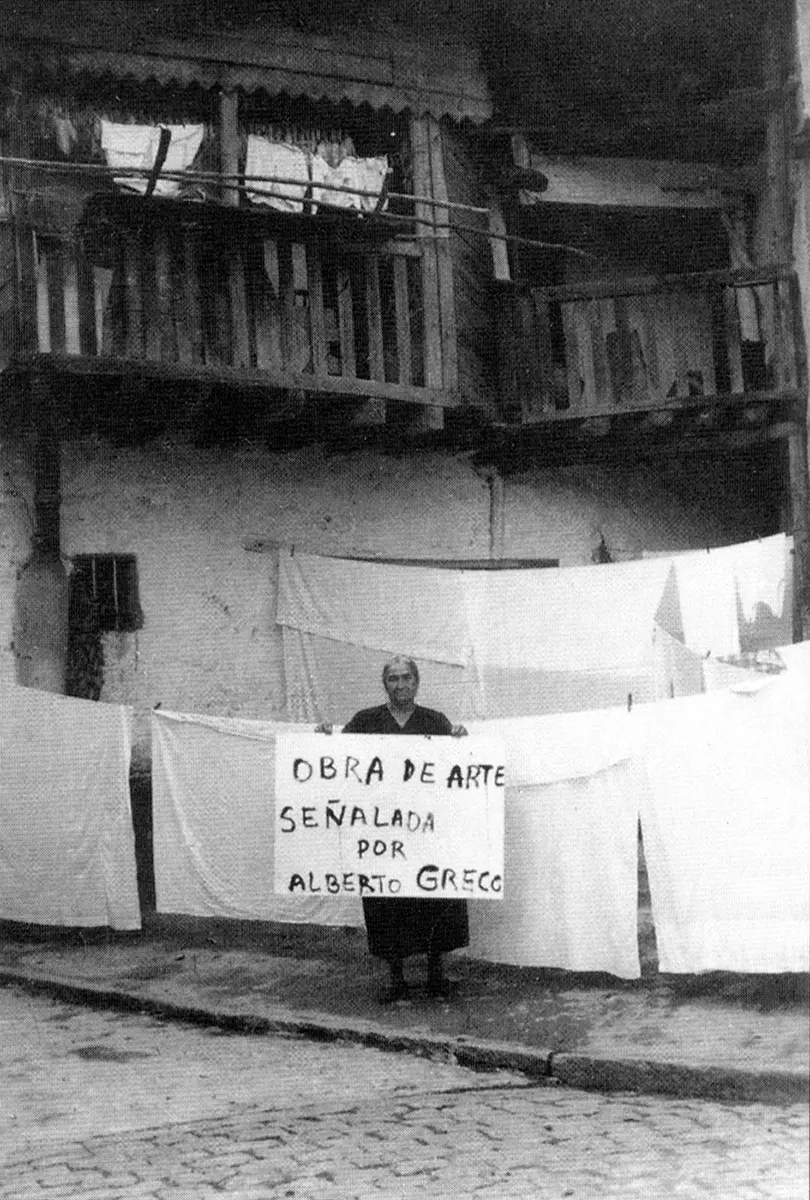
After his hasty departure from Rome, Greco settled in Madrid. For a while, he lived in the house of the Argentine painter Adolfo Estrada. This is where the fruitful friendship with Manuel Viola, Lucio Muñoz, Manolo Milares, Raúl Valdivieso, Eduardo Arroyo, and Antonio Saura was born. A little later, he met a Chilean painter who invited him to spend some time in Piedralaves. In that small town just over eighty kilometers from Madrid, he carried out an important series of Vivo-Ditos that were documented photographically. Among other things, he “signed” a peasant riding a donkey and a woman holding a large sign with the text “Work of art indicated by Alberto Greco.”
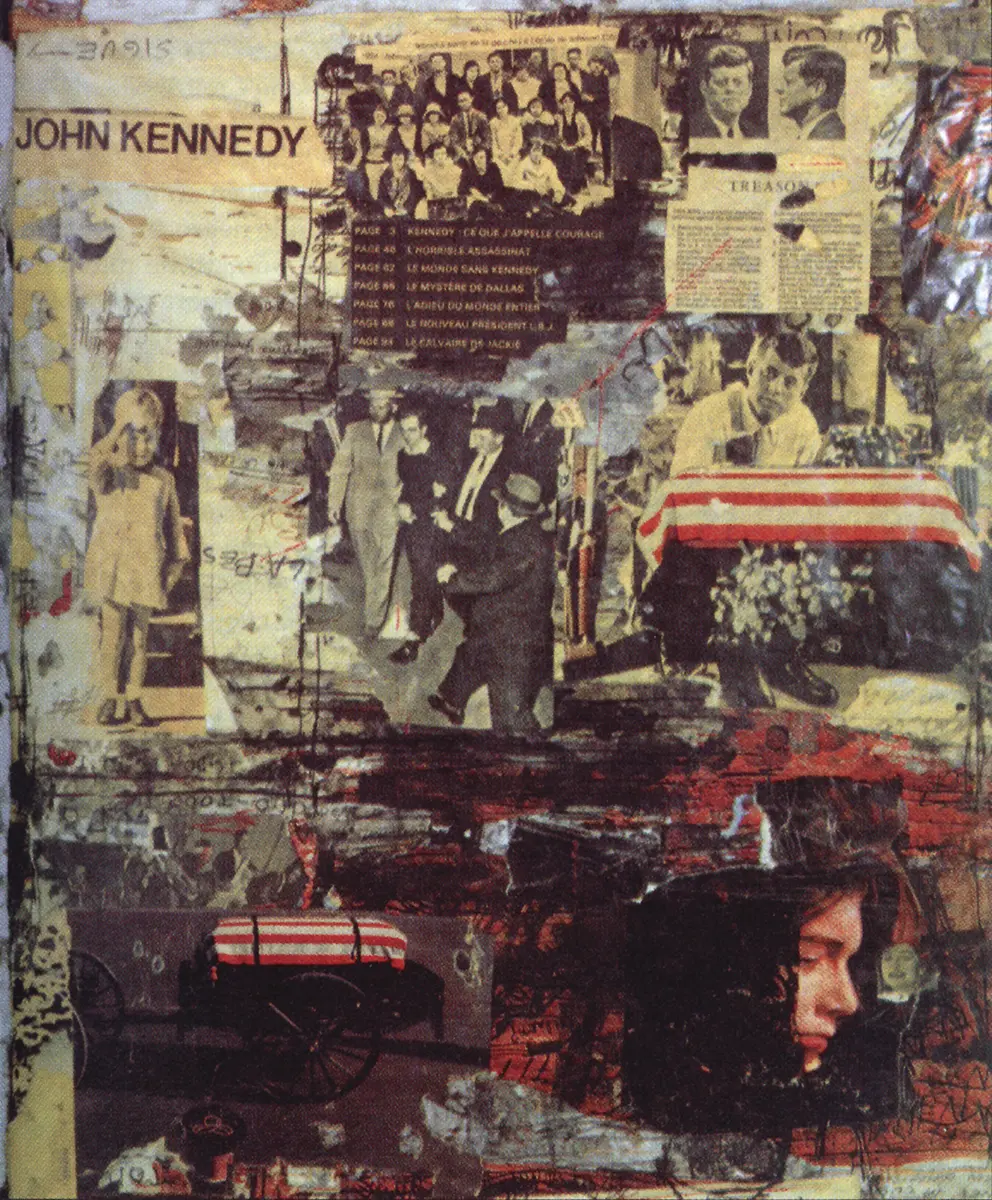
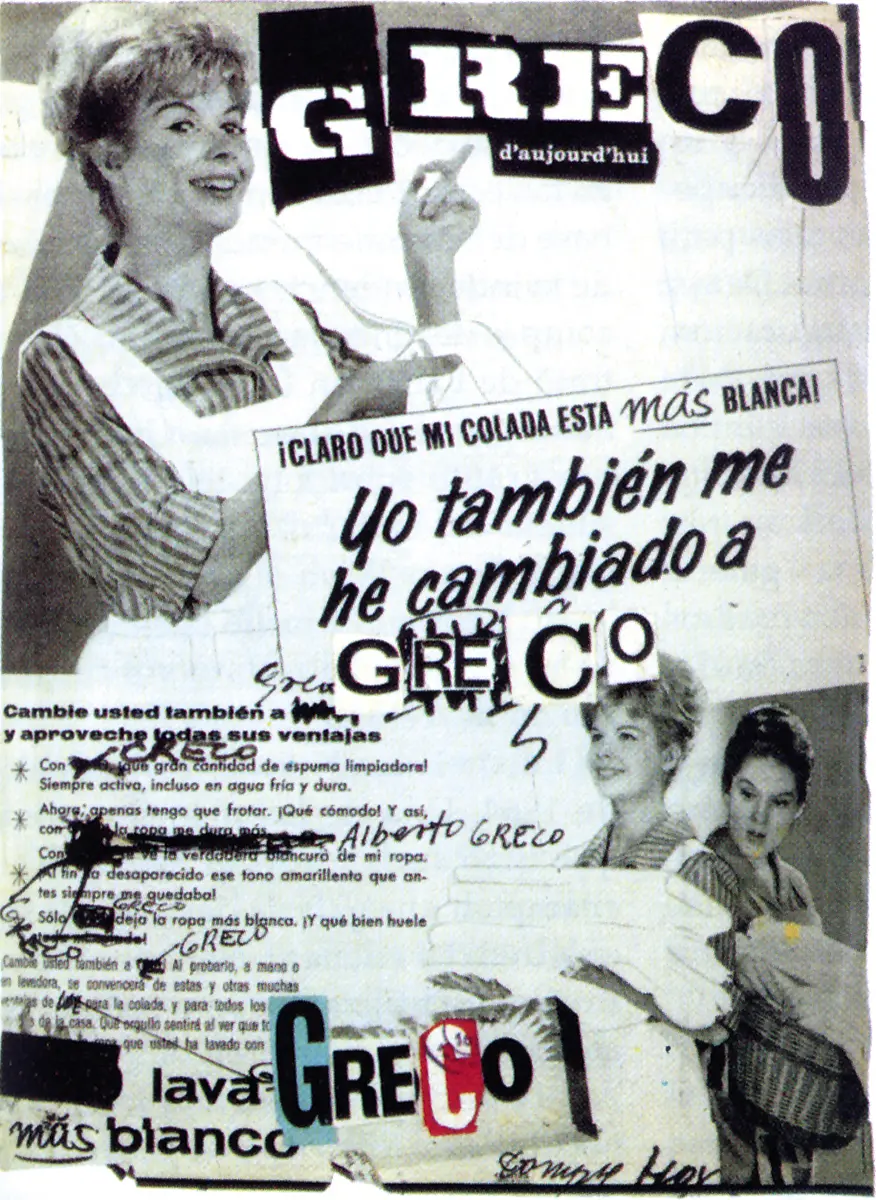
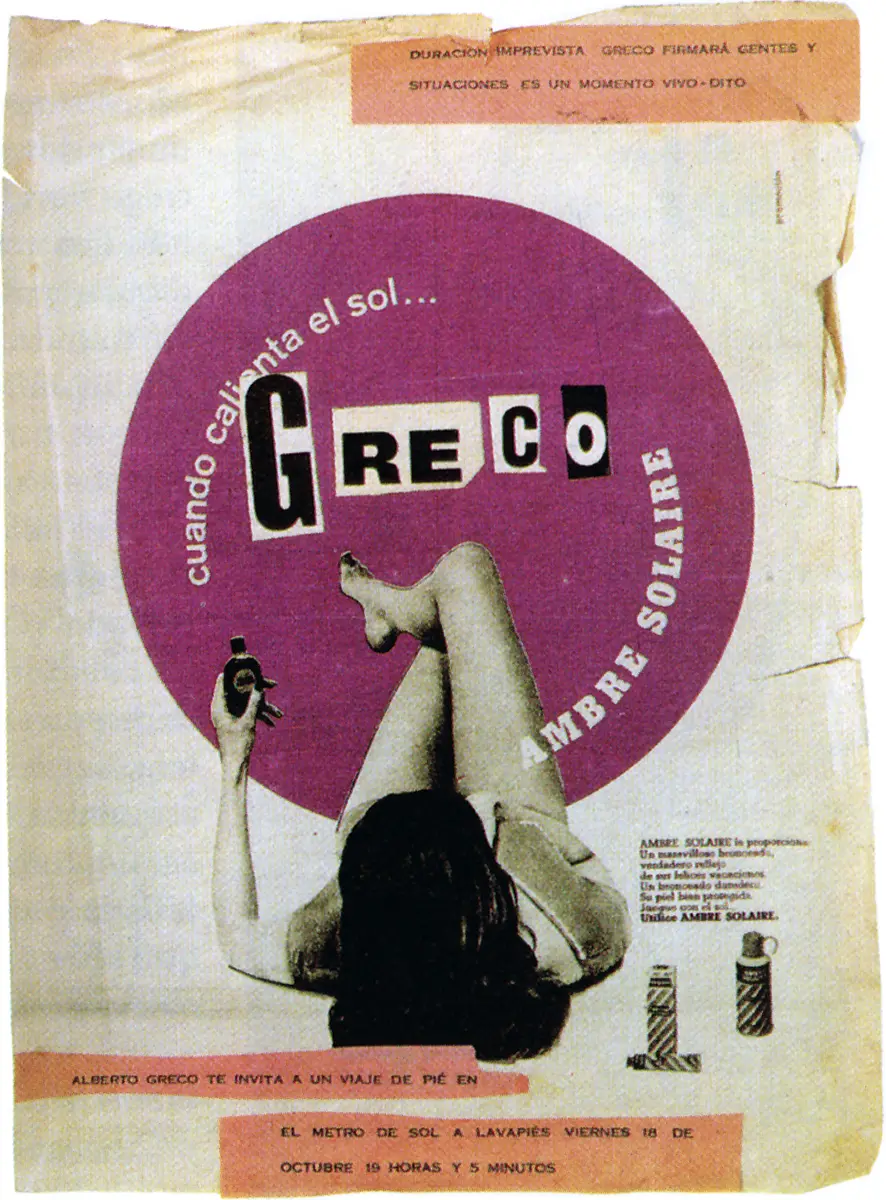
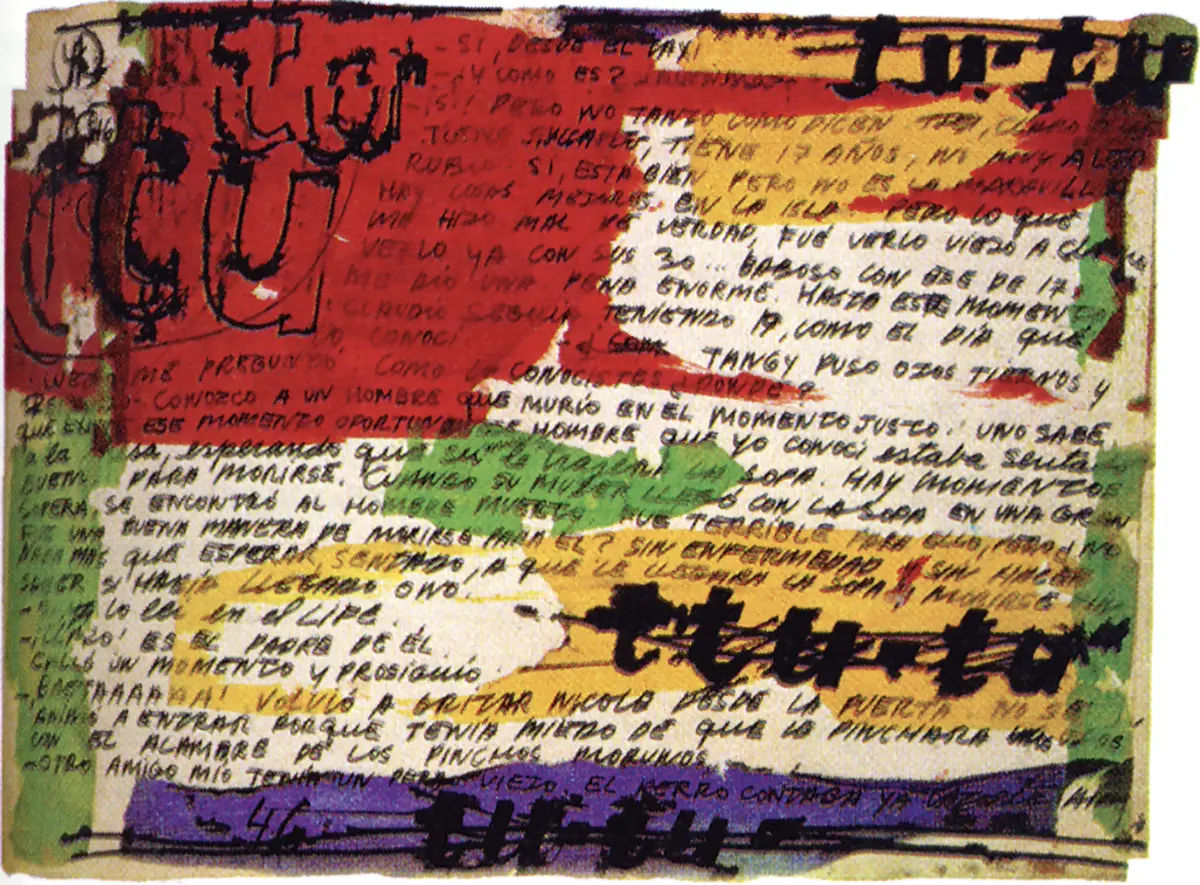
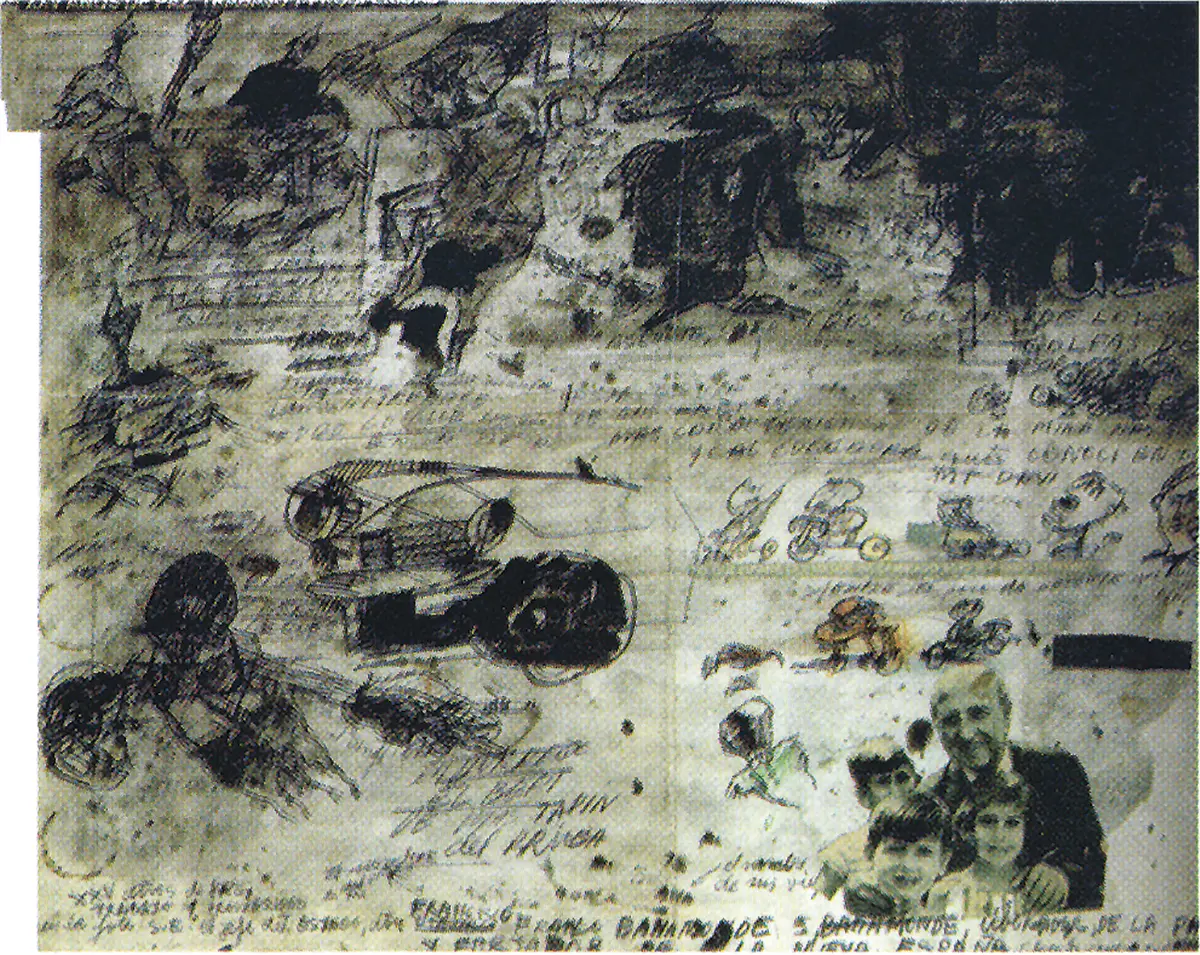
In Madrid, he organized several actions, some of which ended with commotions and the consequent police intervention. On 18 October 1963, he carried out Un momento vivo dito. Viaje de pie en el metro desde Sol a Lavapiés y visita al mercado. Mostrar el objeto encontrado en su lugar (A vivo dito moment. Standing subway ride from Sol to Lavapiés and a visit to the marketplace. Showing the found object in its place). In the notice he stated: “Greco will sign people-situations-lamb heads and everything he considers to be a Vivo-Dito work of art.” It was a complex operative that, after the strange trip on the subway, ended with the burning of a roll of fabric for making sheets that he had painted, signed, and on which the participants had stepped. To finish it off, everyone danced in a frenzy around the fire. In April 1964, three months after turning thirty-three, Greco showed his work in Madrid’s Juana Mordó Gallery. On the day of the opening, an ad published in a newspaper sought “boys and girls between the ages of 3 and 9, who can sing and dance, with suits and dresses, for a screen test.” Many young children, accompanied by their parents, joined in the multitudinous vernissage that turned into a chaotic and absurd spectacle. The canvases presented, with the appearance of a visual and textual palimpsest, show a chaotic mixture of painting, drawings, writings, strike-throughs, traces, and collages. Saura wrote that these works were a genuine “diary of additions and superimpositions.”8 The pictures of that period, of an explicit baroque exacerbation, seem to hark back to an anarchic memory that can only recall disseminated, unstable, and fragmentary images and writings. At times, the manuscript letter includes tango lyrics and phrases that recall his country: “They say that in the pampas there are many cows, but I never saw any”; “Hey, kid, I’m a porteño from the pampas; “let’s go to Calamuchita”; “homage to Maipo, Nélida Roca, Semillita, Rita Montero, Ada Falcón.” With his typical irregular handwriting in the catalog, he dedicated the show to Enrique Santos Discépolo (a famous tango writer). Everything seems autobiographical, although with a farcical tone. Some writings on the paintings recall the street graffiti due to their form and impudence. In other pieces that parody known advertising ads, the word “Greco” appears as the main part, replacing the commercial brand of the product advertised. In two works exhibited in the Juana Mordó Gallery, he incorporated objets vivants: a woman with a basket of sunflower seeds and a blind street vendor selling lottery tickets. He placed them in front of the canvases in order to draw and stain their outline. From time to time, during the opening, the little old people stood inside the silhouette sketched on the large white canvases. It was another version of the Vivo-Dito. In the studio on the Calle Manzanares, where he had opened a “private gallery,” Greco painted some pictures in collaboration with Antonio Saura, dedicated to the assassination of Kennedy. The canvas, according to the Spaniard, was “savage, disgusting, repugnant, a marvelous real murder.” With Millares, using rickety chairs acquired in the Madrid flea market, he constructed a painted object, which is now lost.
Vivo-Dito in Buenos Aires
Greco returned to Buenos Aires before the end of 1964. His goal was to present an experience of Arte-Vivo, which turned out to be the last action in his native city. The invitation announced: “My beloved Madrid. Painting spectacle Vivo-Dito. With the collaboration of the famous Spanish dancer Antonio Gades; introduction by Jorge Romero Brest.” On 9 December, half an hour before the scheduled time, there were so many viewers crowded in front of the Bonino Gallery door that traffic on the Calle Maipú was stopped. Hung in the first half of the gallery were two decadent odalisques painted by Peruzovich (which later decorated the Ba-Bar-o). Under them, some small signs pointed out Mi tía María del Rosario Greco (My aunt María del Rosario Greco) and Mi tía Ursulina Greco (My aunt Ursilina Greco). Two picturesque shoeshine boys, who habitually worked on the Calle Florida, were seated in front of white stretchers, surrounded by shoe polishes, inks, and brushes. Greco arrived at the gallery disguised as an admiral (or something similar), with a band crossing his chest and an ornate hat with multicolored feathers. From a platform, he threw carnations over the audience and he distributed pennants with the effigy of Palito Ortega (a popular singer). Then, with a nasal, trembling voice, he read a nearly incomprehensible text. The audience flooded the gallery, and the decision was therefore taken to continue the action in the nearby Plaza San Martín. On the base of the enormous monument to the hero of South American independence, in time for a military march, Gades tried to dance a fandango accompanied by a guitarist. Greco sketched the silhouette of the dancer with graphite on a white canvas. He signed it and wrote the sentence “Long live modern art”; then he scribbled and crossed out the writing.
End in Barcelona
Greco traveled to New York before the end of 1964. One of the first things that he did was to interview Duchamp in a Madison Avenue gallery. The goal of the encounter was to ask for his signature in order to use it as a prologue in some exhibition. A little later, he carried out an action, known as Rifa Vivo-Dito in Central Station. He persuaded Christo, Lichtenstein, Oldenburg, Spoerri, Kaprow, Brown, and others to give him drawings and small works. He placed them in the lockers (there were nearly eighty, counting his own drawings) and sold the keys so that, upon opening the small door, each participant found something. Everyone took something with them, although not always works of art. The keys had been sold in the Chelsea Hotel, not very far from Central Station, a mythical spot of New York’s bohemia.9 Toward the end of April or the beginning of May of 1965, Greco settled in Spain, accompanied by Claudio Badal. He stayed in Madrid for a month, where he presented a one-day show with Millares in the Edurne Gallery. The Zaj Group collaborated with an action in which everyone present made a bell ring.10 On this occasion, he showed two pieces with an explicitly political attitude, a theme scarcely repeated in his work: La ragazza del regim and XXV años de paz y prosperidad (Twenty-five years of peace and prosperity). In this latter piece, we see a photograph of Franco surrounded by children, aggressive military figures, and writings with allusions to the “forger of the new Spain.” Shortly thereafter, he traveled to Ibiza accompanied by Badal. After the definitive separation and distancing of Claudio, Greco began to write Besos brujos at the beach; he finished it in Madrid, at a table of the Café Gijón. The book’s 130 manuscript pages, sketched with printed characters and indiscernible calligraphy, full of drawings and smudges of grease, beer, and wine, tell of the ups and downs of his love for Claudio. The book is a chaotic and delirious collage in which banalities are mixed with distressing confessions. On one of the pages, he wrote: “The moment for dying has now come. The moment for buying those absurd pills. Although I am less eager than yesterday. But I want it to be very clear that I do this as a result of my frustrated relationship with Claudio. Although I have nothing to leave him.” To conclude his chaotic pilgrimage, Greco put an end to his life in Barcelona, three months before turning 35. In a letter, Badal recalled the painter’s final moments: “I found the door ajar, and on a table were many plates with leftover food and bottles, and Greco was in the bedroom, dressed in red Turkish pants; his torso was bare, and he was barely breathing; his hands were crossed and the word Fin was written with ink in the palm of each hand.11 Greco died at daybreak on 12 October in a hospital of nuns. A curious coincidence: he had dedicated an exhibition to nuns in Buenos Aires. A year later, in Vatican City, during the Ecumenical Council, he disguised himself as a nun in order to carry out the photo-performance that he titled Albertus Grecus XXIII (homage to his exhibition of Pizarro on the first anniversary). After the scandal of Cristo 63, he was confined, in a straitjacket, in a hospital served by nuns. He escaped with the help of the director of the company. Some accounts affirm that he left Rome hidden in the habits of a nun.
NOTES
1. Alberto Greco, "La verdadera historia de Cristo 63." Alberto Greco (Valencia: IVAM, Centre Julio González, 1991-1992) 286.
2. The show Propositions Monochromes by Yves Klein had been carried out in the Colette Allendy Gallery of Paris, barely eight months before Greco's proposal.
3. Cited in Germaine Derbecq, "Alberto Greco, el mago de Buenos Aires," Le Quotidien (1960).
4. Organized by the critic Germaine Derbecq, wife of the Argentine sculptor Pablo Curatella Manes (1891- 1962).
5. In a letter to Adolfo Estrada in 1963, he points out: "I was right to fear the plagiarism of ideas in the face of Ben's forms and living sculptures." Actually, Ben had presented the "signed" Sculpture vivant in 1961.
6. A French version of the Manifesto Vivo-Dito was published in K.W.Y. num. 12, Paris, 24 June 1962.
7. Letter to Lila Mora y Araujo, April 1963.
8. Antonio Saura, "Glosa con cuatro recuerdos," In Alberto Greco, op. cit.
9. Greco got support from North American artists through his friendship with Christo, whom he had met in Paris in the context of the group of the magazine K. 11. W. Y., which also included René Bertholo, Lourdes Castro, and Jan Voss.
10. It is obvious that the Zaj Group, founded in Madrid in 1964, originated from the precedent of Greco's urban actions and "Incorporation" as well as from the festivals of the Fluxus Group.
11. Letter to Francisco Rivas, 1991.
JORGE LÓPEZ ANAYA
Director of Graduate Studies at the Academia del Sur. Art critic for the daily La Nación (Buenos Aires) and correspondent for the magazine Lápiz (Madrid).