
The Whitney Museum in New York opened an exhibition of artists who use computers for their work. It is a disappointing show, not so much for the quality of the work, but because of an excessively narrow view of art problems and a lack of recognition of the profound changes our dealings with information are introducing in our perception of the world.
One of the problems we used to face in art until not long ago was to have to choose between “what” and “how.” Tradition always gave priority to “how.” Our schools teach painting, sculpture, etc. and there was a time in which salons and prizes were organized accordingly. In time, these technical divisions started to disappear, at least in the more enlightened circles. One started to talk about “art” instead of skills and to identify messages, purposes, and the formulation of problems. As the twentieth century passed, the medium used for a work of art lost its importance opening the way for the discussion of more weighty theoretical issues. With the introduction of computers into the art scene, art could be discussed in terms of information in both planes—technical and message, form and content—and one can assume that a great many dichotomies were left behind. Art could be understood as potentially integrated into a coherent and indivisible unit.
The steam machine was the model used until recently to think and try to understand the universe. This determined how conventional cause and effect laws were applied and that everything was perceived as being within an energy kettle with an interaction of mechanical rules. The paradoxes and contradictions to which this model led (possibly including Einstein’s inability to achieve a unified theory— the contradiction of behavior in separate physical worlds defined by either gravity or quantum laws) have led many scientists to find a new paradigm: the computer. With it, the borderline between what we perceive or think as physical and what we call information ceases to exist. The informational act of measuring affects the physical presence of what is being measured and determines the state in which we perceive things.1
This “inconceivable” and “unimaginable” act, in a world limited by our daily perception, takes things out of the “natural” plane and transports us into the “cultural” (though not less real) plane. It also takes us to a metaphoric proposition: that we live in a computed universe. It is, however, a universe where we cannot perceive the computer that computes us. It is also a universe where, at the level of quanta, we affect the things we perceive. It is, in other words, a position that in this moment takes us to the extreme of considering information as the essential substance of which the universe is made.
Aside from the theological parallels—we live in a world created by a god whom we cannot perceive and to which we only have access through faith—what is interesting in this model (a model about which I am illiterate and don’t have a clue) is precisely the elimination of the borderlines between information and its physical support. At least in art, this signifies an opening to absolute creation and the liberation from the limitations of craft.
It is with all these very dramatic thoughts turning my head that I went to see Bitstreams, the new exhibition at the Whitney Museum.2 I thought I would see a show making an impact on history, an exhibit that would guide generations to come, if not because of its visual results, at least through the theoretical parameters that framed them. I relapsed into the same optimism I had when I went to see Paradise Now, the exhibition about the impact genetic research has on art.3

Instead I found myself in an exhibition that retreats several steps. The only thing in common to the 53 artists is that they use computers for the execution (and sometimes, although not always, for the conception) of their work. In the retrograde place of a “painting salon,” we find a technologically more advanced but institutionally equally old-fashioned “computer salon.” Most noteworthy here is that, if one has a computer with good memory and a quick DSL or cable modem, the “salon” is easily accessible from home through www.whitney.org. Although not completely. Not all the pieces are available and neither are all the facets of the works (video dynamics seem absent). But at least one can listen to the sound pieces (about half of the artists have musical works) without having to wait for the headphones in the installation designed by the LOT/EK group of architects.
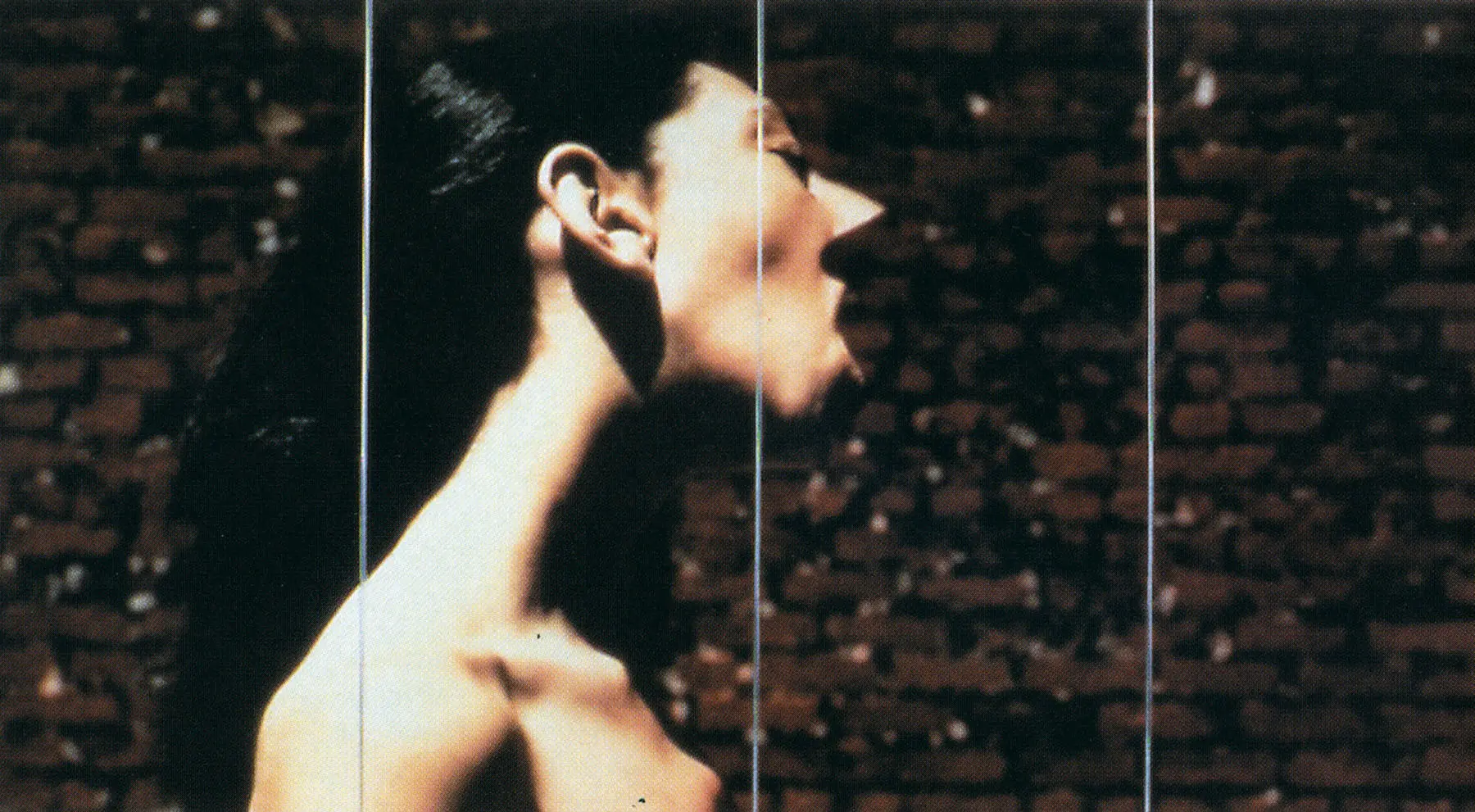
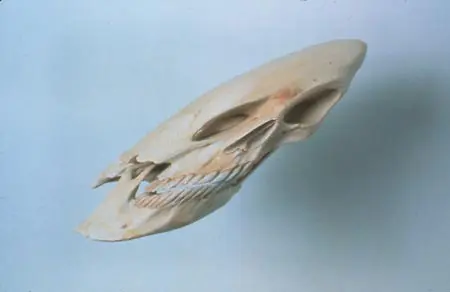
The context of “computer salon”, which might have been seductive during the 80s given the novelty of technical artifices, today actually diminishes the work exhibited. Pieces that would stand on their own presence, here appear weakened thanks to an emphasis on the trick. Two of the more publicized works (by the museum and by the reviews) are Me Kissing Vinoodh (Passionately), by Inez van Lamsweerde (1999), and Skull, by Robert Lazzarini (2000).
The first shows the author kissing somebody with total dedication. But where one expects the kissed companion only the background wall is to be found. The absent profile distorts, in an interesting fashion, the profile of the artist. The enormous image (nearly 3 by 5 meters) quotes Magritte’s Les jours gigantesques (1928). But instead of the fusion achieved by Magritte, here it is the absence that conditions the shape of the profile. The (rather stupid) reaction one immediately has, obstructing the impact of the piece, is the realization that von Lampertz employed Photoshop’s “rubber stamp” tool to get the effect. It is a way of saying that “anybody can do that,” a thought that does not apply when confronted with art. However, it is an understandable reaction given the show’s emphasis on technical mechanisms.
Lazzarini’s Skull consists of a series of sculptures where skulls are anamorphically distorted. Made out of plastic resin and bone powder, their realistic effect is perfect. They stretched into different directions and have the typical anamorphic attribute of seemingly reconstituting their original proportions when seen from a particular point of view. Their three-dimensionality makes the skull appear as if moving and dynamically distorting. Here the reaction is not anymore that “ anybody can do that.” One rather feels that it is an effect and that after the (sizeable) impact there is no residue left.
John Haddock also uses Van Lamsweerde’s method, but more dramatically. In photographs of horrid crimes (children trying to escape napalm bombs in Vietnam, Rodney King’s beating by Los Angeles police), he carefully erases the victims and reconstructs the original space. The initial violence of the photograph thus is not depicted in the photograph but, with the help of the title, is recreated in the viewer’s mind. In another series, Haddock reconstructs crimes (Martin Luther King’s assassination, for example) in video game animation style. The tension created between the memory of the event and the banality of the representation creates a dramatic level that surpasses documentation. The drama, however, only works for those who have the corresponding memories.
The virtual space used by Craig Kalpakjian is more real. He recreates existing but inaccessible spaces. The interior of a ventilation duct (Duct, 1999) appears tenuously lit by the rays emitted by lamps in the surrounding hypothetical office. The computer with its endless and implacable logic deduced all the infinite shadows and reflections.
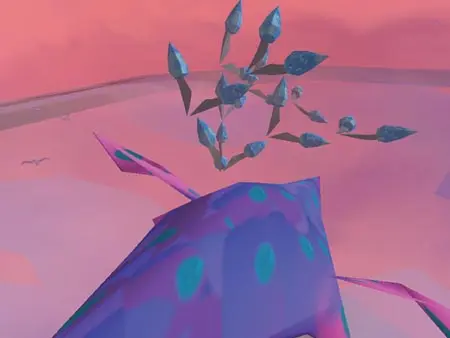
Possibly the most ambitious piece in the whole show is Ecosystem by John Klima (2000). Klima created a video game that takes place on an enormous projection on the wall. The variables in his system are represented by flying creatures (they do not completely turn into birds) and by vegetal forms that serve them more as prey than as food. The intensity of the ensuing attack/consumption is connected to the real-time fluctuations of the stock market in the geographic area over which the flying creatures are passing. The position in each moment is controlled by the spectator with joysticks. But the seriousness of the subject matter doesn’t really compensate for the fact that a real video game is much more sophisticated and, of course, much, much more fun.
The sound section, distinctly separate from the visual installations, proves that the track Sussan Deyhim made for Shirin Neshat’s famous video Soliloquy survives and maintains its hypnotic power without the aid of the images. Jonathan Bepler, in his The Man in Black, used the sound of the flapping wings of 200,000 bees, added to effects by batterist Dave Lombardo and a text read from a letter by Gary Gilmore before he was executed in 1977. It is the most interesting piece in this section. Most of the other artists stick to sound collages and repetitions taken from different sources. It is a similar strategy to the one in vogue for the last several decades. Most of the section sounds like a big homage to John Cage without, unfortunately, transcending his work. The memory of Fluxus (in their majority admirers and disciples of Cage) during the sixties, is overwhelming. Yasunao Tone, a former Fluxus member, is here as well, with a CD of an older composition covered with perforated adhesive tape. The CD player, frustrated by the obstacle, emits transformed and cacophonic sounds.
A small parallel show, Data Dynamics, takes place in what normally is used as the “project room.” Here one finds some pieces that use the Internet. They are less focused on the idea of a product and more concerned with situations and interactions and, therefore, potentially more interesting. But it is only potentially. These were the pieces that could have touched on topics more connected with the structural changes we are undergoing. However they restrict themselves to a mixture of some voyeurism with documentation and pomposity. At least they do end up challenging museographic techniques. The show raises issues of availability of equipment and space for the public, time for manipulation, and quality and resolution of presentation. If, on the other hand, the access from a personal computer would be easier (there are pages that don’t open, incomplete connections and various frustrations) one could even prove the obsolescence of the museum as we know it. In fact, however, a visit to places like www.rhizome.org is much more comfortable and fun.
A dozen years ago there was an exhibition of computer art in the now defunct IBM gallery in New York. In the review I wrote at the time for Arte en Colombia4 I said: “The perspective for the future is fascinating for the positive and the negative. On one side, access to technology will allow for a correction of the creative act. On the other side, the schism between development and underdevelopment will grow, and the art of the economies on the periphery will increasingly be confined to the level of arts and crafts.” The exhibition at the Whitney shows that the panorama hasn’t changed much and that I am not a good prophet. The correction of the creative act hasn’t taken place yet. For sure, the difference between developed and underdeveloped economies has been growing, but that is not a problem related to art. And I have to admit that computers have become more accessible than I expected at the time. Furthermore, shows like the one in the Whitney Museum ensure that my fear that the art made on the periphery be segregated into an arts-and-crafts category remains unfounded. Everything seems to stay in the same pot.
NOTES
1. In a recent article in Scientific American (Max Tegmark, John Archibald Wheeler, “100 Years of Quantum Mysteries,”2.2001, pp. 69-75) the case is discussed of a playing card standing on its edge in perfect balance. It has a 50% unpredictable probability of falling face up or face down, of becoming 0 or 1 in the binary terms used in computer programming. The authors analyze the evolution from the “classic” theory, where the card falls one way or the other, to the “decoherence” theory, where the balanced card has both states coexisting and, in fact, falls into both positions simultaneously in a state called “superposition.” Although the example of the playing card is not completely real, the decoherence theory seems to satisfy the contradictions that appear in quantum analysis on a sub-atomic level and allows for the interference of a single photon to revert conditions to the classic theory (the card falls face down or face up, but not both ways at the same time). Decoherence theory accepts the simultaneous existence of all possible states. Of all those possible states, the one registered is that one coherent with the information already registered (the “past”) in the environment in which perception is taking place. “This ‘information’ is stored in the environment in the form of the movement of atoms or light waves or other particles that encounter the object in question.” (Tom Siegfried, The Bit and the Pendulum, John Wiley and Sons, NY, 2000, pp.183-184).
2. Bitstreams and Data Dynamics, Whitney Museum, New York, March 22-June 10, 2001
3. “Art and Science,” ArtNexus #39
4. “La computadora y el arte,” Arte en Colombia #39, February 1989, pp. 52-55.
LUIS CAMNITZER