
The sensation felt after immediately entering the Museo de Arte Contemporáneo was that Coqui Calderón’s retrospective show proposed something beyond the mere chronological arrangement of her works. Unlike most retrospective shows of Panamanian artists held in recent years, this exhibit was presented as a “total oeuvre” that gave consideration not only to the inventory of paintings, but also to the need to establish the show within the framework of academic study, with reflections on the artist’s historical moments, her conscientious use of the exhibit space, the publication of a catalog with an in-depth text and reproductions, or even a didactic proposal or a brochure for the exhibit’s visitors. All this is a working frame for a selection of works spanning the last four decades of the 20th century that shows the artist’s enormous productivity and the progressive steps in her development as an artist.
The exhibit’s montage at the Museo de Arte Contemporáneo was achieved through a system of temporary cloth walls that served as tapestries of subtle colors used as the background to the paintings and their chronology, changing color according to the period represented in each of the show’s five halls. Also, as part of each hall’s ambiance (done by the artist and scenographer Emilio Torres), a column showed copies of period newspaper clippings and photographs that —even without descriptive texts— reminded us of the socio-political situation of the times, inviting the visitor to sojourn not only through the artist’s development but also the different periods she has lived in. As an additional didactic element, the show included a monitor continuously playing a video with an interview with Coqui Calderón and information regarding her life and work. Those who took advantage of the opportunity to sit on the bench were able to listen to the artist herself talking about her work, in what constituted a valuable opportunity —especially for the student visitors— to draw closer to the person behind the works. Moreover, a few days after opening day, the museum announced the lecture, free and open to the public, held by doctor Angela de Picardi, author of the comprehensive study on which the exhibit was based and which constitutes the core of the exhibit’s catalog. These educational elements, so commonly found in museums around the world, were truly impressive, given the fact that generally, they are not part of exhibits held in Panama, where artistic education is sorely needed.
The works included in the show, which was curated by Carmen Alemán and Angela de Picardi, began with a group of early, dark, experimental, expressionistic works —landscapes, human figures, and still lifes that young Coqui Calderón created at the beginning of the 1960’s. Following them were a series of abstract compositions in which Calderón established, quite early in her career, her interest in geometry and color, as well as her ability to base her harmonies on a sense of movement both linear and formal. Curiously enough, several of her abstractions show a kinship with other Panamanian artists active during the 60’s, a fact that could give way for an interesting comparative study.
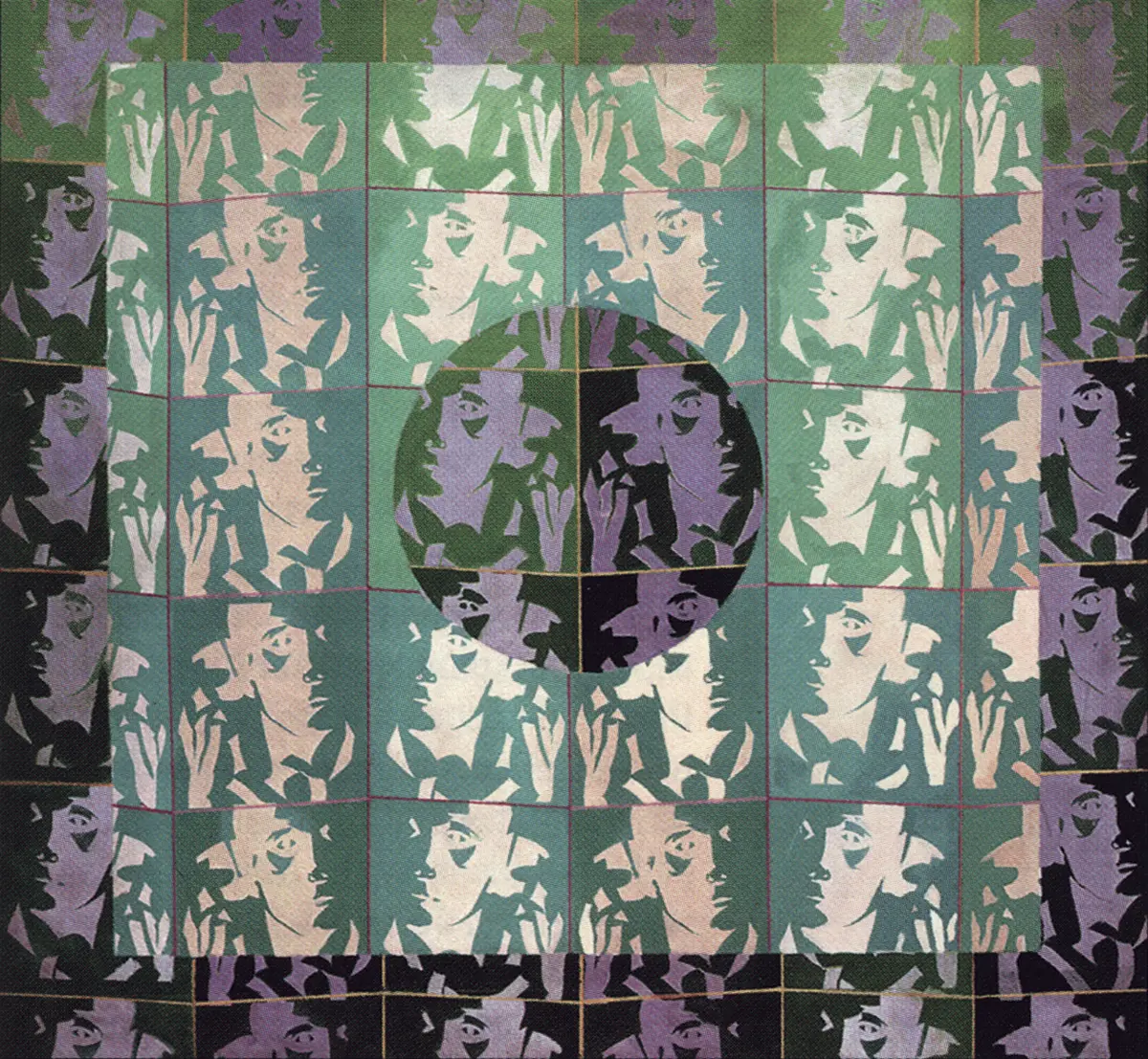
The 1960s, as documented in the valuable catalog text, were very active for Coqui Calderón, who during those years lived in Panama, Paris, and New York. Towards the end of the decade began what Angela de Picardi defines as her “kinetic phase,” which lasted from 1967 to 1979. It was an important moment for the artist, characterized by the use of acrylic, flat colors, and strong contrasts inside geometric, rhythmic, kinetic, and frequently symmetric compositions. It was the period in which Calderón was honored by Marta Traba in a Salvadorian contest, a period in which her works —such as Mujer con teléfono (Woman with Telephone) (1973), with complex rhythmic patterns in greens and pinks— contained social commentaries, reflecting the unsettling aspect of modern urban living.
The hall in which the works from this period were shown —works worthy of their own exhibit because of their quality and historical interest— suffered from a sort of visual saturation. A series of white dashes crossed the hall’s black floor, producing “a path” quoting the show’s title and at the same time dividing the hall, creating a space for the presentation of the video. At the center, the column of newspaper clippings stood surrounded (as was the rest of the show) by a circle of inscrutable white stones. At the end of the room hung the diagonal backdrops holding the paintings. All these elements produced a dynamic environment that encouraged the visitor to continue while at the same time visually competing with the period’s interesting and rarely seen works.
As it was well demonstrated by both the exhibit and the catalog, Calderón’s kinetic phase ended with the series Nalgarios (Buttocks), also characterized by the repetition of geometrical shapes, contrasts, and the important role that movement had within the compositions. Also, the retrospective exhibit clearly showed how, during the 1980s, the artist’s interest shifted toward the human figure and the landscape, in lyrical works heralding her focus on the nature of being a woman —a recurring theme that would hold her attention almost exclusively in the following years. However, there were some interesting interruptions around 1984, when she created a series of political works on paper and, again, between 1987 and 1989, when she painted a series of pieces titled Serie Panamá o Vientos de furia (Panama Series or Winds of Fury), where she protested against the corruption and lack of freedom imposed by military governments in Panama. These works are particularly valuable because they place Calderón as one of the few Panamanian artists who have used their art to uphold their political beliefs. Here we should highlight another innovation of Calderón’s retrospective show: the fact that the series of political works produced during the 1980’s were presented to the public in an alternate space —the Casa Góngora, a restored colonial structure located in the old section of Panama City. Since they are works that do not quite fall into the artist’s thematic development —although they do so stylistically— it seemed appropriate to use another exhibit space, in which the video of the artist was also shown. (Similarly, her most recent works were shown in the Galería Arteconsult.)
The period corresponding to the 1990s, during which she produced pastels and acrylics applied on canvas, was presented in the Museo de Arte Contemporáneo’s top floor. It’s a period characterized by landscapes, still lifes, and, toward the end of the decade, multiple interpretations of landscapes and women —these sometimes depicted as angels or as Mother Nature, but always as compositions with geometric backgrounds and intense colors. Noticeable within the context of the retrospective show were the studies made by the artist (which are normally tacked on to her studio walls), exhibited today as precious miniatures of color and composition. At the same time, they stand as quiet explanations of her working method, from the draft to the large canvas. These large paintings are the ones occupying the show’s last hall, which was impressive in the harmony of the montage. Their works rich in color hung over temporary walls painted with tranquil tonalities that multiplied the space available, producing a successful atmosphere.
Coqui Calderón’s retrospective show should have remained open for more time than the programmed month, not only for its historical value but for the opportunity it gave the public at large and connoisseurs to draw their own conclusions regarding this Panamanian artist. We should note, as part of this purpose, the depth and extension of the historical study accompanying the show, which highlighted Calderón’s artistic developments alongside a stylistic analysis of her works. Together, these elements contributed to present the achievements and experiences of this distinguished artist’s career. Which, by the way, should be the legacy of any good retrospective show.
MÓNICA KUPFER