
The Kurimanzutto gallery found the perfect space for its artist Daniel Guzmán’s solo show inside the covered garage of a 1950s house in Mexico City. Hijo de puta (te he estado observando, ya sé quién eres) (Son of a bitch [I’ve been watching you. I know who you are]) was the title for this retrospective show of drawings, newspaper clippings, photographs, texts, and other objects both created and found, from which the artist articulates his intimate world.
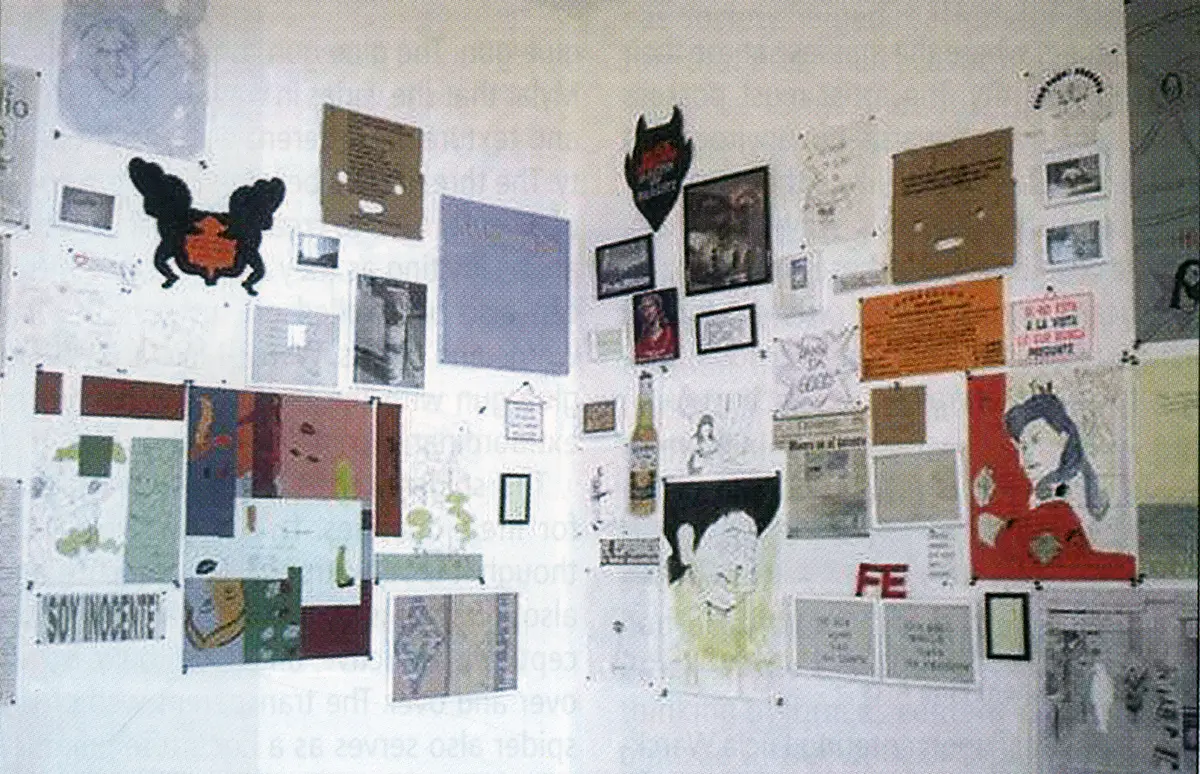
In this exhibition, Guzmán comes across as free of inhibitions and unafraid to be seen. Once impersonalized, intimacy becomes something to be shared instead of something to be ashamed of. At 36, the artist reviews his therapeutic and almost unconscious work of collecting images and phrases that, in time, have attracted his attention, in a place where gregarious discourse detonates a personal signifier. The collector’s persistence and the impulse to appropriate, through the techniques of modern art (drawing, design, collage, found objects), have guided, within a dominant culture, the search for a subjective identity. Foucault has pointed out that freedom is having the possibility of creating oneself, the non-coercibility of imagination in the face of the discourses of power. Although identity is not in itself and for itself, and although the subject is nothing more than the accumulation of its heritage and its determinations (social and genetic), any particular way of managing all this information will always be the product of a given subjectivity, and identity held together by the individuality of a proper name. The sign-value or the symbolic value of each of the materials present in this exhibition may be random but their collection and arrangement are singular.
Fe, esperanza y caridad (Faith, Hope, and Charity), one of the show’s three pieces, is itself a triptych on three walls, composed as a collage, where every drawing, clipping, or phrase, whichever its provenance, joins with the rest in the formation of a heterogeneous narrative where a disenchanted subject is portrayed, a subject whose ironic gesture opens the possibility of redemption for conscience.
Besides this piece, the artist made a video, recording himself singing those songs that have marked him sentimentally, an act of memory guided by background melodies that accompany the workshop’s activity; an intervention in mood, airborne phrases caught by his heart. The third piece is a mountain of audiocassettes, the corpses of a mass-mediatic consumption of identity, icons, rhythms, and names that have determined the musical taste of two generations, imposing styles, ways of life, and values with which to identify and grow. On top of this secular pyramid, written on a piece of cardboard, we read; “Only the false remains.”
Self-portrait and mirror, the totality of this work crudely reveals a face; feelings are aroused more by pain than pleasure, and in the end, experience is not bitter but conciliatory. Surprisingly, it is that very skepticism that fuels faith, hope, and charity; it is irony, not pity or guilt, that makes art out of introspection. Dignity is to be found within contradictions, and expression itself is redemptive.
Fe, esperanza y caridad was also the title of a film trilogy made in 1972 by three independent filmmakers. Each of these three maxims is interpreted through the social reality of the Mexican lower classes, which are the most fervently religious. For the three virtues to emerge, the individual experiencing them must face fatality; without resignation, there is no revelation. With these three foundations of Christian dignity, Guzmán, in turn, structures his own search for knowledge, love, or sex, but it is disillusionment, the poisonous stinger, that leads him to spirituality; loss is the engine of art, and frustration, a creative impulse.
Waving the flag of counterculture, being beatnik and punk, using the aesthetics and the phrasing of comic books, and embracing a rock-n’-roll philosophy, Guzmán creates a contemporary countenance —multiple, disoriented, more informed but also more deformed, multidisciplinary, multimedia. Today’s artists must be close to the world of entertainment and consumerism, for it is there where the masses satiate their need for identity. The artist must possess great sensitivity towards his environment and be able to register, like a thermometer, the rise of the moment’s symbolic values, double-reading events (those apparently insignificant breaks in the order of things) which, ultimately, keep the individual’s diversifying impulse alive.
ITALA SCHMELZ