
Diana Dowek’s painting is committed to the time’s social causes. In the 1970s, the singularity of her critical gaze placed Dowek among the major representatives of the decade’s definitive realism. This realism, in Argentina, was characterized by its distance from photographic mediation, as it had been adopted by the hyper-realists and the abandonment of “hard” objectivity in favor of a greater subjective charge in the transcription of images. Attentive to current events, these artists didn’t fail to offer their own interpretation of them.
Dowek’s experiences, shared with her contemporaries, were the stepping stones and the stimuli for the justification of her artistic practice. This made her one of the artists who, in the continuity of their work, bear witness to the painful, dire events of recent Argentine history. Dowek’s exhibition at the Museo Nacional de Bellas Artes, with works from the 1970s to the 1990s, provides good evidence for such an assertion.
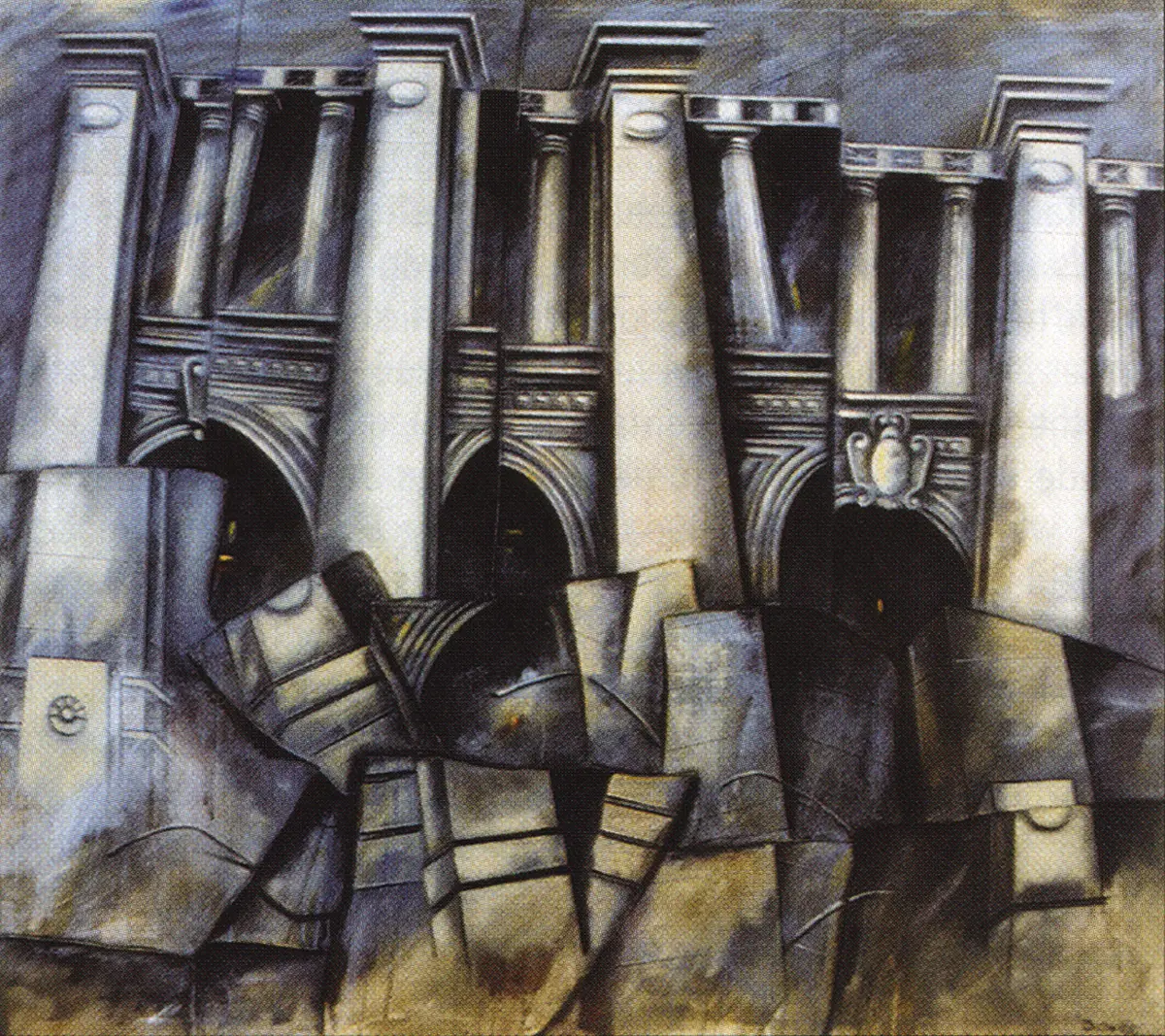
The works exhibited here reveal the need to turn directly communicable the images’ content, without stopping at the level of the merely anecdotal or illustrative. Strengthened by the singularity of her technical resources, she used emblematic, easily decodable figures such as barbed wire or grass moving in the wind. The former named symbolically oppression and repression; the latter brought to the fore connotations of spontaneity and vitality, with their implicit meaning of freedom.
Dowek’s open-field escapes and rearview mirrors (from those menacing 1970s Falcon automobiles), gave way in the 1980s to the Las heridas del proceso series (The Wounds From the Process, in reference to the military process of 1977-1983, among the most sinister episodes in Argentina’s troubled history). Here, the slit canvas, sewn with wire, as well as those frames seen from behind and the torn pieces of paper, turned corporeal the metaphors of torture and violence.
Also made in the 1980s, Dowek’s representations of the Madres de Plaza de Mayo (The May Square Mothers). Here the protagonist is the white kerchief worn by those brave women who demanded —and still demand— the return of their disappeared sons by walking tirelessly around Buenos Aires’ main square.
Towards the end of the 1980s, Dowek’s series of postmodern lovers shifted violence into the environment’s indifference toward human needs. Swift encounters couples making love clandestinely, under neon-lit highways —these images made manifest that humankind’s most vital necessities, such as shelter and protection, have been expelled from the paradises that modernity built and postmodernity, to its chagrin, has inherited.
In the 1990’s, Dowek centered her gaze on the institutions of power. The fragmented façades of huge government buildings —the Judicial Palace, the National Congress, the House of Government— signal an imminent toppling caused by advancing water and fire, symbols of erosion and destruction.
Some of the elements that singularized Dowek’s early work are condensed in the artist’s more recent series of “interiors.” Dowek’s gaze is turned now inwards —or better, to the point of articulation between “inside” and “outside.” As with the public building columns, furniture in different rooms (bookshelves, tables, chairs) is unable to contain or support anything. Different planes clash, destabilized by the interplay of diagonal lines and the anarchic reflection of the parts with one another.
The drama of Dowek’s later works is not located in the streets, but in a room’s sheltered intimacy; it is not politics but individual conscience. These works refer not to the ruptures in a social equilibrium but to the ruptures of individual balance. They also make clear that, beyond the shifts in content and scenery, the critical perspective remains the same. And it not only refers to instability; according to the artist, those who resist can survive the fall. She says, “There are many ascents and many falls. Movement is constant and uninterrupted.”
ELENA OLIVERAS