
The visitor enters a dark hallway, only illuminated by the video projection of two hands manipulating some strange, small objects. Recorded male and female voices whisper again and again: “Touch, don’t touch, touch,”. On the screen, the hands in the shadows hold, fondle, and tumble the mysterious pieces repeatedly, as if they were performing some alien ritual. To the left of the screen, there is an unguarded, dark chamber with a glowing, frosted, plexiglass console in the center. Inside an open compartment of this piece of furniture are the objects seen in the video, exposed and vulnerable, ready to be touched by the visitor who has just seen them being handled on the screen. But as soon as the visitor approaches his/her hands to the table, a video camera becomes activated and the image of the visitor’s hands is projected on one of the walls of the chamber. The surveillance video turns off as soon as the hands are removed. A space, that initially seemed private, is transformed by the camera’s eye into a public chamber. The visitor is confronted with the option of touching in exchange for being “exposed”, watched, and probably recorded by an inhuman eye.
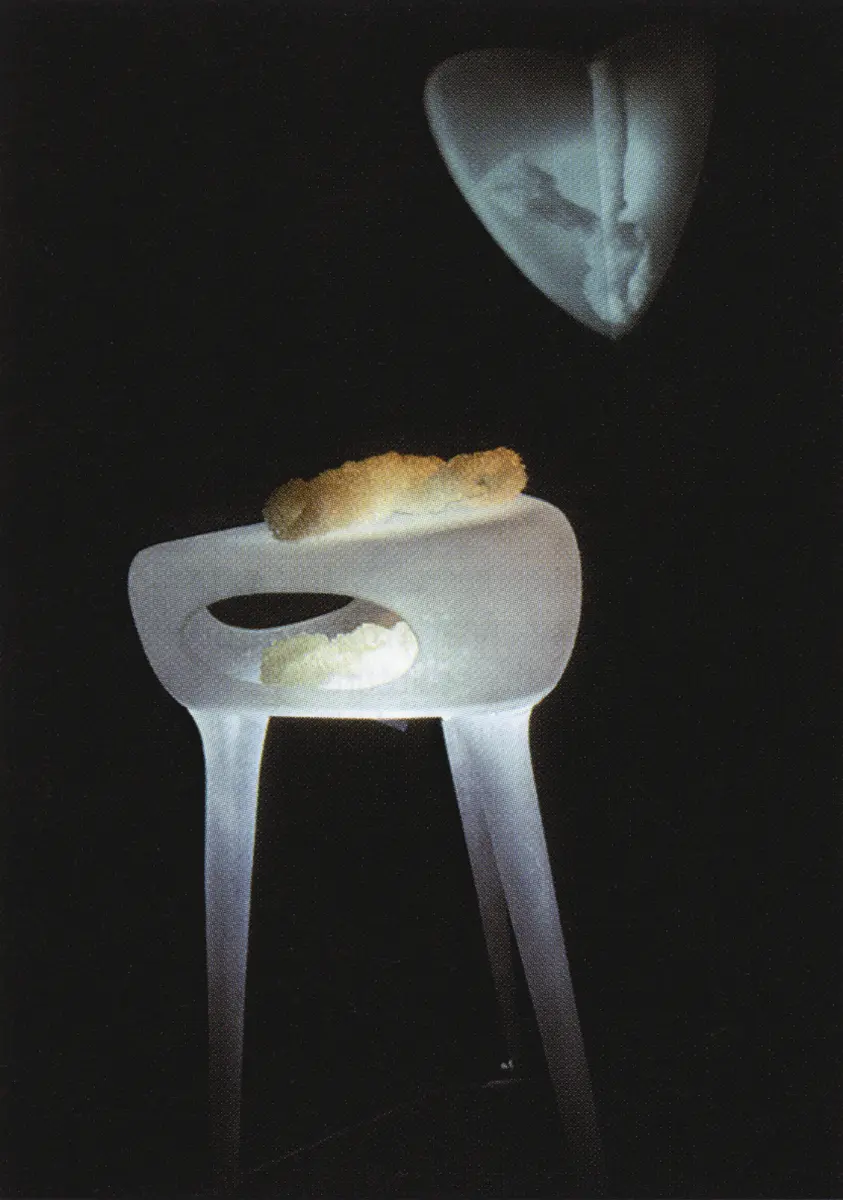
Ingrid Menéndez’s Permanent Visibility is an interactive, multimedia installation involving sculpture and video technology, which comes alive with the willingness or the reticence of the visitor to participate and be caught on camera. The sculptures, made of knitted nickel wire and crocheted plastic lanyards, are according to Ana Tiscornia, “Metaphors for containers and barriers at once protecting and menacing.” The tactile objects are hollow forms and flat shapes made of enmeshed fibers that encourage bending penetrating, stretching, and rattling. These organic figures invoke traditionally feminine domestic handicrafts, while they are made of industrial, and thus conventionally masculine materials. By using these particular objects, Menéndez creates an obvious gender reference: the feminine sphere becomes the manipulated subject under permanent scrutiny of the male gaze. Just as the sculptures seem to be pieces of a fragmented whole, the visitor’s hands become disembodied through the lens of the camera.
Menéndez (Caracas, 1963), is interested in exploring the relation between the self and society and she does so by experimenting with media and technology. As Donna Haraway puts it in her indispensable A Cyborg Manifesto: “By the late twentieth century, our time, a mythic time, we are all chimera, theorized and fabricated hybrids of machine and organism; in short we are cyborgs.” Men and women are cyborgs, fusions of the organic with the man-made. We depend on biology as much as on a variety of technologies, from language itself to a vast array of gadgets, extensions, and prostheses (telephones, watches, computers) that have become almost indispensable elements of our anatomy and social interactions. Most of these devices have created and established links between the individual and society, but more importantly, they have molded our consciousness in terms of the interfaces we use to relate to them. Culture, whether we like it or not, is today human engineering, and Menéndez tries in her work to deconstruct the trappings of omnipresent surveillance machinery and our reactions to it.
When faced with the videotape in a media-controlled society we become aware of the fragility of privacy. Just as we feel strange “talking to a machine,” when we leave a message on an answering device, our attitude is transformed when we know that our actions are being registered by a camera. This turns the instantaneous gesture into an archival memory or a file that can be analyzed in real-time or in the future by strangers or by some inscrutable software program. As Menéndez points out, the most ominous example of the sinister use of surveillance cameras was on display during the 2000 Super Bowl, when face recognition software was used to compare each and every person in the stadium with the criminals and terrorists of a database. In June 2001, this technique was applied again to every person on the streets of a district in Tampa. These two events, considered by government officials as very successful, announce the imminent future of surveillance in a time in which we are going to be under increasing and permanent visibility; a time in which the tools that are supposedly there to protect us will transform us into involuntary players in a strange and trance-like paranoid drama.
Permanent Visibility places art objects as bait for the visitor in order to intertwine feelings of surprise, amusement, and guilt. But moreover, Menéndez's work is an interesting exploration of our interactions with non-human eyes and ears, and the boundaries that we construct around ourselves in a world infested with peering eyes where being alone doesn’t mean anymore being by yourself.
NAIEF YEHYA