
British-born artist Isaac Julien collaborated with Venezuelan-born choreographer Javier De Frutos in the creation of two richly evocative and unsettling film installations, The Long Road to Mazatlán, 2000, and Vagabondia, 2000. Both were part of an exhibition that included works by Paul Pfeiffer and Johan Grimonprez, as well. Julien’s works seduce the viewer through a provocative, semi-narrative sequence of images filled with iconic, but multi-layered characters.
The Long Road to Mazatlán manipulates the cinematic symbols of the Hollywood Western, projected in three frames across an expansive horizontal screen. The twenty-minute film explores the sexually charged interchanges between two cowboys, set against the dusty landscape dotted with sagebrush and poisonous snakes, the cattle auction “theatre,” the saloon filled with the lovelorn songs of Mexican Mariachi’s, the intimate enclosures of a motel room and a private pool. Through Julien’s lens the cowboy “uniform” of a gallon hat, low-slung jeans, and almost perversely pointed, cowboy boots, assumes erotic significance in this film, enhanced by the movements De Frutos prescribes the two, self-aware young men.
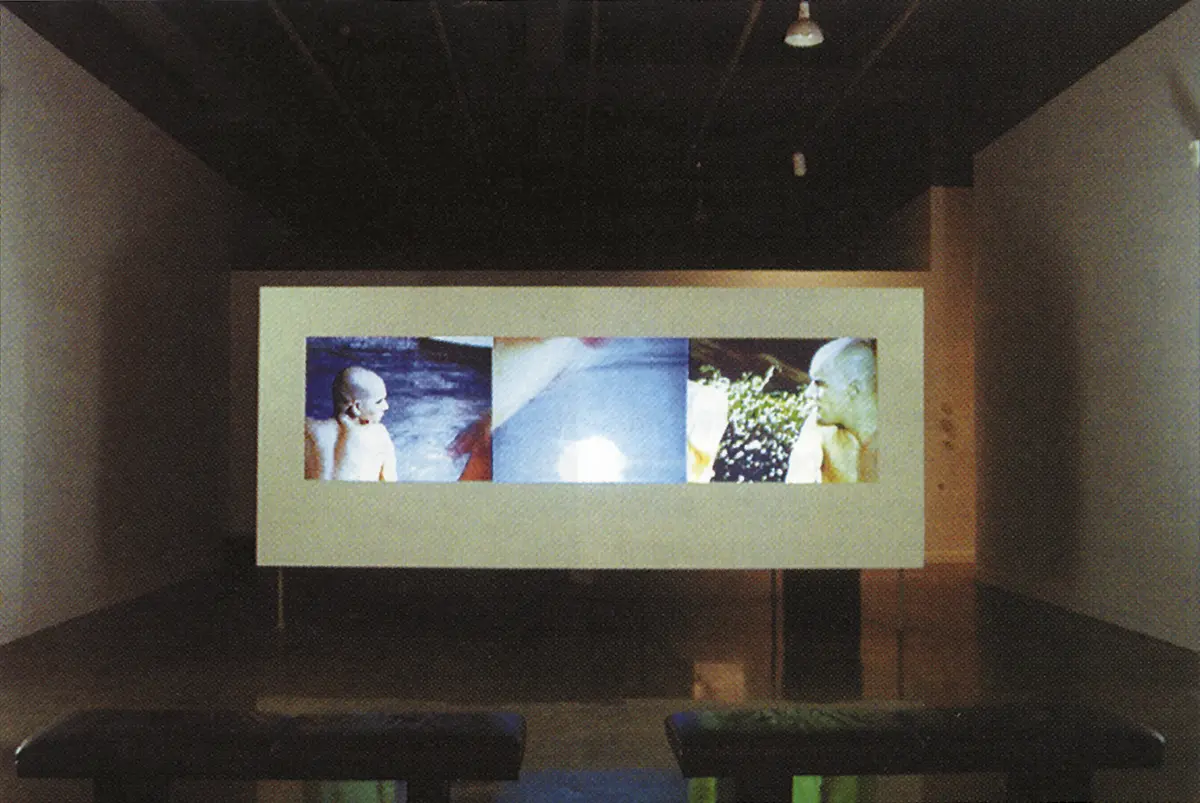
Together De Frutos’ choreography and Julien’s potent frames establish the film’s provocative stance. From the outset, the viewer is aware of the cowboys’ physicality, imparted through close-ups of their faces, torsos, and legs, their eye contact in the bar and auction theatre, the graceful manner in which they hold and move their bodies, separate at first, culminating later in the explosive intertwining of physiques within the lush, pool waters. The sounds of flowing, then rushing, water heighten our sense of their sensual play.
Perhaps the most unsettling segment in the film juxtaposes frames showing the lithe, long-limbed cowboy drunkenly singing and dancing along a stretch of desert highway, with the adjacent frame projecting a group of garishly costumed, carnival performers, repeating their rhythmic song and dance routine along the same, desolate road. The incongruity of these brightly feathered and sequined dancers, of indeterminate gender, performing within this forgotten landscape, jars the viewer, accentuating the ambiguous state of the inebriated cowboy.
Vagabondia, Julien’s newest film installation in collaboration with De Frutos, explores with palpable, disturbing effect the seen and unseen worlds of an art museum and the characters who inhabit it. The installation begins with a crimson velvet curtain that leads the viewer into a faux, museum storage space with maroon walls covered by gray packing quilts. From there one opens another velvet curtain and enters a blackened room bearing a horizontal screen projecting two distinct, but related frames. The projected film emits the only light in the room. The cloying scent of perfume permeates the air. The viewer, stumbling in the dark to find a chair, immediately is drawn into the labyrinthian tale, based within the Sir John Soames Museum, the collector’s cramped, shadow-filled London residence.
The film peers through the winding rooms filled with old paintings, ancient sculptures, and heavy furniture, focusing briefly on the guard and the prim art conservator as she prepares to restore an antique canvas in a gilded frame. Dramatic, unsettling music suddenly fills the air. On one screen we see a suspicious man, a character Julien based on British artist, John Hogarth’s Vagabond figure, a 17th-century man dressed in disreputable costume. He erratically jostles about the space, first surfacing in the museums’ back corridors; a mere wall, but worlds away, from the fastidious conservator. The vagabond furtively winds his way through the crowded rooms, menacingly touching the priceless pieces. The flippant and erratic movement De Frutos has assigned him, defines his character as much as his odd dress and facial grimaces.
Julien’s six-minute film deeply unsettles through his portrayal and juxtaposition of divergent but dependent images. The viewer grows dizzy melding the frames of the clock ticking, perfectly composed museum personnel with those featuring the wildly, provocative vagabond, whose presence appears in shadowed light and fractured glances. One leaves the installation, struggling to escape the almost hallucinogenic experience of simultaneously opposing worlds, exaggerated by dramatic sounds, an oppressive scent, and the surrounding darkness. Julien and De Frutos’ work resonates profoundly by celebrating film’s seductive powers —the moving image spinning an engaging tale—and by complicating the medium’s usual flow with palpable intrusions. The heady, unsettling installation, the frames separately projected and bled together such that the distinctive views collide and meld, and finally, the manner in which the choreography defines and disrupts the narrative, are qualities that create the unexpected and lasting impressions generated by these two film installations.
MARY SCHNEIDER ENRÍQUEZ