
In the catalog for Javier Rodríguez’s Descendencia (Lineage) exhibit we read: "Late, by myself, in the boat of myself,/no light and no land anywhere,/cloud over thick. I try to stay/just above the surface, yet I’m already under/and living within the ocean." This beautiful poem written by Jelaluddin Rumi (XIII c.) could very well describe the content of Rodríguez’s (Venezuela, 1975) collages and boxes —all of small format and constructed between 1999 and 2000 with mixed technique over paper or wood. This is the first exhibit of a young man who’s been living in London for four years and demonstrates a talent for treating pictorial surfaces based on various media.
The lyrical and the playful result from an artistic will, both evocative and incisive, resolved based upon two processes. Thus he produces, simultaneously, two realities of meaning and two artistic climates —collage and painting. The first is resolved through appropriation and use of preexisting images extracted from the history of art’s iconic works; and the second is through the pictorial work done on hazy and tonality-rich backgrounds, where the characters take over by emerging from the deepest planes, superimposing themselves until they reach the outermost planes. From here we could define duality as a fundamental quality of his work —opposition and dialectic of what’s painted or appropriated, of figuration and prefiguration. As if in an initiation rite, he places his characters on a new order, both artistically and in terms of meaning.
This duality also manifests itself in the two operations performed by the artist. The first is the aggressive, almost sacrilegious, act of cutting religious emblematic figures and then lovingly placing them on dreamy surfaces and surrounding them with poetic atmospheres. A manifestation of the masculine and the feminine.
Javier Rodríguez’s artistic interests center around the mutilation and reordering of elements on the support, and the meanings are expressed as an act of purification of the characters flying and lovingly interrelating with one another. The composition is singular. Following determinate paths over which the figures move, he opposes empty spaces with full ones. For example, in Trascendencia (Transcendence), the duality evidences itself by means of contrasting the cut figures of Adam and Eve at the moment of being expelled from Paradise, on the right-hand side, with the void that holds what seems to be an imperceptible group of figures or shapeless stains, as if they were the unfinished souls of the expelled. Something similar occurs in the dichotomy of pairs found in El circo (The Circus), where we encounter the circus-like figure on the right and the mysterious, shapeless stain on the left. For Rodríguez, the separation and reconciliation of shapes is a creatively magic gesture.
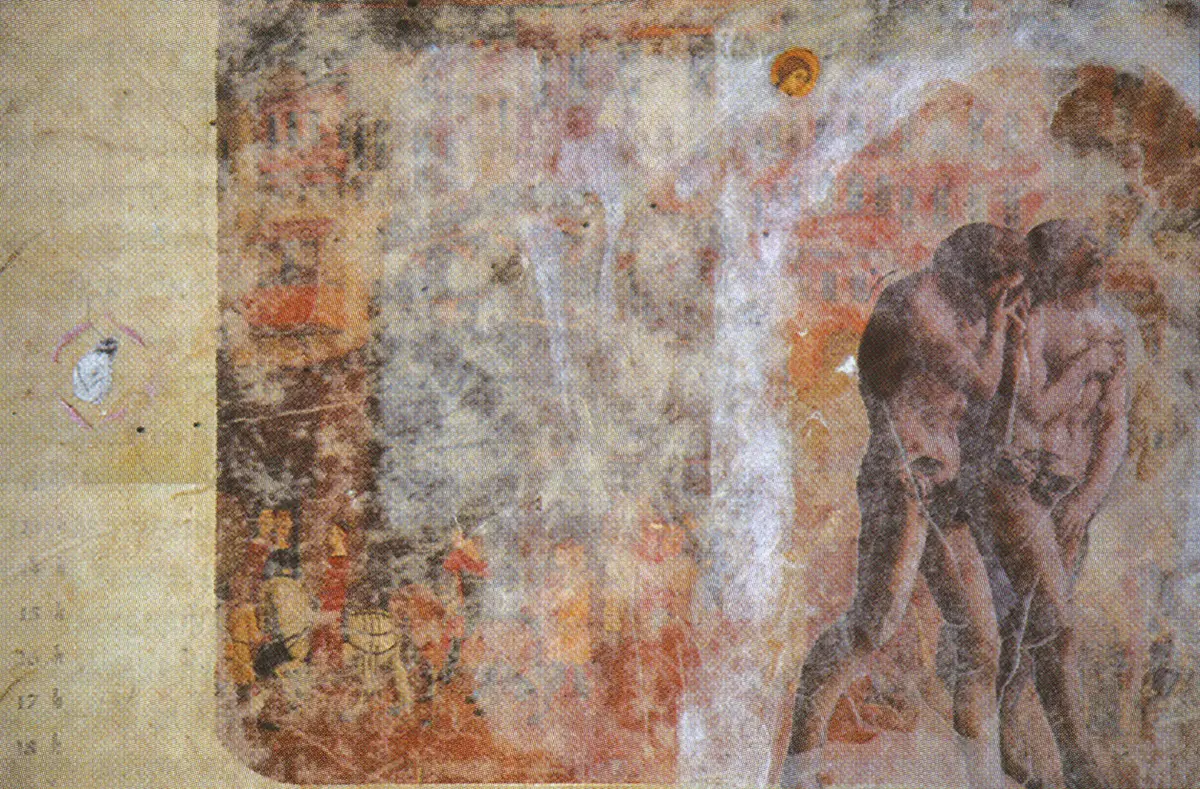
When we see the results he obtains with his collage-painting technique, a defining, poetic, and technical opinion by Max Ernst on his own collage works comes to mind: "If the plumage is made up of plumes, the collage is not made of collas". In this case, Javier Rodríguez incorporates collage into the game of visual and textural elements found within the pictorial process. All of it derives from an intimate and mysterious composition. He feeds off a heteroclite repertoire of images; he mixes the sacred with the profane on subliminal backgrounds with hazy, colored stains populated by characters whose nakedness, facial expressions, and positions —in many cases as if swooning— interpret a pain that’s mystical. The silk paper wrinkled by hand and the oblong-shaped colors ranging from tenuous ochers, golds, blues, reds, or yellows, are determinant in creating the space’s affective temperature. Nothing is static. Meaning and content are resolved in infinite atmosphere and time, in the mystery and the intimacy.
BÉLGICA RODRÍGUEZ