Since his first works alluding to the object-memory relationship, Juan Carlos Delgado has worked simultaneously with objects and painting. His first great installation was made of a series of shoes that were able to summon the absent presence of their owners. The installation showed us how the absentee continues living in his or her objects and becomes their prolongation. Once the hall was darkened, some of the shoes made of phosphorescent material generated the sensation of floating light —the same light that man carries inside himself. The series Rojos y rosas (Reds and Roses) was made up of fields of color in the fashion of a chromatic field of energy. Some figures insinuated themselves behind those color zones. Due to the haziness of the figures and the background, those paintings forced a perception that was more molecular than subtle.
He also developed paintings that were more in the classical tradition, successive variations of the works of master artists such as Velázquez and Vermeer. In those works, the painting was constantly making and unmaking itself. Such intention of structuring by means of (maybe) unstructuring became a contemporary entity to destabilize the limits and reach of painting, a process began by the Baroque. After this stage in painting, he returned to experimentation with materials and objects. With smoke he drew faces on lime-based wood; the figures seemed to be eternally flowing from black to white. Once again light and darkness danced together to generate a “birth” from the dark entrails of memory.
Afterward, he placed beds in natural and urban environments. Under them, he deposited black oil against a black background. The beds’ surface turned into a sort of canvas, or void, or a black mirror reflecting the cosmos. Once more we find the image-generating power that absence and emptiness have. The beds also made us think of dreams as the source of the images conceived inside the night’s uterus.
For his most recent installation, he placed light boxes in key places around the city. Each one of them evoked the breath of life, or memory, that remains in all places.
All these topics and strategies reappear in this exhibit, but they are reshuffled in order to achieve a farther-reaching installation. Due to both the placement of the pieces and the tense relationship between them, space has been de-centered. Neither of them creates a link with space in the same sense as a figure against a background. The spatial quality activates and becomes a protagonist, it folds within the show’s physical limits as well as outside them. Some pieces create an imaginary prolongation onto the walls, inviting new associations of meaning.
The boundaries of the pieces are fragile and extend into one another. We are therefore captive and vaporous condition of the notion of limit, which only marks the possibility of overflowing its boundaries. Under these circumstances, the show became a huge mirror in which physical and mental images interwoven with one another in an incessant dance of movement.
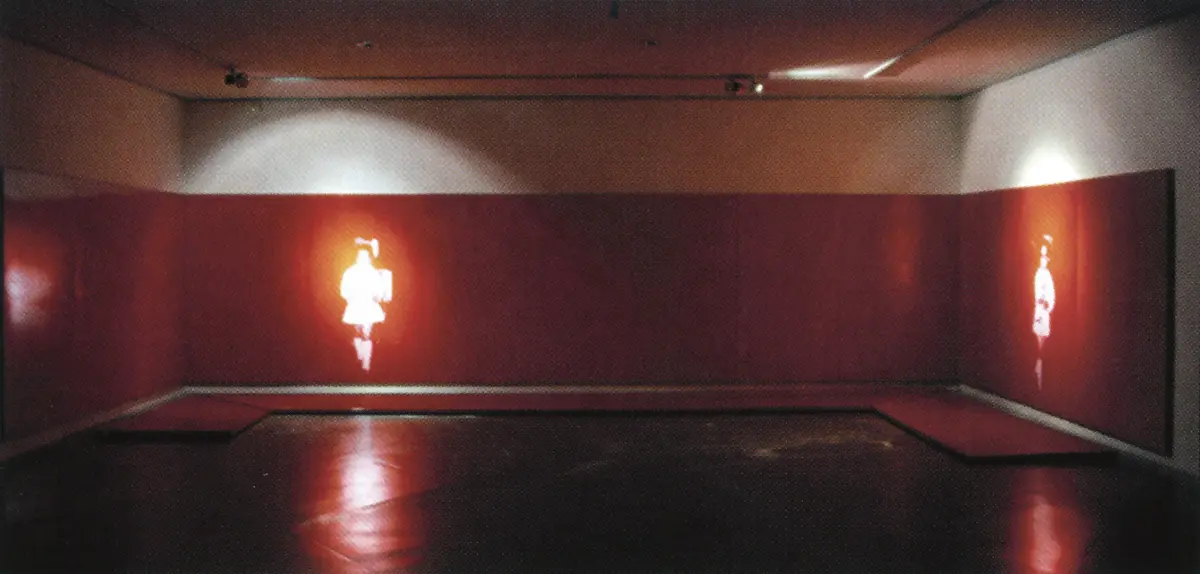
The show is made up of the elements that the artist has traditionally worked with —objects and paintings. On the painting’s side, we find a wide, highly energetic red zone. The frame has been lost; we feel a sort of pictorial art transcending and substituting the idea of a painting’s “frame.” This zone extends downwards to the floor, and there we find a reflective red space that behaves as a chromatic mirror mixing the images buried in the painting as well as potentially other zones in the surrounding space. Certain digital impressions emerge from some places of that special field. What is shown is not necessarily what ought to be seen; the visible matter is a veil inviting us to look more closely. In other words, what’s visible makes us see a certain invisibility. Such operation is present throughout the show. It’s a strategy both feminine and seductive —that which shows while hiding and hides while showing. Within the visible, we must decipher the invisible.
The idea of energetic strength and light is explicit and recurring. In one of the pieces we see a series of heads, some closed and some open. Inside the open ones, we can see a strong color red. The heads open and close as if they were breathing, reminding us of the silent fire that lies beneath respiration. Maybe they allude to that other fire, liquid, less visible but more substantial —blood. Memory, another of his thematic constants, joins the motifs of light and fire. In a certain part of the installation, we see some oars resting against the wall. On the floor, crushed glass simulates something aquatic. The paddles touching the water have faces imprinted on them. The object invites us to imagine those faces disappearing and appearing in the water as the rowing goes on.
Memory’s own rhythm seems to be suggested in that movement: for a moment something emerges from the depths and then returns to time’s hidden waters. We find something similar in the shoes and desks. One or the other is progressively incrusted on the wall until it almost disappears. But it remains vibrant, full of energy and meaning. This way the spectator if forced into experiencing sensations related to what’s beyond what has been perceived.
The frailty of limit, tensions between what’s present and what’s absent, between visibility and invisibility, the echoes and the reflections make images bounce about like soap bubbles, enlivening the show in a paradoxical condition —a minimized Neobaroque who is requesting a more fleeting perception, a perception that’s on the border of objects.
JAVIER GIL