
You missed the Galán show, but not to worry, your presence was not required. This was an ‘exhibition’ as a performative act—the act of making internal grief public. The grief was personal, not public, as is ever the case with personal loss; and internal emotions known by their public enactment. But wakes are more necessary for the living than the dead, and this was Galán’s wake for his mother, attended by his invented company of painted screen dreams simultaneously dead and alive: My Mirrors as mimetic devices.
“Mom” was laid out on a bright red ground, amidst dark paintings, hung at the center of the back wall and opposite the main entrance at the end of the promenade gallery hall. But “mother” (Portrait of María Elisa-Roma) was a dead sheep, the sacrificial lamb flanked by Galán’s attendant saints, here and throughout the show, by paintings of what is called in the business, “homoerotic” nudes, in various costumes—not in drag so much as decorated, swathed by a courtier who did not care whether the stylizations “suit” them or not. Sacrament and sacrilege fused through iconography. But what of the language of painting?
The figures are real and yet not real. Mostly absent are Galán’s abstract patterns, obvious still-life references, and figures rendered in the self-consciously crude, neo-expressionist systems of double-coded signs.
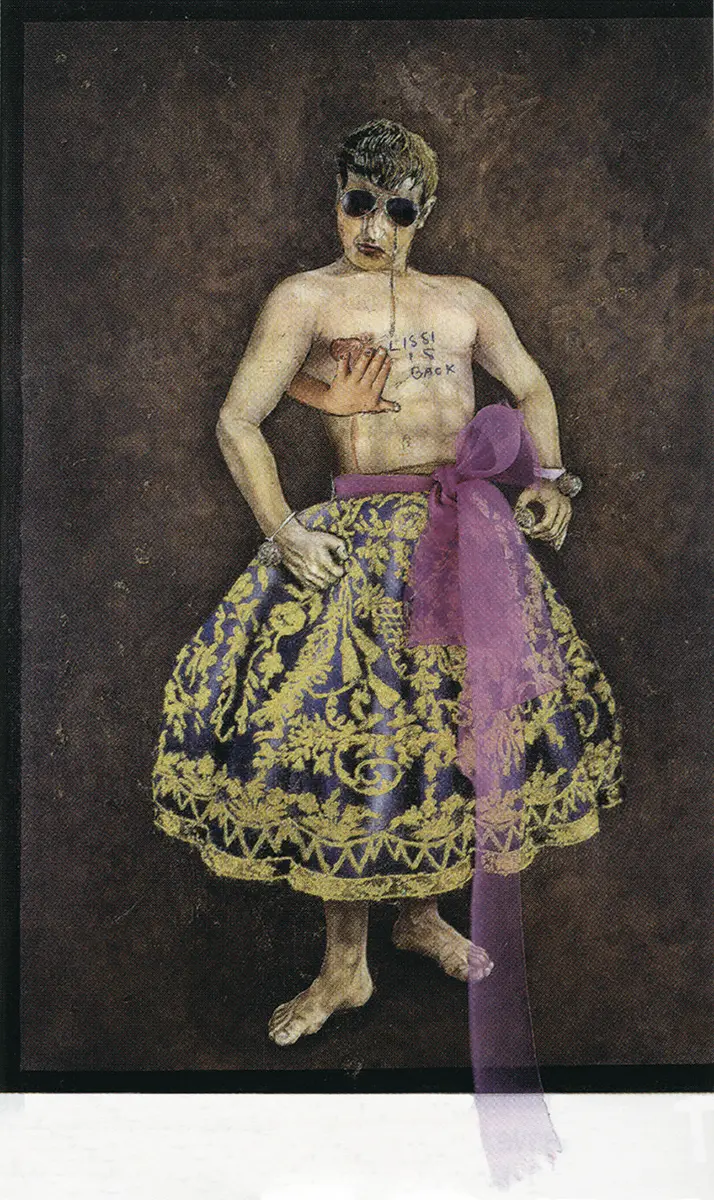
His sense of self-consciousness remains but is now harder at work. The mostly nude and frontal figures are rendered through academic modeling with frequent stress on physical tension through mannered body poses or the melodramatic use of foreshortening. Caravaggism lives on. But the modeling style also reinforces an underlying realism to establish a self-conscious contrast to his use of glittered patterns and fingernails. The collaged objects of private meaning stand apart from the figures, the “real” chiffon waistbands looped through the canvas, or the purple aviator glasses mounted to hide the tears. All the painted figures weep, as patron saints in mock-real grief. Over the 3-D modeling in oil rests an acrylic resin and pigmentation that coaxes many figures away from their physical realism into tension with the unreality of a cheap plastic carnival doll. The figures attend and testify, yet they mock. This is a grotesque retinue of avatars for Galán, who is known for his “comings and goings,” as he passes ghost-like through the conflated bodies of the living dead.
Galán’s self-portrait opens the catalogue, twice. The first photo is bathed in beatific orange-red light as he gazes forlornly heavenward in his black leather jacket and slightly bearded face. Next, he is Christ with a loincloth, bound and bloodied at the pillory. The upturned head and gaze of abandonment appeal to the unseen ‘father-mother.’ Opposite this man of sorrows is a poem that speaks of promises made and always broken because the sinful power of the body that “craves and desires” returns him at night to “fatal pleasure, lost again.” Many of the penises are covered with scrawls, apparently more rejected than accepted. So much for Mom! Or is it? What of such conflations, such crossings?
Mother/father, forgive me for I know not...In the face of the loss of a parent, we all ask ourselves in what ways we have been inadequate to an internalized vision of what “they” expected from us. Such snapshots come compliments of a super-ego, imprinted on us all by outside expectations, not of our bidding; both powerful and prohibitive, it crosses all parts of our lives. And that is what Galán’s mirrors present; fragmented crossings into the life of a Mexican, Catholic, gay, male, art-historically trained artist.
And there is confusion, guilt, dreams, and memories—normal displacements born of borders, boundaries, taboos, and now grief. Titles and words crudely scrawled across canvases ask of acceptance and returns, bundled in a language of Latin kitsch. Here in Gringoland, we do know not what to do with them. Is it good art: is it serious or authentic? The answer stems from Goya: Who can say? What crossings do we all bear?
RICHARD LESLIE