
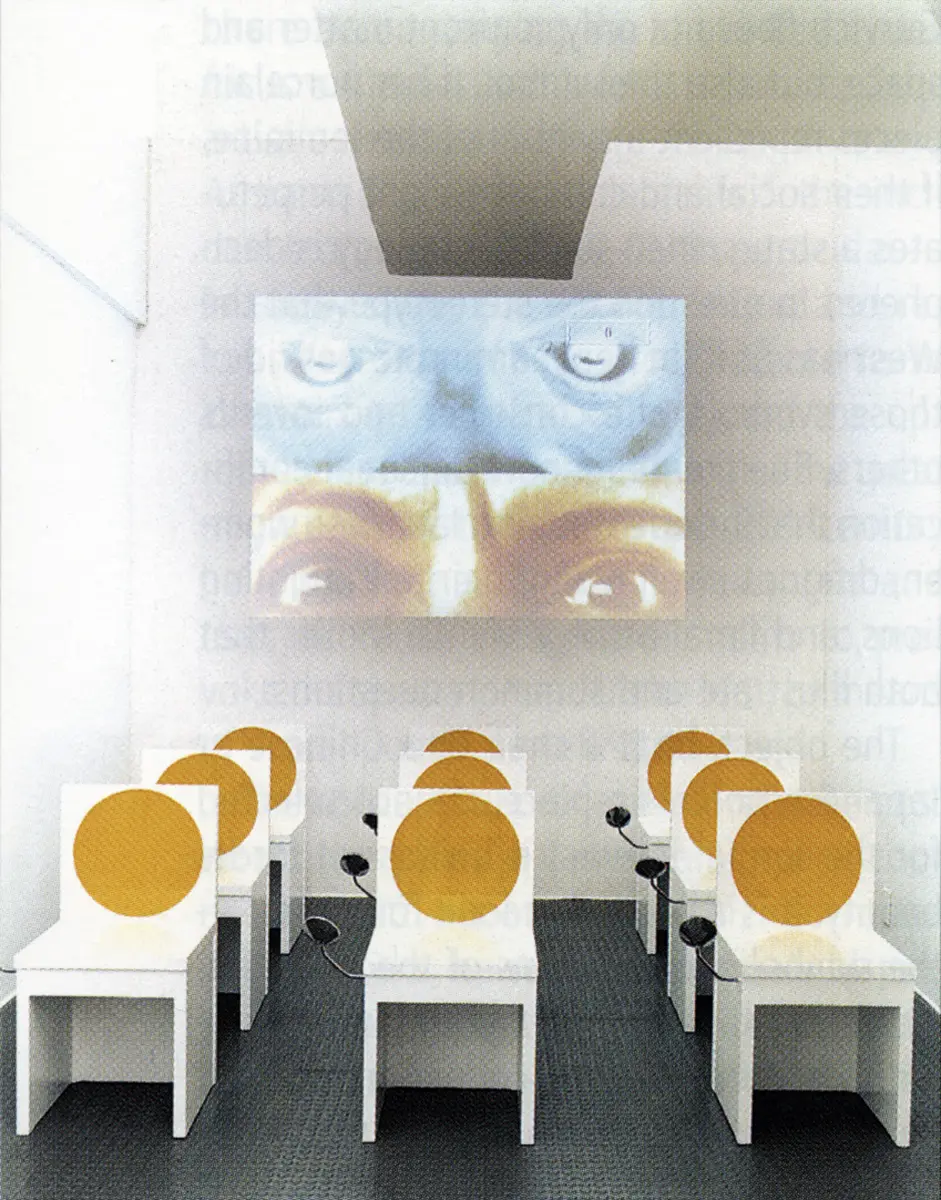
Once the spectator has taken a seat in the Cadeiras Pussy installation, the whole of Leonora de Barro’s exhibition has been covered. The last work comprises nine chairs equipped with rearview mirrors, headphones, and video-projection backrests. Through the mirror, we try to watch the projection, without being able to see the screen in its entirety. Although the video was realized on the basis of prior works by the same artist, the editing, montage, and sound create a new work, which doesn’t present with clarity the older ones. Among the many images, it is possible to discern important landmarks in the history of Brazilian art: a self-portrait by Geraldo de Barros, a significant figure in the São Paulo concretista movement and the artist’s father, in a photograph that has been appropriated by Leonora (En forma de familia, 1995). The fast succession of images in Cadeiras Pussy, and the act of literally looking backward through the rearview mirror, refer to the idea of re-visiting the past through images that have been fragmented by memory. The spectator’s focus on visual and auditive stimuli can generate a feeling of disconnection with the show’s space and of the absence of anchors for a mental plane —the speed and concatenation of images link to thinking—, inducing the suspension of “real” time. This experience motivates, in turn, a reflection on the passage of time, and on our ways of perceiving and recreating history. When we stop searching for images in the mirror, we remember we are seating in front of an art show: looking backward, we see prior works of the artist; looking forward, her current work.
The installation’s soundtrack is made of musical samples and spoken words, with a beat resembling a game of ping-pong: novo, de novo? novo, de novo? nada de novo no ar... nada de novo no ar... nada a ver com nada a ver com nada a ver... Slowly, the words become recognizable: all of them have appeared before in this exhibition, both in the titles and within the different pieces. The expression nada de novo no ar (nothing new in the air) poses one of the show’s dominant themes —there’s nothing new in contemporary art— and at the same time it names a piece with three ping-pong balls suspended in the air above a glass sheet imprinted with the phrase nada de novo no ar. Another piece, Nada a ver, also contains printed-over balls hovering above a glass sheet. The expression nada para ver, meaning (in Portuguese) to be entirely beside the point and unrelated to things at hand, has here a literal sense: there is nothing to see in this piece beyond just a number of ping-pong balls with just those words printed on them. Similarly, all 17 works in the exhibit are constructed with elements of the game of ping-pong. Plastic, transparent boxes mounted on metal structures, lids open or closed, are filled with balls on which words have been printed, as in the case of novo de novo, dividir imagens multiplicar idéais ou me pese me leve. Two objects, Pussycat1 and Pussycat2, are formed by two or three paddles arranged in parallel on a wall-mounted vertical structure, a play-like situation hindered by gravity. The name pussyquete is a combination of the word for “paddle” and a reference to pop music, from which the exhibition’s title comes: What’s new, Pussycat?; even if the spelling is Portuguese, the pronunciation is English. Among the other works, there is one consisting of a white ping-pong table, paddles, and two words in orange acrylic on top: Ping on one side, Poem on the other.
The visual work, contained in the title and in the formalization of the same expressions with changing meanings, in the last installation, becomes a combinatory of rhythms and sounds and acquires yet a new set of meanings. The appropriated ping-pong element is in this case the continuous, repetitive sound the game produces, used as poetic rhythm (Ping-Poem). Leonora de Barros’ work refers directly to São Paulo’s Concrete Poetry movement of the 1950s and 1960s, particularly to its predilection for lyrical wordplay. In this show, the artist deals with the diverse formats and fields of meaning present in language —visual, textual, auditive— highlighting often the fact that there is, in her own treatment of the topic, nothing new. Finally, though, what should she do? Her work expresses considerable irony towards conservative reactions to modern art, which need to find value in novelty and originality, and which summarize today’s artistic production in a sequence of pastiches.
As a whole, this exhibition connotes an ironic criticism of the problem of the new in art, criticism to be understood, in practice, by the spectator. The artist creates all her works from fragments of various histories (of Brazilian art, of her own family, of her own work) and through appropriations from the worlds of art, play, and language. As we move through her show, coming in contact with different ways of presenting the same expressions forces us to acknowledge the many possible understandings of any given object or issue, depending on its context. In the final installation, the words we read before, or even the artist’s older works now resigned, create a new experience. Even without; “saying” anything new as her point of departure, Leonora de Barros demonstrates that the different ways of recontextualizing and resignifying ideas, images, and words can generate a new meaning for the work of art.
ANA PAULA COHEN