
The Galería Digital Epson presented Pop Latino (Latin Pop), by Argentine artist Marcos López (1958), a show that was previously seen, among other cities, in Caracas and Buenos Aires. It includes photographs taken in Argentina, Cuba, Venezuela, Paraguay, and Brazil between 1993 and 2000. Accompanying the show is a catalog with several texts by the author, which helps contextualize and give direction to the reading of the series.
“Obviously, Pop Latino is not necessarily Pop Art,” assures López in one of the catalog’s texts. The title draws from both words in their widest sense, understanding pop not as an artistic and/or historic movement, but as something popular and latino, mostly due to the places in which the photos were taken, whose essence permeates the images.
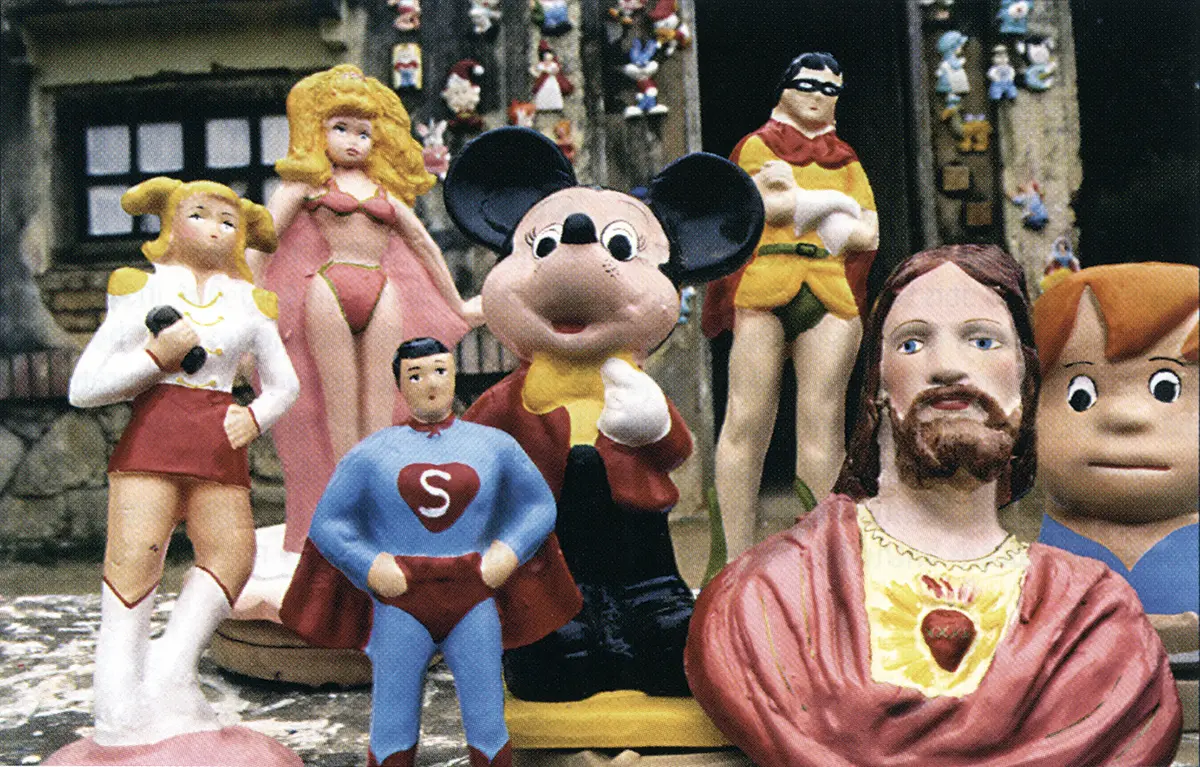
There is something in the forms or in the way the compositions are constructed that remind us of the esthetics of Mexican muralism. This restlessness can also be felt in the texts, such as this one that’s part of the Manifiesto Caracas (The Caracas Manifesto), where López talks of the process he intervenes in order to “internalize the mystique and idealism of Mexican muralism to later switch and adapt it to the current communication codes of that senseless thing called ‘global village’: Arman —Dolce Gabbana—Belgrade missiles— virtual reality.” This shot at the global village evidences the existence of common references while at the same times it shows that Latin America does not share all of them; both are very different worlds and many times quite distant. This recurring restlessness gives us a glimpse of the international and the local, as it is torn between them. Many codes that López uses unite us in the sense that they are common between Latin Americans and other citizens of the world, while others separate us because we do not know them, closing the possibility of reading them.
In Texturas del Caribe (Caribbean Textures), another text found in the catalog, López touches upon a point that for me is key while at the same time, it results in confusion for the understanding of this series of photographs: “I never worried to find out what magical realism was all about. Maybe it is this: When all the parts of a situation are conscious of participating in an absurd act while trying not to expose it or make it evident. Like a game between grown-ups.” The key, is that it makes clear that this series is not deliberately trying to show that quintessentially Latin American condition called magical realism, although Pop Latino is very much in accordance with it.
In their majority, the photos seem constructed, although some can be the product of reality as such. The protagonists’ attitude ranges between denunciation and exaltation. Obtained through a large-format digital printer, the photographs capture some of the characters disguised as Argentine popular icons such as Carlos Gardel, Che Guevara, Cavallo, and Menem, just to mention the most recognizable. The characters pose inside ambiances saturated with color and artistic elements, superheroes, logotypes, and other symbols indicating the time’s consumerism. There is, in some of the pieces, a playful intention to reach an indeterminate time by using current scenarios and products and combining them with clothing used during the 1960s and 70s. Present throughout the series is the sense of humor, lightening the social or critical load that the photographs appear to have —if indeed they have it.
López, who has been taking photographs since 1978, has participated in several collective projects. For example, in 1984 he took part in the creation of the Grupo Núcleo de Autores Fotográficos (The Photographic Authors Nucleus Group) together with 12 colleagues (Pintor, Grossman, Pérez Aznar, etc.). He has also ventured into the world of screenwriting and has lived in several Latin American countries, on which he centers his interest as they have served him as inspiration for his works.
FRANCISCA RIVERO LAKE