
Juegos iniciales (First Games) is Matilde Marín’s video-and-photography show at Del Infinito Arte, a well-tended and relatively new space in Buenos Aires. Hands are the exclusive protagonists here, both in the two videos and in the ten photographs exhibited. These works show the hands of a woman who harmoniously makes a series of fascinating, attention-grabbing movements. Beyond any presupposition, poetry prevails.
Produced in 2001, Marín’s photos of two open hands are intervened by the artist’s own drawings, and incorporated into the final image through negative superimposition. Thus, these tracings appear like rays of light, indelible markings crossing a space that seems impossible to grasp or frame. These are the hands of someone who possesses the beauty of middle age, and who knows what she wants. Far from a prestidigitator’s exercises, these hands shelter, clap, and play; they write incandescent geometries in the air. Frankly and directly, these hands seem to offer the traces of some hopscotch, the balance of a checkered board or a field for games whose rules are only known to the artist.
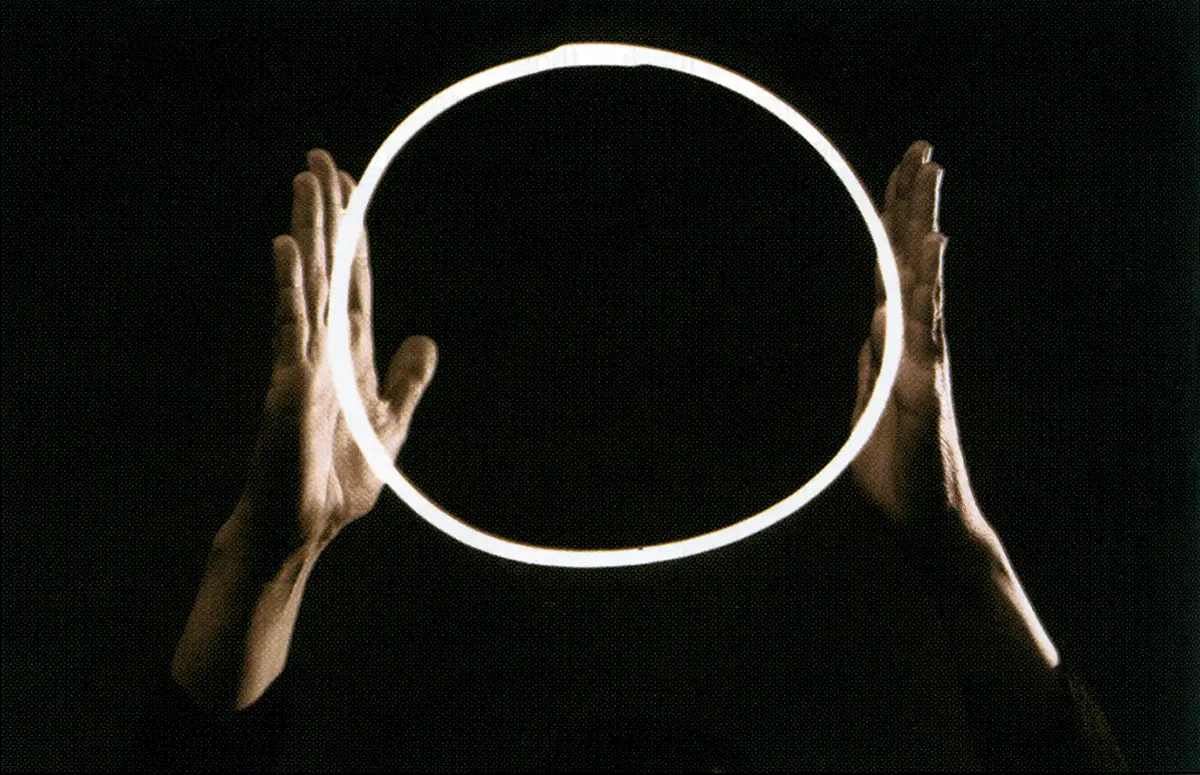
In the photographic series, movements appear frozen in a single image, in a single moment. True but deceiving? It’s a moment that slips away because it has ceased, and because it is unable to hold on to the figures in flight designed by the artist. In the video works, gestures are similarly incapable of stopping the passage of time, despite the incessant repetition of a rhythm, which suggests unending action.
The show’s videos (Juegos de manos [Hand Games] and Luz verde [Green Light]) keep the photographs’ tone. These pieces develop images and sounds that appeal directly to the senses, between sensuality and vulnerability. Marín thought up a sequence of gestures to be played by a pair of hands manipulating strings, perhaps referring to an ancient indigenous game designed to warn against the illusion of permanence. The hands open and close, clap softly and move with utter elegance. They wave and roll and then rest; they appear generous, hypnotic, offering to reveal something that, nevertheless, remains unstated. Movements multiply, but the hands are always the same. The strings connect, then move away from each other, then become entangled. Different combinations are tried, seemingly denoting different emotional experiences; structures are modified, and textures are woven to include desire, volition, and a sense of ending. ¿Do they express a clamor, a prayer? Social commentary, if any, is expressed through a text by May Lorenzo Alcalá, superimposed in italics to the rhythmic modalities of play. Words interact with images, exploring a kind of truth without clashing with what the video offers at the purely descriptive level.
These works presented by Marín —a multiple award winner who began as a sculptor and has come to represent modern printmaking in Argentina— derive their will for artistic exploration from an incessant acceptance of the experimental. Incorporating photography and video, now added seamlessly to her body of work, is an honest step forward from everything Marín has already done. These open hands link to Juego de manos, her previous series, which privileged the battle for a personal memory.
First language of childhood, an ancient territory of the sacred, play becomes a serious matter in Marín’s work, but also a matter of tenderness. Like the traces left by ancient civilizations in the Peruvian desert, hand lines invite us to think about the passage of time. Those forms and signs created by the strings in their movement seem to strive for a place in our memory. Marín’s work establishes a difference; they express a space that is difficult to reach and a time that doesn’t want to be stopped. Nothing remains unchangeable, everything slips away like sand between the fingers; even when the photographs’ sepia tones seem to promise an illusion of eternity.
¿What’s behind these multiple hand exercises, what drives the movement of these firm, feminine fingers? They are always the same hands, the artist’s own, announcing in their silence the vibrations of the unknown —the disquieting tremor of revelation.
VICTORIA VERLICHAK