
There is not a single computer on display, or even a suggestion of computer technology in Pablo Helguera’s (Mexico City, 1971) new show. Nevertheless, its title, Everythingness (unfeeling), conveys the Zeitgeist of our technological era and the contradictory emotions that we face while surfing virtual space, when we are confronted by the illusion of being able to reach everything in the universe and the numbness that we experience at being unable (at least until now) to trade physical sensations through a modem. Our online persona (or personas) are our numb clones, capable of independence and of developing their own sense of self but incapable of feeling. The fluidity of online identity is one of the most radical innovations that the net has introduced into the culture, and the possibility of manufacturing alternate digital personalities is a strategy to extend the self, and to increase, intensify, and multiply the capabilities of experience and pleasure. This search for higher and better sensations is what Helguera wants to explore with his recent work.
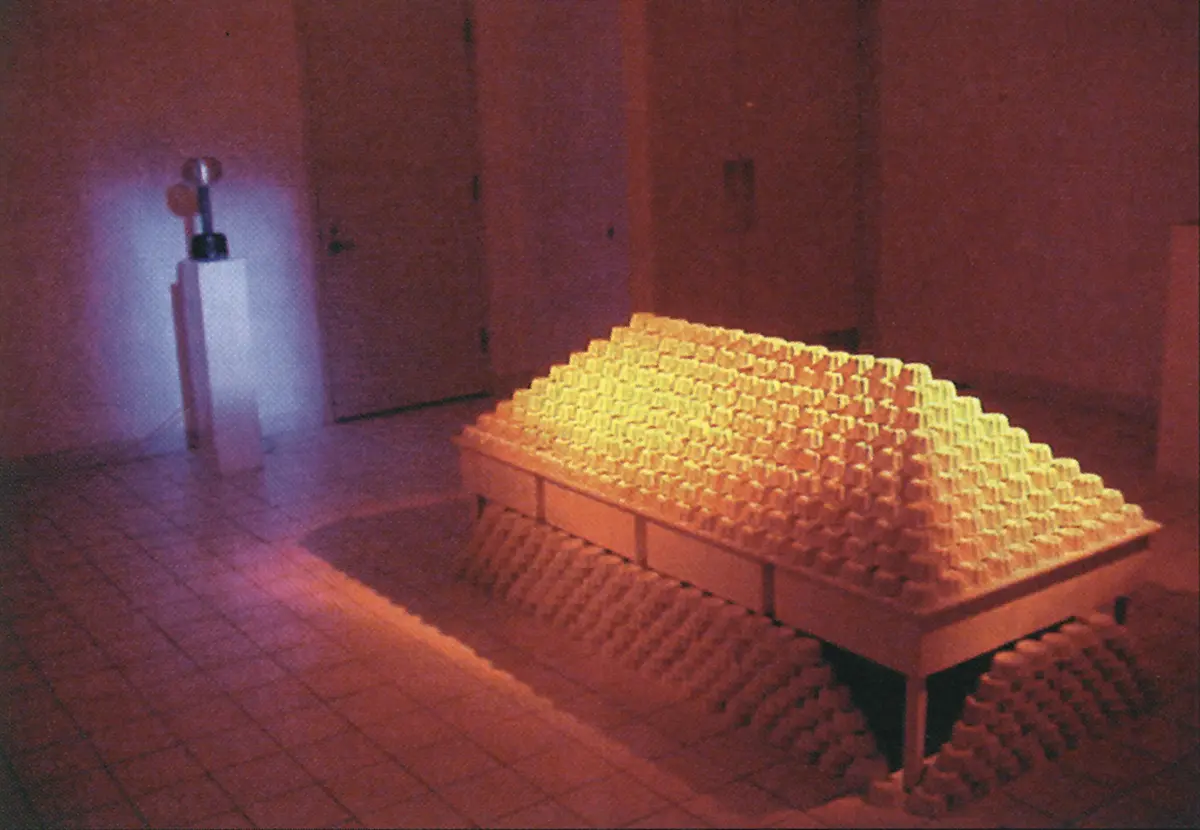
As in his former shows, Helguera plays here with intertextuality, juxtaposition of elements and meanings, and a sort of dialectic discourse among the different pieces in his installation. Entering the gallery, the visitor is received by the words of the 17th century Spanish poet, Francisco Quevedo: “Ephemeral, yet permanent and lasting”, written with colored powder, as if it were a sand-painted Tibetan mandala. This brief phrase summarizes what seems to be the forgotten meaning of ecstasy, as something that cannot be stored or commodified. In the center of the gallery, there is a mountain made of 1,500 plaster casts cut from Jell-O molds representing volcanoes —the totality of the existing volcanoes on the planet. A registry with the alphabetically ordered names of all these volcanoes is projected on a wall. The pile of miniature volcanoes is bathed by bright, theatrical red lights that add an element of almost cartoonish drama. Also included is a Van der Graaf Generator, which discharges electrostatic electricity on the visitor's hands. And, finally, anonymous testimonials on the use of the drug, ecstasy, are inscribed with pills.
Everythingness (unfeeling) centers around the notion of ecstasy, and it is a reflection of our incessant and obsessive desire to attain and capture the ephemeral. Or as the artist put it: “It’s a general reflection on the motivations of our behavior, an exploration about the roots of our reasoning behind the things we do to get what we desire.” All the pieces are ironic commentaries or metaphors on the efforts made to preserve the ecstatic experience, either by continuously generating static electricity or by trying to preserve the memory of the drug experience by writing it on mock ecstasy pills (the party and euphoria drug par excellence): “This was the best I’d ever felt in my life,” “I had nostalgia for the moment I was living.” Ecstasy is supposed to be a moment of supreme pleasure, corporeal and spiritual, a feeling that cannot be seized or repeated at will. And, as Helguera explains, the very intent of controlling ecstasy results in the elimination of its uniqueness. The central, most striking element in the show are the plaster representations of volcanoes. Volcanoes could be considered to be the embodiment of telluric ecstasy, they are ever-threatening and unpredictable forces of nature, and here they are the link between our desire to seize ecstasy in a latent state and nature’s most elusive orgasms. The ecstatic state is problematic because on the one hand, it is a cultural obsession of our time but, on the other, it represents a terrifying loss of control, the abandonment of the rational and the submission to the primeval, to the origins of the species or, as Camille Paglia expresses it, to the chthonic or the bowels of the earth, the incandescent abyss that connects with the surface through the volcanic chimney.
Helguera’s installation could be perceived as a science museum display although it seems deliberately low-tech, even the Van der Graaf Generator adds an element of nostalgia for a long-gone ideal of the future. Nevertheless, the show is a reflection on our hypermediated society, on the desensitizing power of the mediasphere and its never-ending bombardment of infotainment. Everythingness is, according to Helguera the unabashed struggle to conquer heightened states and the illusion of attaining a perpetual feeling of bliss in a society dominated by the ideal of unlimited possibilities. While unfeeling is what G.H. Ballard might have called "the suburb of the spirit:" the demise of affection in an “almost infantile world where any demand, any possibility, whether for lifestyles, travel, sexual roles, and identities, can be satisfied instantly.”
Everythingness (unfeeling) is the second part of an ongoing project first presented in Basel, under the title Everythingness, for which the artist created a corporation dedicated to the commodification of time.
NAIEF YEHYA