In her first solo show at Paris’ Palix Gallery, Ruth Gurvich —born in 1961 and living in the French capital since 1987— presented an eloquent sample of the work she’s been doing on paper for several months now, where she explores paper as an instrument to question memory as space and time. The museographic quality reinforced the artist’s artistic and constructive intervention over the series of objects (chairs and porcelains) exhibited in the show —whether they were crushed flat or blown up, shrunken, or at a real-life scale.
Gurvich develops a detailed research work, both formal and conceptual, based on a reflection rooted on experimental, dominated, and assumed pluriculturalism. Uprootedness as a familiar symptom (Gurvich comes from a Russian-Polish family settled in Argentina for two generations) forces the artist to build her own personal order to place herself in the world and try to understand the reasons behind that complex relationship motivated by the events of her personal history. The every day and the functional object is at the center of her questioning. The object as pretext —the object’s object— and point of departure, but also the transformation or transmutation of a gaze which is neither completely esthetic nor completely anthropological, but above all a question on the relationship between art and space.
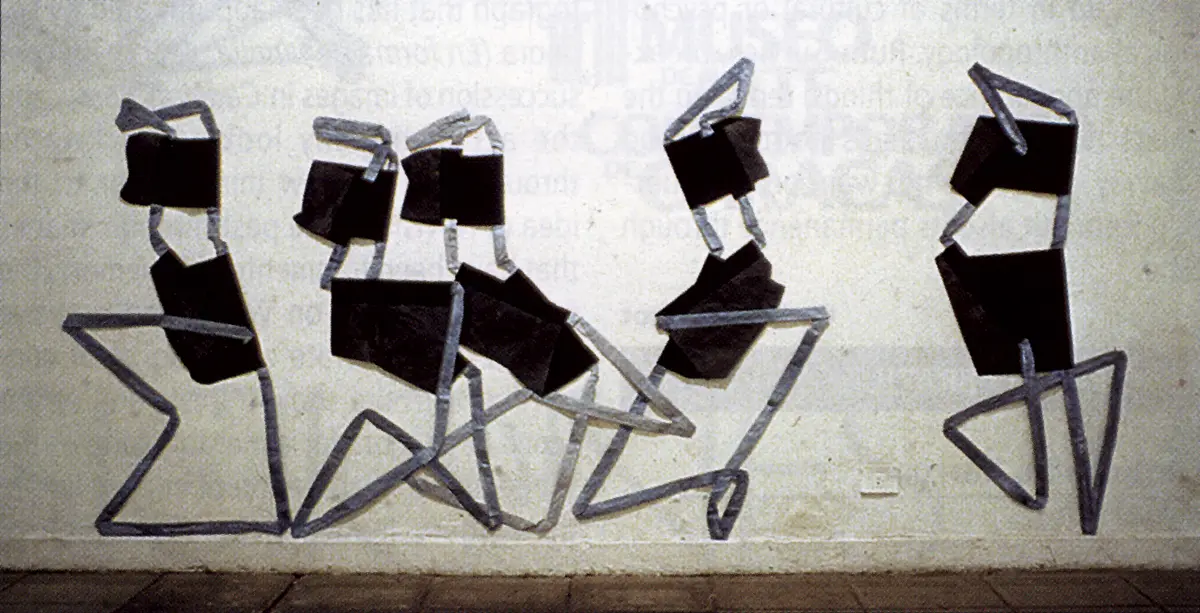
The act of smashing weakens the form’s permanent quality and the object’s function. If indeed since 1995 the artist has been smashing, bending, wrenching, and flattening the material previously built (through paper and tracing), taking as models archetypes such as Chinese porcelain, cars, tea pots, cups, and plates or planes (without ever making the object disappear), it is to uproot from each day’s banality the spirit of such cultural emblems that are also references to time, technological society, and design. In this metamorphosis where the object-witness retains its original identity, Ruth Gurvich leads us to a reading that allows the object to exist in a superposition of meanings.
The manipulations that Gurvich has done on Marcel Breuer and Le Corbusier’s chairs and armchairs —irrefutable emblems of modernity— introduce a multiplicity of references, allusions, and memories. If the distortion of reality affecting them reminds us of the ephemeral, it is so to better generate the principle of virtuality determining her creative work’s most playful aspect. For the artist, the chairs are like “characters”, but the choreography linking them does not prevent them from appearing as orphans of a body. What’s more, there is tenderness and humor in this metaphor of the dialogue between absentees.
In the works on porcelain we find the same preoccupation as in the flattened chairs. Built-in life-size (uncertain volume of white paper on which the artist intervenes with painted motifs), the Chinese- or Japanese-inspired porcelain pieces, wrinkled and flattened, are displayed in cabinets as if they were decorative objects. Ruth Gurvich does not only confront matter and space but also the symbol. If her porcelain pieces represent a symbol of the feminine, if their social and cultural weight perpetuates a status, then such symbology is deciphered to question the stereotype that the West has of it. In her yearning to get rid of those symbols, she constructs and invents others. She creates a new personal codification that include weeping Japanese women, dragons swallowing their tails, fighting lions, and floral arrangements. Motifs that both illustrate and summon questions.
The object, be it a chair or a Chinese or Japanese porcelain piece, it’s not selected for the formal interest it holds, not for its beauty. It is a pretext to look for words —the symbolic foundations of the reflection on history’s weight, the family, and culture with its entourage of codes. Art doesn’t necessarily have to contradict what has been said in terms of cultural or psychological anthropology. Ruth Gurvich, breaking the appearance of things, reducing the object to a version that’s both near and far away itself, does not want only to question form but also its permanence through time.
CHRISTINE FRÉROT