
Félix Perdomo emerged in the Venezuelan plastic panorama in the ‘80s. A decade of changes, of heterogeneity and appropriation of styles, of artistic trends that began, were consumed, and ended like a whirlpool that passes, destroys, and leaves behind the trail of a fait accompli. A decade catalogued by some critics as prodigious, and by others as inauthentic and hardly consistent. Also, a period that saw a clash of thoughts and ruptures before established artistic conventions that were both formal and conceptual.
However, the decade of the ‘80s left a trace. On one hand, the social role of the artist was remarkably altered when he or she left the silent work of the studio in order to become involved with the media and mechanisms of the consumption of art. The artist-manager appeared, which gave guidelines to some ethical considerations concerning the (authentic) values that should be in fashion in the creative act. From the plastic point of view, stylistic diversity put into question the plastic validity that upheld a work, especially when the execution of this work was motivated by market requirements.
The result was the premonition of the death of modernity due to saturation and at the same time a deterioration, of culture.1 Originality, as the first justification and motivation for art, disappeared as a conceptual support. Nevertheless, the tradition, at times explicitly denied as a referential parameter, was revalued deep down: the heterogeneity of the ‘80s actually allowed artists to turn to everything. From the geometric formulas changed into the so-called Neo-Geo, to the most explosive expressionism; from the intuitive and spontaneous images to the immediate references to mass culture and advertising. There was room for everything.
In this context, the work of Félix Perdomo remains almost unchangeable. As a key artist of the ‘80s, he did not follow the vortex of those years. We may even say, today, that his career is nearly linear, with no great leaps.
Previous Steps
Although the new figuration in painting took shape in Venezuela in the ‘70s, it also came about that this expressive medium remained consigned to the plastic interests of other sectors. There were several reasons for this. In the first place, the hegemony is represented by kineticism as an official art and image of power. This tendency has had and continues to have a lasting effect on the country. Through support or rejection, it has motivated the realization of several artistic manifestations that have somehow transcended the course of Venezuela’s contemporary art history.
The kinetic pieces, as well as monumental urban sculptures that also made their appearance, contributed to that temporal disinterest through painting in the ‘70s. The same thing happened with the ephemeral responses that, in opposition to kineticism, did not take long to arrive. These manifestations may be interpreted as a form of opposition not only to the object in itself, the essence of the conceptualist movement, but also those (material) pieces that were favored by the market and were highly esteemed by the official culture of the moment.
There was also a third cause: the boom of a new drawing, conceived on a large scale, making a show of great technical virtuosity in its forms and descriptive elements. This lasted some years until the formal opulence of this tendency met its end when, in the early ‘80s, there were defined reactions. One of them was the return to painting not only with new vigor, force, and expressivity but also through implicit conceptual support which was the reason for self-reflection. Hence the concepts “figuration” and “abstraction,” for example, lost their definition as they were conceived in the pictorial work in an ambiguous and complementary fashion. As a result, the formal outlines of the pictorial slowly began to transform, literally, opening up new—and at times discordant—formats, as well as the combination of disparate materials selected from the extra pictorial reality. All of this formed part of a new type of pictorial conception in which everything was possible.
The remains of the country’s economic bonanza were felt at the beginning of the ‘80s. In spite of the real crack of the economy, made explicitly evident after 1983, the State and private initiatives paved the way for large international exhibitions, at the same time as they made it possible for numerous artists to travel abroad. Félix Perdomo did not draw on these benefits. At least not directly. However, he was in tune with the spirit of the time, particularly with the resurgence of painting.
The Artist
A student at the Pedagogical Institute of Caracas, Perdomo participated —in conjunction with his academic studies— in the drawing studio that artist Antonio Lazo had established at the very site of the Pedagogical Institute in the mid-'80s. This experience was decisive. Without having traveled and without having had the possibility to receive any sort of grant, the contact with informed (and traveled) artists somehow mobilized his disquiet through broadening references and artistic understandings. Also present in the studio were José Rivas, Onofre Frías, and Gladys Medina, all artists who are active today.
The studio was consolidated by dint of intense work —"We created around 500 drawings per day," the artist recounts today— and it made up a discussion group focused precisely on the question of drawing. The work of that studio was so peculiar that people spoke about the style of the artists of the Pedagogical Insititute. In 1990, Mariana Figarella later confessed how she was personally able to verify the influence that Perdomo and Rivas had on Lazo’s painting, who was then their professor and guide when they were painting in that studio.
This group also sought to consolidate their education, learning inside out the paintings of the classic masters and contemporary North American painting. As a reaction to the drawings of the ‘70s, they drew in small format and they consolidated a spontaneous style, made of awkward, almost child-like strokes, in opposition to the purity that emanated from kineticism as well as from the virtuosity of the drawing of that decade.2
After participating in several exhibitions and biennials, Perdomo’s work was consolidated in 1986 with the show Al filo de la modernidad (On the Edge of Modernity). This exhibit, curated by Mariana Figarella and Ibrahim Nebreda, was executed amid a certain skepticism on the part of the board of directors of the Museum of Fine Arts at the time. Nevertheless, the show had an enormous impact not only as a fissure in that museum’s exhibitory line, but also on the work of several of the artists involved: Eugenio Espinoza, Susana Amundaraín, Walter Margulis, Rosana Vestuti, José Rivas, and, of course, Perdomo. For some, like Espinoza, for example, it was transcendent in its pictorial reflection, for it was in that show when he broke the plans that go from the format (or combination of formats in one single piece) to the materials and considerations about abstract art.
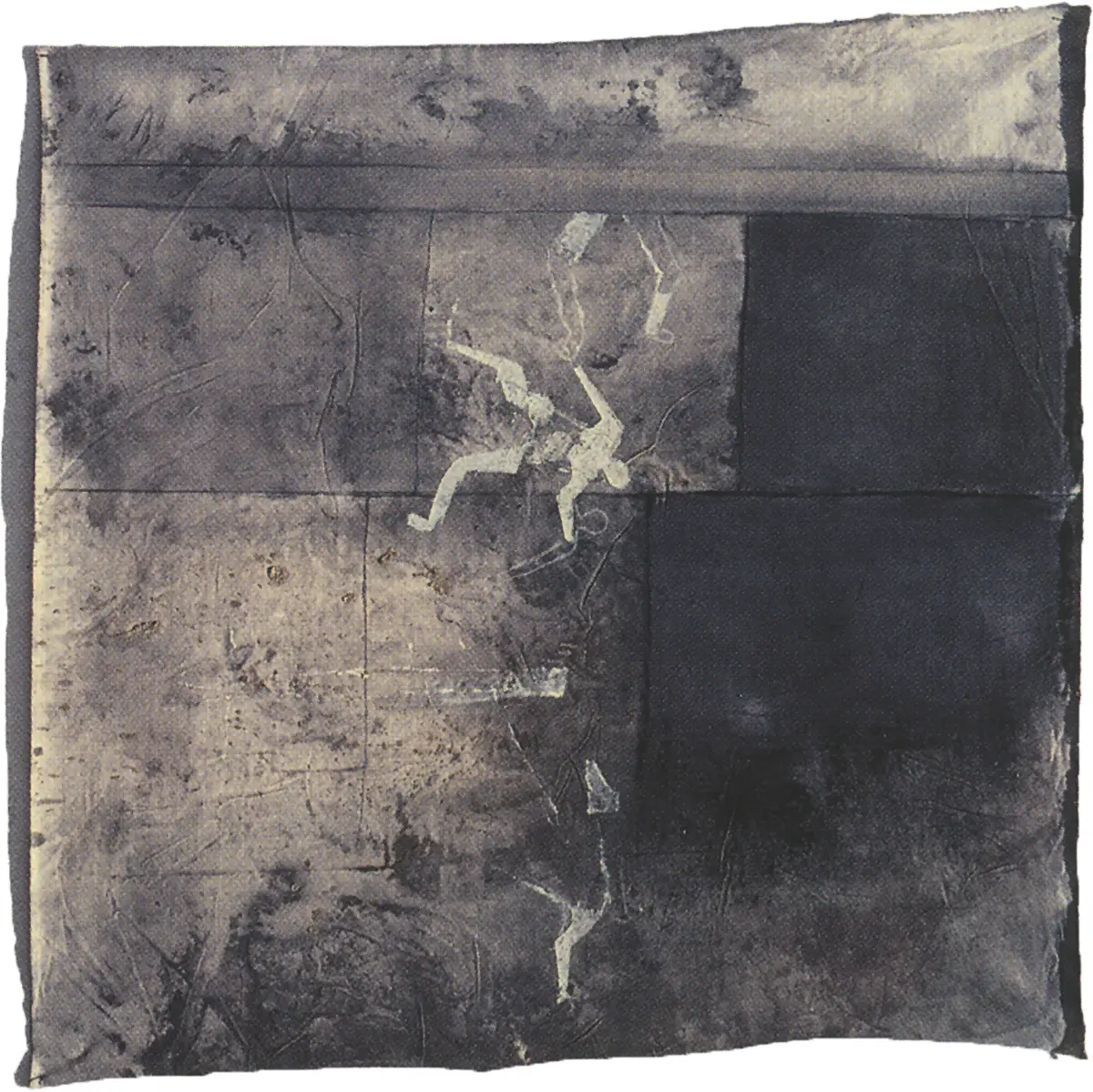
For his part, Perdomo remained consequent with the work executed in the Pedagogical Institute. He did not abandon drawing, which appears as a structuring feature of his painting. Over the (abstract) background treated with clearly pictorial media (in which he emphasizes texture, color —pinks and ochers— and material), he maintains a nexus with figuration through strokes drawn sometimes with a paintbrush, charcoal, or the edge of a knife or metal. Intentionally awkward, elemental, lines that allude to the childish world or to the free and spontaneous gesture. "They outline silhouettes of acrobats, trapeze artists, and animals (bulls) that recall," as Mariana Figarella pointed out, the cave drawings and the spontaneity of Klee and Dubuffet. Also, Matisse, as the artist himself recently clarified for me. The pictorial and the drawing consolidate one single work. Both plastic conceptions, united, comprise the space of the work—Mariana wrote in 1986—. "A circular space where everything flows and returns to find itself, where everything is in continuous motion."3
Moreover, we could say that Perdomo’s career is in some way tied to his participation in groups of artists. El Establo, La Taza, and the Herbario are names of groups that grew up in the same decade around him and other companions. The common motivation: is to have a space for drawing and painting, as well as maintaining the exchange of ideas and discussion. If the experience around Lazo was decisive in unleashing changes that stirred up individual freedom in Perdomo’s work, his contact with Jorge Stever was also crucial. This artist, who has lived in Venezuela since 1974, gathered artists like Eugenio Espinoza, Oscar Pellegrino, and Sigfredo Chacón in his studio—in addition to Perdomo—which made up the Clínica group. They shared similar inquiries, although the results were different on account of their individual style: interest in the material and the pictorial surface, reduction of color to dark tones, search for authentic or primary images, concision to the essence of things, in order to erase learned recipes. Although the group dissolved after a while, Perdomo today points out the importance of his friendship and intellectual exchange with Stever.
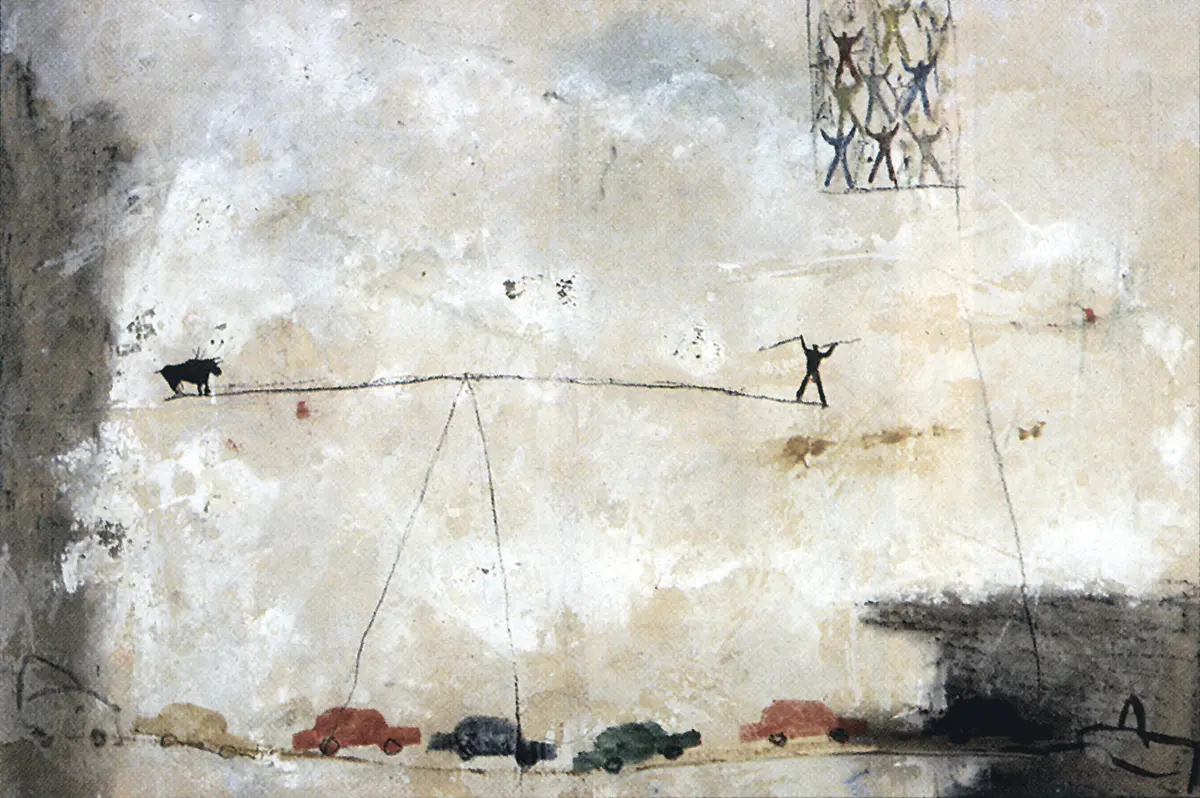
After that moment, his work became better known and valued. In 1989, for example, he exhibited with his friends in Wind Factor at the Galería Vedoblevé and at the Sala Artisnativa (now Alternativa), a space that since then represented him for ten years. The Jesús Soto Musuem of Modern Art in Ciudad Bolívar put on the show Nueva pintura abstracta. Ocho planteamientos (New abstract painting: eight formulations), curated by Jesús Fuenmayor. This show was later exhibited at the Sala Rómulo Gallegos at the CELARG Foundation. This show had the intention of inquiring into the international avant-gardes, as well as reflecting on the elements that feed abstract language. As an artist who operates with figurative references, Perdomo’s participation was considered a contribution to new abstraction. Roberto Guevara pointed out on that occasion how the concept of abstraction in Perdomo is relative since the artist creates an atmosphere of suspense in which recognizable forms are occasionally found, such as a bottle, a ship, or a fish. All of this appeared to be a "summa of impressions that follow one another in unforeseeable moments."4
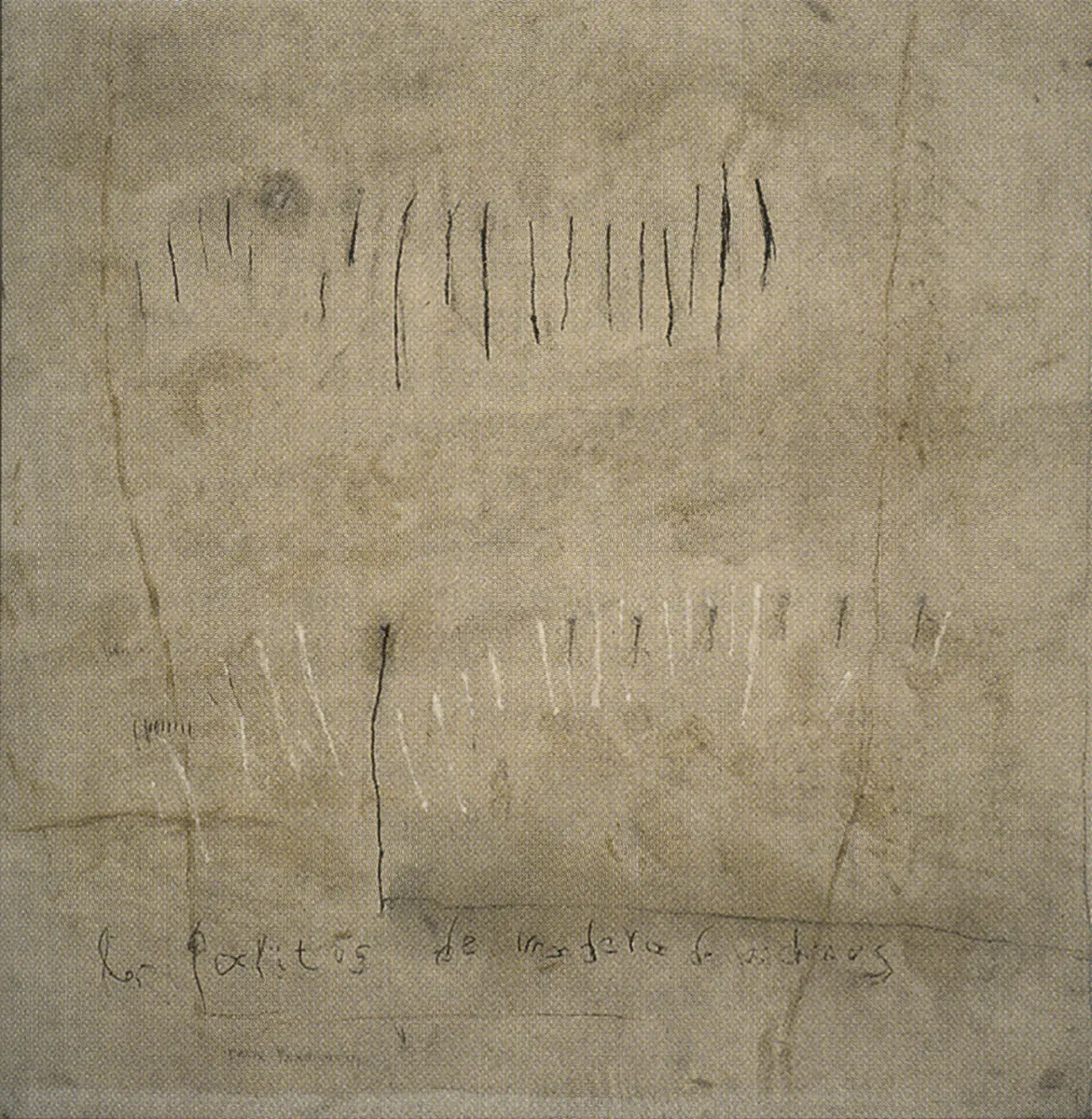
Experimentation with the materials also gave a materic and chromatic quality that determined Perdomo’s style. The mix of clay, fuller’s earth, organic materials, sand, sawdust, talc, industrial paint, and "everything that exists" —as Roberto Guevara said—flow together in a harmonic way amid transparencies, rubbings, gouaches, and drips. In La tarea (The task), a solo show executed at the Sala Artisnativa, this was made clear. The materic and textural condition of the works combined with the theme of schoolchildren’s dictations and the sloppy writings of someone who is just learning how to write. Pictorially, they were two-dimensional spaces, flat, with no depth, whose material and resources make their pictorial quality stand out. The forms and figures continued to be linear outlines (Series: Planas, n.d.). On the other hand, nostalgia, an underlying condition since his works from the ‘80s, is perceived through the recollection of these very primary images. After 1990, his participation in important shows abroad also began. The first was The Next Generation. Perhaps Phyllis Tuchman, the curator, perceived the rise that this young introverted, and modest artist would later have: his work was exhibited in Ecuador (where in 1991 he won second prize at the 2nd International Painting Biennial of Cuenca), Colombia, Italy, Spain, Argentina, Mexico, the United States, and Chile. From every point of view, it was crucial to have won the grant to participate in the Foreign Artist Studios Program in 1991, promoted by New York’s Institute of Contemporary Art PS-1 and proposed as a contest by Venezuela’s Calara Foundation. The jury was made up of a group of people who belonged to both countries. When Félix Perdomo traveled to New York with this grant, it was the first time that PS-1 had accepted the participation of a Latin American country, and he was the first Latin American artist to receive it. His cohabitation with artists from other countries, his continual visits to shows, and his will to experiment that this institute promotes (it took in artists like Basquiat, Haring, Scharf, Bildo, and others) was an experience that, according to his testimonial, "is the best thing that can happen to an artist."
However, the urban weight of New York, the solitude, somehow sensitized him to consider with greater rawness the fragility of the human condition. Street violence, death, and the concentrated density of populous cities (New York-Caracas) opened up other thematic models in his painting.5 With the same formal characteristics that shaped his style since the previous decade, urban landscapes appeared (conceived as city maps seen from above). In them, the silhouette of a corpse on the ground, just as we see it drawn at the scene of a crime in the movies, including the yellow police tape (Series Levantamiento de cadáver [Removal of the body]). Violence is also expressed in the series Nuevo circo (New circus), alluding to a congested area of Caracas where the bull ring is —which bears the name of the series— and a bus terminal whose demolition was the cause of political disagreement.
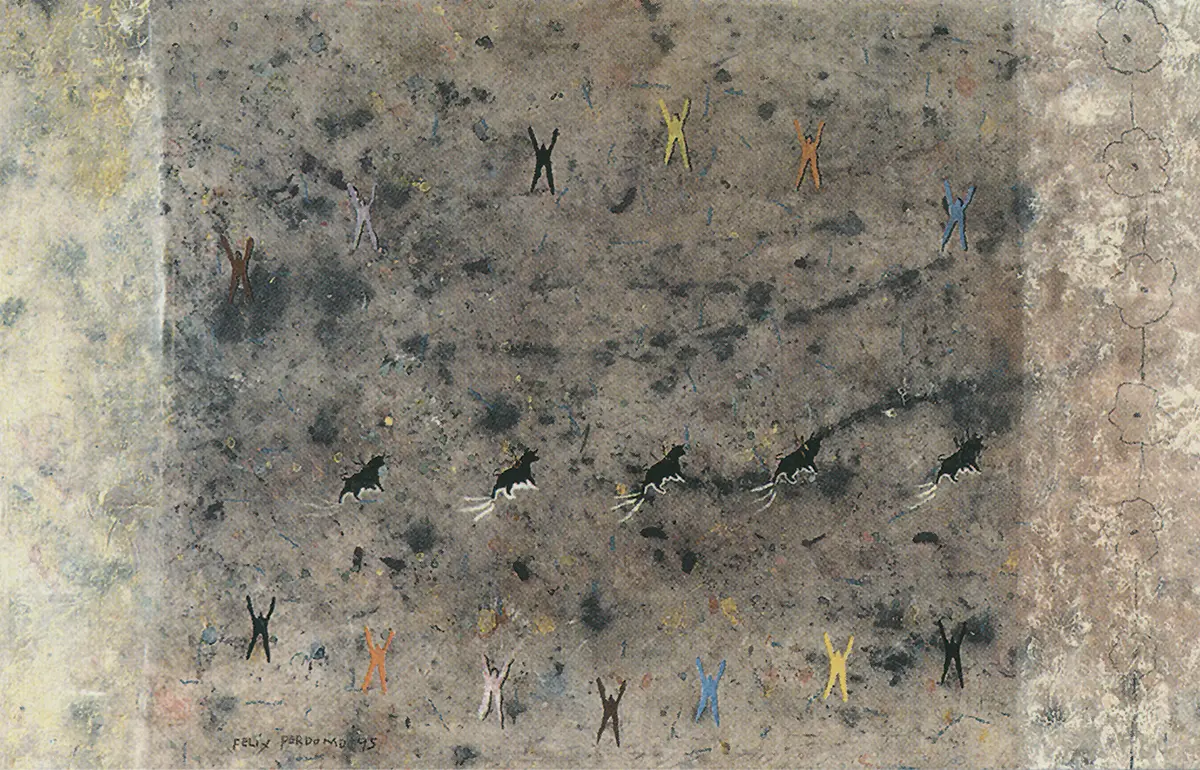
With the expression of violence, Perdomo purifies his freedom in the creative processes. He uses the traces of real steps of the people walking along a populous Caracas avenue, the Avenida Baralt, in order to compose the resulting image of a pictorial surface (Series: Paisaje urbano [Urban landscape, 1993]). With no further details, these images suggest the transit and urban density of this avenue.
A little later, the pictorial surface is randomly shaped through non-traditional resources. Cascada (Cascade), a work made with matches arranged on a white descending plane, as the title indicates, won honorable mention at the 1st Dimple Biennial in 1992-1993. In an act that approached ritual, the artist set fire to the matches as a way of painting with violent and ephemeral materials: fire and smoke. Perhaps this was a way of violently challenging the pictorial space. He repeated this pictorial experience on several occasions at the Sala Alternativa.
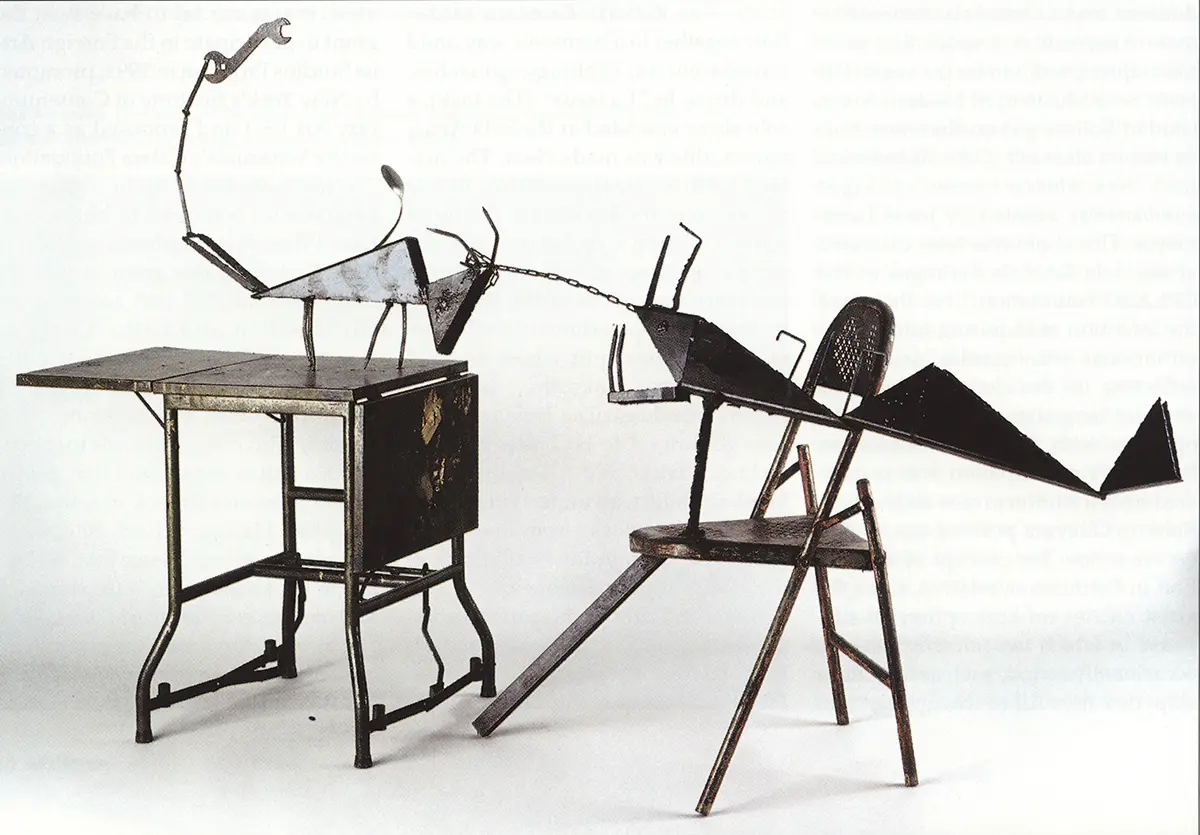
In the mid-'90s, the artist needed to undergo a substantial change. More than a change, a break in his work as a painter. He began to make chains. These are sculptural pieces made with a toggle and pieces of metal which are drawn by the trapeze artists and acrobats that we saw in his initial painting. Leaving aside the rustic condition of the material, with no trace of any pulitura that may disguise its precarious materiality, these chains are pieces that pirouette in the space like silhouettes. They are aerial sculptures that look like children’s toys, full of irony and humor. "I seek to make people laugh with the things that I do," Perdomo stated in 1995, on the occasion of the show at the Galería Namia Mondolfi where he exhibited these pieces. Back then, he recognized the exhaustion of media without denying his condition as a painter, and sculpture was then "a rest, an escape when you exhaust the possibilities of what you are doing and seek new materials in order to continue to live." What is certain is that these pieces were conceived as an "extension of painting," to the point that they fused sculpture and painting into one single work and, in that show in particular, he considered them as a whole like an installation.
Constant Thematic and Formal Considerations
Still in New York, pictorial surface and space continued to be the essential elements of Félix Perdomo’s painting. So it was in his previous work. So it would be until today. Street violence and urban density were not the only themes that interested the artist. There were also the flying carpets, as Phyllis Tuchman calls them, the projects for windows, and the works related to dictation (as we saw in La tarea). In the case of the carpets, there is no inkling of depth, since they deal with the vision from above the weave of tapestries that Perdomo probably had at his disposal in the studio (Series: Alfombras mágicas [Magic carpets, n.d.]). With few resources, he also carried out another of his constant themes: his still lifes: cups, bowls, pots of paint, objects that do not require a special beauty and which are in his sight only as compositive pretexts: "I paint still lifes of old cans with dirt, sawdust, and glue because I do not have good oils, much less porcelain vases. . . I am a minimalist because of my own circumstances."6
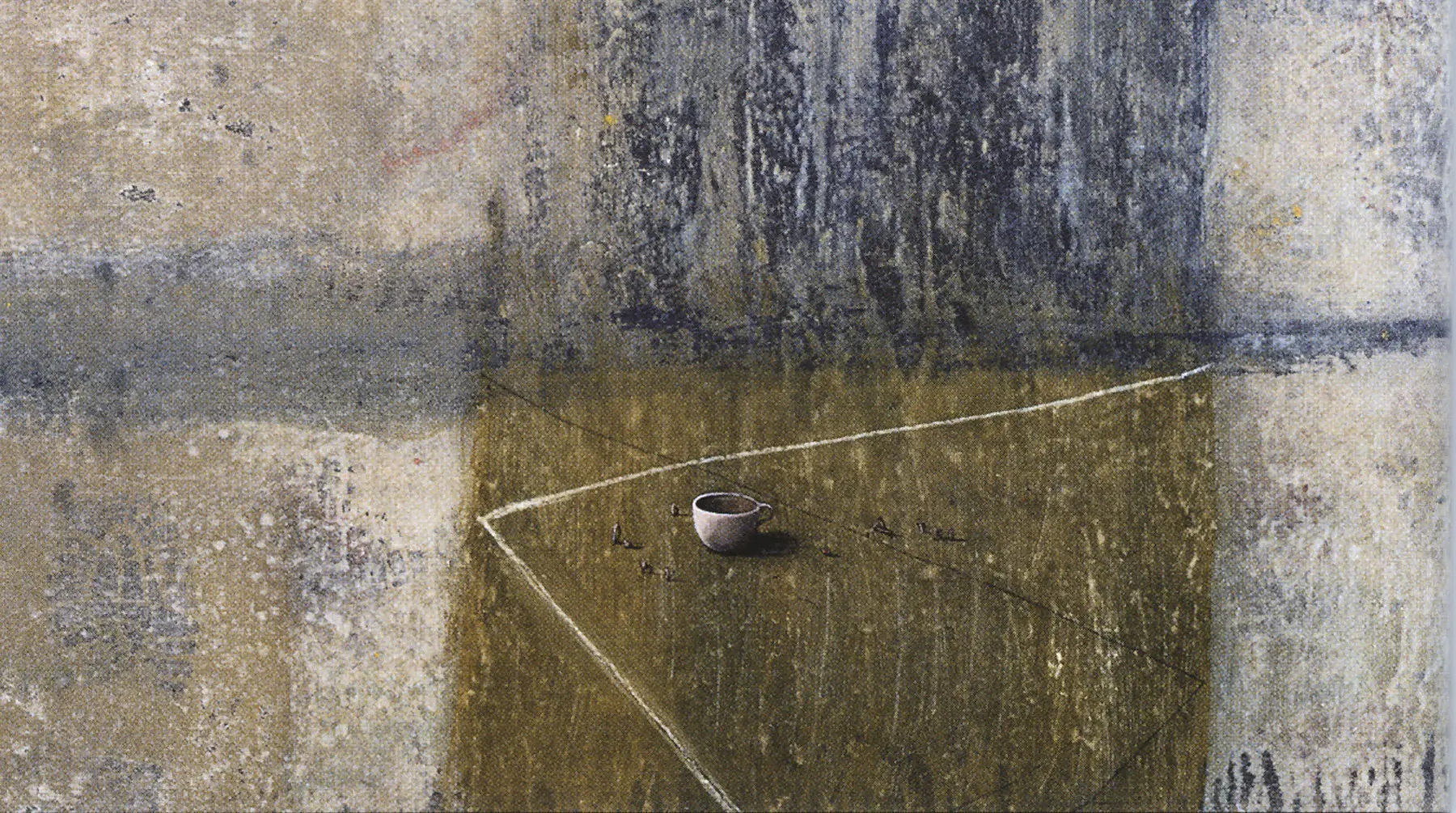
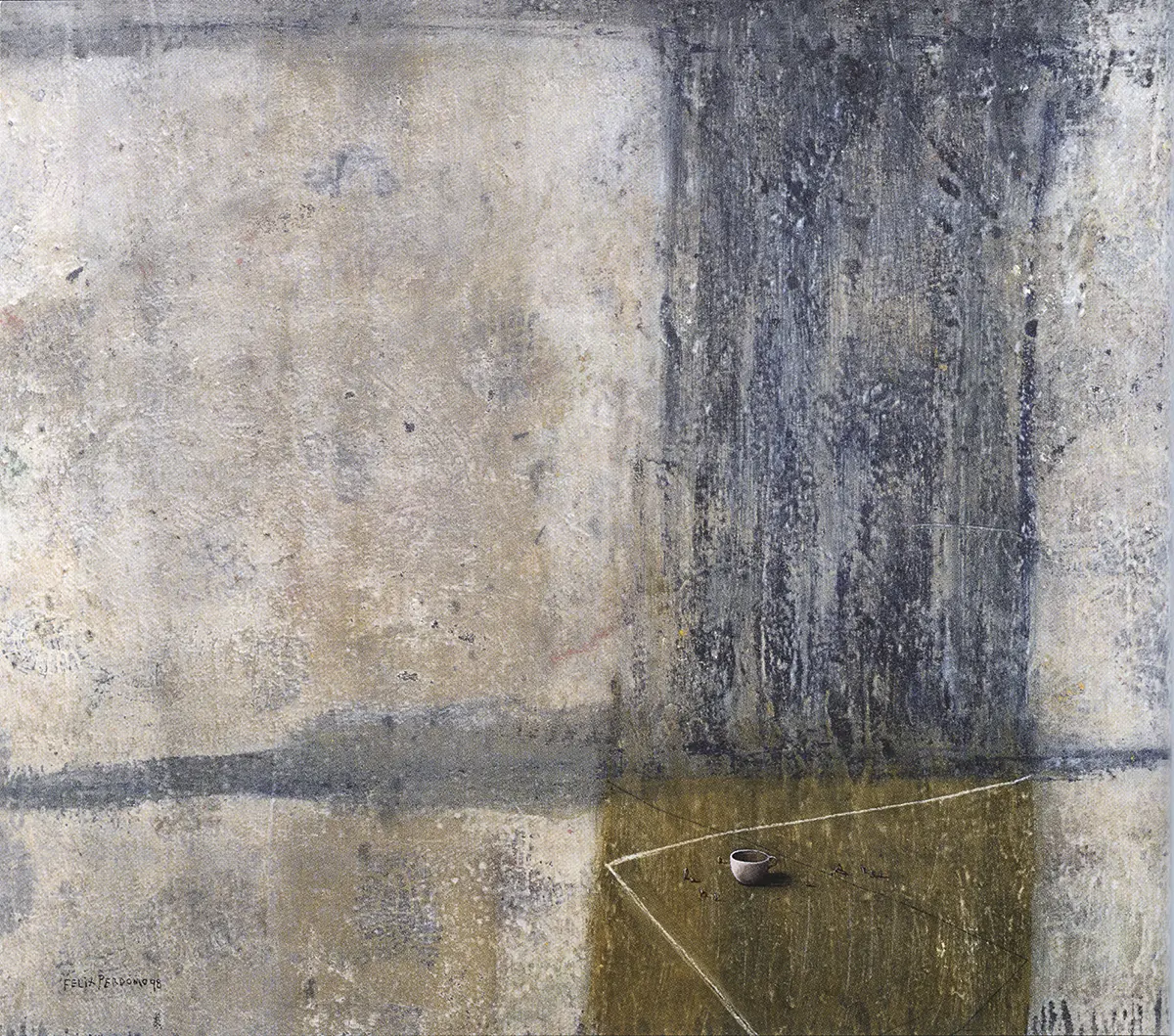
The cup has been his leitmotif since 1997. Since then, he has not stopped painting it. As an artist little disposed to color, he reduced even further his chromatic range to ochers and grays —which Perdomo assumes as color—in search of harmony in those earth tones. Painting evokes in metonymical terms the presence of man. This is substituted by his object (the cup) or a part of it (the trace of his step). Although in the early ‘90s denouncement and irony were present in his urban painting, by the end of that decade there remained the vastness of space assumed as an analogy of silence.7
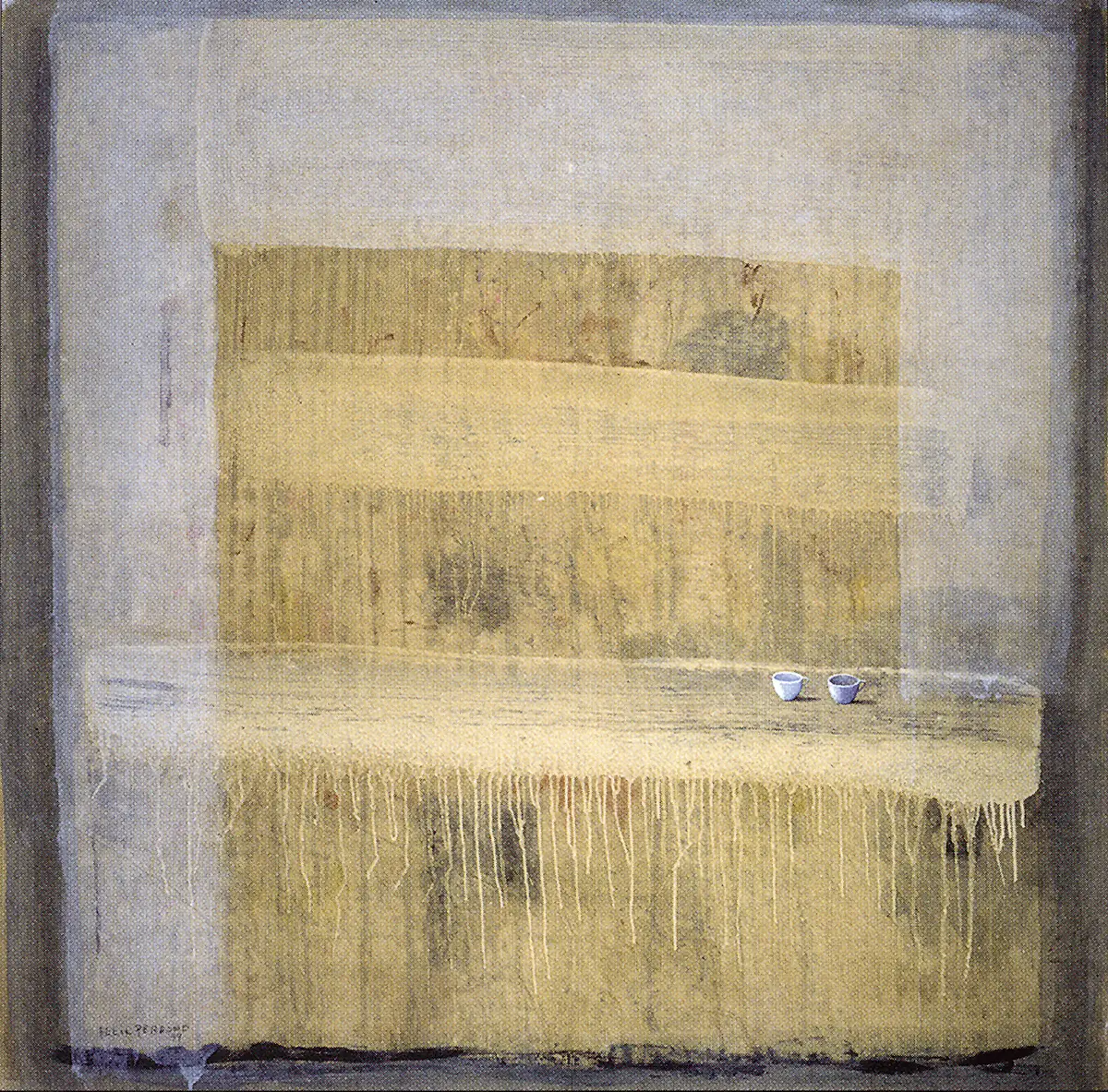
By the end of the ‘90s, his work stood out precisely because it expressed itself with fragility and a nostalgic childish gaze. Eugenio Espinoza, at the show presented in 1998 at the Grupo Li Centro de Arte, the gallery which currently represents him, foresaw how behind that candor could be found the kernel of a metaphysical thought given the atemporality perceived in those spaces —neutralizing fields— and in the solitude of the figures (cups).8
This same metaphysical thought seems to be incorporated in his most recent works. The spaces continue to denote his vastness and suspension of all movement. The cup continues to be the point or argument that makes the existence of that space possible. The difference: the almost hyperreal representation of a space conceived with depth. Cups, sticks, and other pretexts take shape, showing themselves in detail through the use of chiaroscuro and the representation of their volume. Those silhouettes, which made our imagination and childish imagination pirouette so much, are turning into concrete acts with conceived volume and space. Currently, Perdomo is probably in a transition period. In addition to depth and volume, he is reconsidering color with all its intensity. This is a work in the process of definition.
NOTES
1. Eliseo Sierra, in his text for the catalog Al filo de la modernidad (Caracas: Museo de Bellas Artes, 1986).
2. Catalog Al filo de la modernidad. Reprinted in June 1994 for the catalog Félix Perdomo. Nuevo circo. Pinturas (Bogotá: Galería Garcés Velásquez, 1994).
3. Catalog Al filo de la modernidad. Reprinted in June 1994 for the catalog Félix Perdomo. Nuevo circo. Pinturas (Bogotá: Galería Garcés Velásquez, 1994).
4. Nueva pintura abstracta. Ocho planteamientos (1990).
5. An episode that especially moved the artist deeply was witnessing a crime in the street and seeing the corpse on the ground. Conversation with Elvira Neri, Director of the Sala Alternativa, January 2001.
6. Federico Pacanins, “Perdomo,” El Nacional, 7 Jun. 1998.
7. Víctor Guédez, “Félix Perdomo: espacios referenciales y referencias espaciales,” Estilo 9.33 (1998): 96.
8. Review published in ArtNexus 30 (1998).
SUSANA BENKO
Art researcher. Editorial coordinator of ArtNexus in Caracas.