
Aristides Ureña Ramos, a Panamanian artist who lives in Florence, held his most recent show in Panama. He called it itookpanama, quoting, in lowercase, US President Teddy Roosevelt’s famous statement when he got involved in Panama’s independence to rally US interest and build the interoceanic canal through the brand-new republic. The show reflects Ureña’s intention to create his own historical chronicles that, as visual “docufables,” give testimony to important events in his native country’s history —seen through his surrealist eyes.
The eleven pieces exhibited in mixed media on canvas belong to a group of 76 that make up the whole itookpanama series. The pieces’ titles, which are always important to this artist with a constant preoccupation with language, make reference to Panama’s independence from Colombia (November 3, 1903) as well as to other events in the nation’s history, the country’s tropical features (swamps, rivers, oceans), legends (such as the Tulivieja), and customs (such as the annual celebration of the sugar-cane harvest). In other pieces from the same series, Ureña visually represents his image of the Europeans’ and the Americans’ dreams, but also the dreams of the great Afroantillian population, without whose strength the construction of the canal could not have been undertaken.
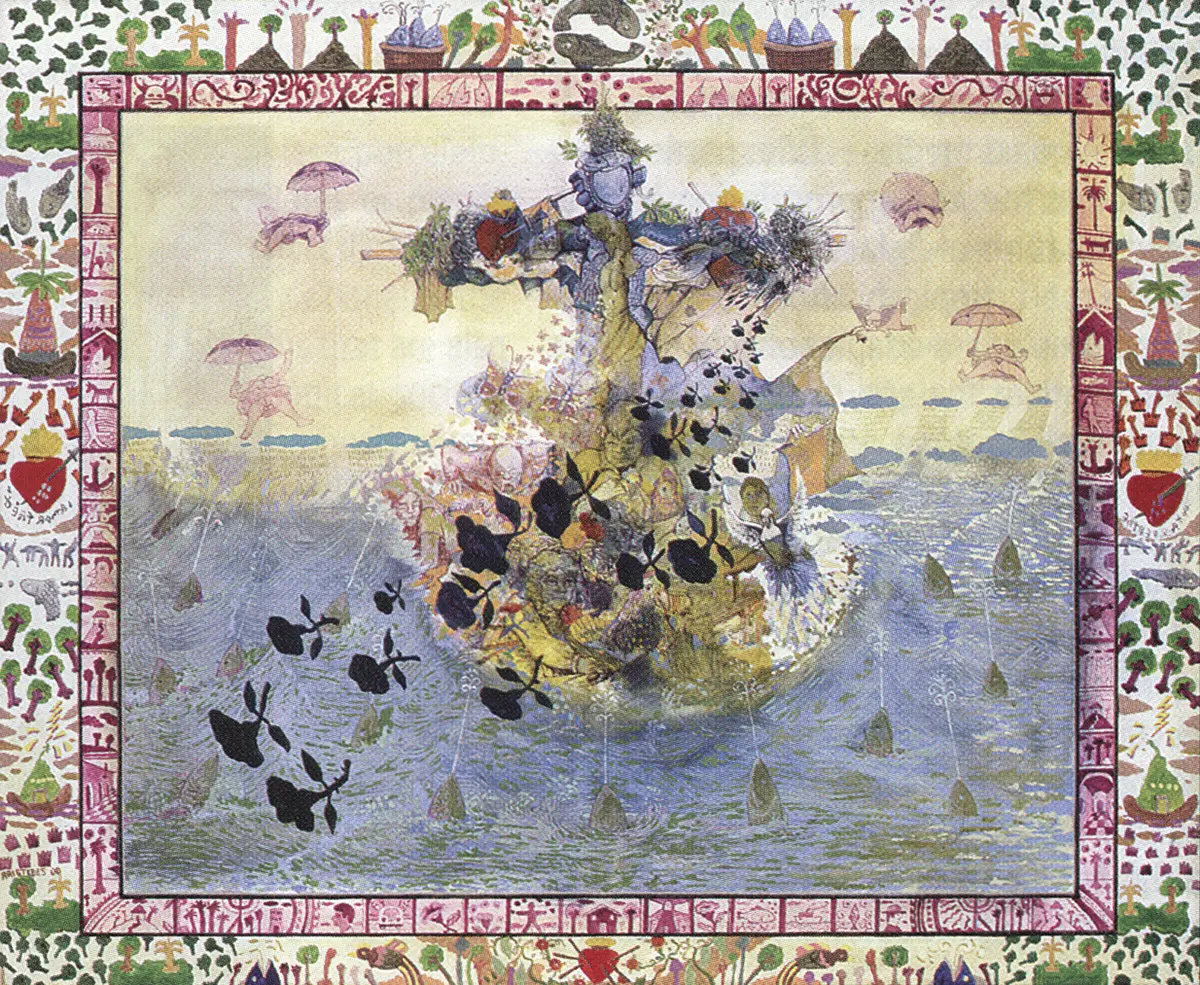
In El día en que nació mi país (The Day My Country Was Born), the show’s emblematic piece, Ureña paints his own image of Panama as a baroque monument emerging from the blue sea toward the luminous sky. Over the horizon, we see small, rainy clouds against the clear sky. Make-believe girl angels float in the sky holding umbrellas as if they were parachutes, showing us, from their strange perspective, their crotches instead of their faces. The sea surrounding the composition’s central group is full of fishes spitting water as fountains from the Old World. This Panama-according-to-Ureña holds a great cross-loaded with burning red hearts, drapes, shields, and vegetation —from which black roses spew onto the sea. At the center, a great cloud of butterflies emerges from the foam in different and arbitrary proportions, along with the Panamanian flag, people of different races and ages, and a peace dove —all in a single lot symbolizing nationality.
In this piece, as in most of Ureña’s paintings, the composition is surrounded by a pair of “cornices” —borders that frame the central image— used to announce and reiterate the work’s theme, as it is done by pregones [street vendor cries] or musical choruses. The elements inside these decorative cornices are frequently repeated and for the artist they carry a specific symbology. Among Ureña Ramos’ wide iconographic lexicon, we can find, for example, impassioned hearts, ships to banishment, tropical palm trees, public buses, dark men wearing hats, women-madonnas, birds, and fish —just to mention a few.
Ureña’s world is populated by a surreal combination of the characters and objects he uses to tell a story while at the same time trying to poke fun at it. Under his dexterous hand, they remind us of classical art but also of the world of comics. With an openly post-modern and contentious attitude, he quotes languages from European as well as indigenous art (such as the Kuna molas), from transnational companies’ advertisements (such as the Del Monte and Chiquita logos), from TV —well, anywhere from the globalized world, of which he is a very conscientious citizen. Within the visual and ironic play characterizing his work, we also find quotes —small “homages”— in the style of the masters that preceded him, not only in Panamanian art but also in the history of Western art.
For example, in La muerte de Victoriano Lorenzo (The Death of Victoriano Lorenzo, in which Ureña paints the Panamanian hero not at the moment of being executed, but after he’s been shot), the artist quotes intentionally the manner and the colors used by the Panamanian artist Juan Manuel Cedeño. In other pieces, he imitates another compatriot, the neoclassical painter Roberto Lewis. Creación de la Bandera (The Creation of the Flag) offers still another example because the woman who is sewing the flag has been quoted from St. Sebastian in Michelangelo’s Universal Judgement. In Homenaje a los poetas panameños (Homage to Panamanian Poets) we can perceive a relationship with Panamanian painter Mario Calvit’s sensuality. In fact, Ureña considers some of his works as being “purely quotes,” as is the case of Cuatro de noviembre de 1903 (November 4, 1903), an allegorical composition making reference to the day of the Panamanian flag.
Despite the fact that Ureña Ramos uses mixed technique on canvas in most of his recent works, they are also closer to drawing than painting. The pigmentation tends to be thin and color-intense. Most of the compositions are built with many detailed figures and forms, drawn almost as miniatures, so the spectator has to get close to the piece and try to decipher their components. In some cases, the compositions are so overloaded with elements that the images become confusing, almost contradicting their narrative character. This is what happens in Panama Day, a piece in which the almost exclusive use of blue increases the sense of disorientation, granting it the appearance of being a draft. To the artist, this blue ink, new in his work, carries a symbolic value (it is related to the Delft blue ceramics that the Europeans who came to work in the canal brought along). All and all, with it, he does not achieve effects comparable to those found in the clearer compositions and expressive colors of other canvases.
We can find the rich colors Ureña uses, for example, in the polyptych he submitted to the most recent Venice Biennial. Without having to say much about the sad decision of presenting the works of several Latin Americans in a space outside Venice, it is noteworthy to highlight the many small canvases that covered a whole wall, focusing on the subject of immigration, which has been the axis for several of the artist’s series, as have been the encounter between races and the globalization process.
In fact, Ureña Ramos has worked for nearly three decades around what he calls “pictorial cycles” —a fact that has been well explained by Tania Iglesias in the brochure accompanying the show. The cycles focus on topics and interests such as “the artistic mestizaje of pre-Columbian and Afroantillian cultural elements;” the incidence of mass media —TV in particular— in today’s life; the appropriation and reconsideration of “classical” elements in Western art; tropical culture; and the uprootedness and re-adaptation that the great migrations at the end of the 20th century have brought along. Ureña interprets and uses all those thematic elements to provoke the spectator and incite him, by means of visual poetry, to reflect.
The conceptual process in Ureña Ramos’ works has always carried an implicit connection with his origins. In this recent series of works, he revisits Panama’s history in canvases that touch specific subjects, although they also allow for a wider interpretation. They include elements belonging to history, classical art, advertising, and the Caribbean, as well as the topics of nationality and uprootedness, which have occupied the artist’s attention for decades and now are reflected in such a personal interpretation of the country’s history.
MÓNICA KUPFER