Cartografías imprecisas (Inaccurate Cartographies) is how Carola Bravo (Venezuela, 1961) titled her show at the Rómulo Gallegos Center for Latin American Studies, CELARG. These were not paintings, nor sculptures, nor installations; it was, rather, the convergence of such plastic modalities in the area of drawing. A convergence ultimately resolved in a whole that achieved its goal of activating the space through a complex intervention. Deployed in two large exhibition halls, Bravo’s proposal accomplished a plastic resolution requiring several ways of analyzing and populating an actual, physical location. In just black and white, within the margins of strict minimalism, this proposal was framed from its onset by the duality of the precise definition of cartography (the art of tracing geographical projections) and the randomness of being inaccurate or imprecise —in contradiction with the fact that cartography, by definition, cannot be inaccurate. In consequence, Bravo grants herself an artistic license and builds her work, practically ephemeral, following the purest sense of those artists who have created new formal tools with their interventions in space.
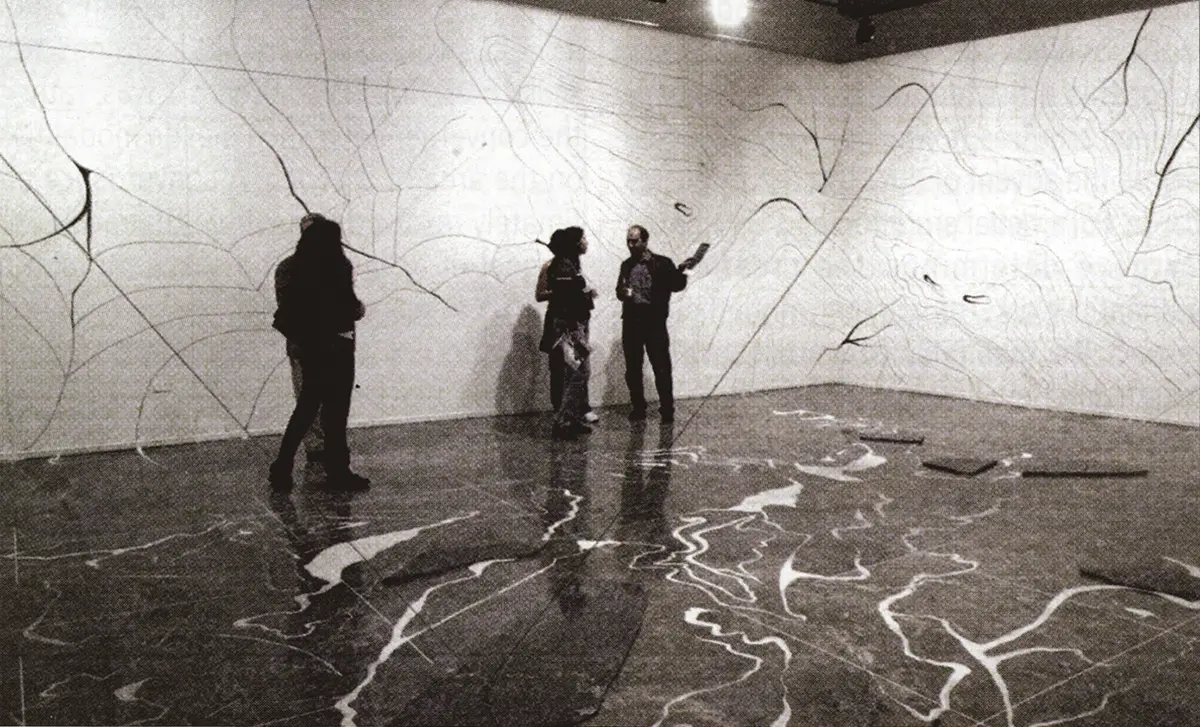
One fundamental aspect is drawing itself. Here, it is drawing on the physical space, following the lead of masters such as Gego, in Venezuela, or Robert Smithson, in the United States. The line directed by the hand, which in turn receives orders from the brain and from the artist’s spirit, moves incessantly and infinitely through space. It has the gestalt virtue of escaping from the spectator until it becomes invisible within the recesses of his or her soul. The vibrant, dynamic, and appraised line moves through walls, floors, the marble fragments which complete a visible reality, "like a surveyor describing and delineating in detail the terrain’s surface." At an affective and conceptual level, the terrain Carola Bravo is interested in is that of the spectator, which may lead us to infer a behavioral connection to the construction of one of Jesús Soto’s “penetrables.” It is not an artistic proposal entering the absolute conceptual field, but its derivation towards the sensorial. Carola Bravo appropriates space, intervenes in it in an almost metaphysical exploration, and then gives it back as a map where the artistic is entwined with the spiritual. The artistic aspect is resolved in the clear and intelligible way the line occupies space and the volume of the stone fragment; the spiritual aspect comes from the way it is presented to the spectator, resembling a cathedral, a cave in Altamira, the sky with its constellations, or like a place where quiet beauty is to be found, beauty without sentimentalism. Such beauty is abstract, but it is also given to comprehension.
We could speak, regarding Cartografías imprecisas, of a classical beauty sustained by the harmonious unity of the all-encompassing line, which forms a drawing of intriguing symmetries, of wobbly circles, of joint axis, of lines vanishing into infinity —an artistic reality where the only things that matter are the fantasy and the creativity of its generator.
In her work, Carola Bravo —an artist and an architect— insists on the spatial relationships of formal elements, in this case, the line, not color or space itself; she debates the value of traditional conceptions, in a world where even installation is old aesthetics. Bravo takes risks in play; she risks the scientific-philosophical view of space as much as the spectators’ common assumptions and sensibility. The artistic space she creates offers the materialization of certain contemporary cultural issues. With this work she brings us back to the spiritual in art (let’s remember Kandinsky and his famous book), posing a number of enigmas and questions for the future. One of these questions has to do precisely with a meditation about man and space, about architecture as social space, and about man as a social being who lives in space, lives with space, and takes space as a nutrient.
BÉLGICA RODRÍGUEZ