
Marshall Berman’s book All That Is Solid Melts into Air: The Experience of Modernity is a classic. Traveling through the key problems of modernity, the author shows how that solidity of forms and modern institutions “were constructed under true oceans that only needed to be set in motion in order to make them smash to bits.” Berman says that it is precisely the modern artists who, by being aware of the void that existed between material progress and the absence of values, felt the need to build. In the face of the void and the fear, a stake in the future continued to exist, and solid materialization made sense. There is a paradigmatic sentence by the author regarding the people and books that he chose because they express specifically modern concerns: "they are moved both by the desire to change—to transform themselves and to transform their world—and the fear of disorientation and disintegration, fear that their life may become torn to shreds. They all know the emotion and dread of a world in which all that is solid melts into the air."
Such a suggestive sentence is one reason to think about what is happening with some works of Colombian art. Maybe because in the last thirty years, the situation of violence has become incomprehensible. Not only is the void and fear recognized, but it is also lived, and it seems there is no hope for the future. Solidity, contrary to the modern period, seems to have less and less meaning for some artists. Then works appear that are light in their materialization, that is, of small format, some made by computer and as gifts, using trivial objects, using a montage that recalls the void itself, videos where the theme is presented without a heavy ideological discourse. However, these works are critical of the country’s situation. What apparently melts turns out to be related to the most solid and permanent social contradictions of history. They have been exhibited in different places and, at times, they seem to go unnoticed on account of their apparent discretion. It is therefore important to describe some of them, in order to ingrain them.
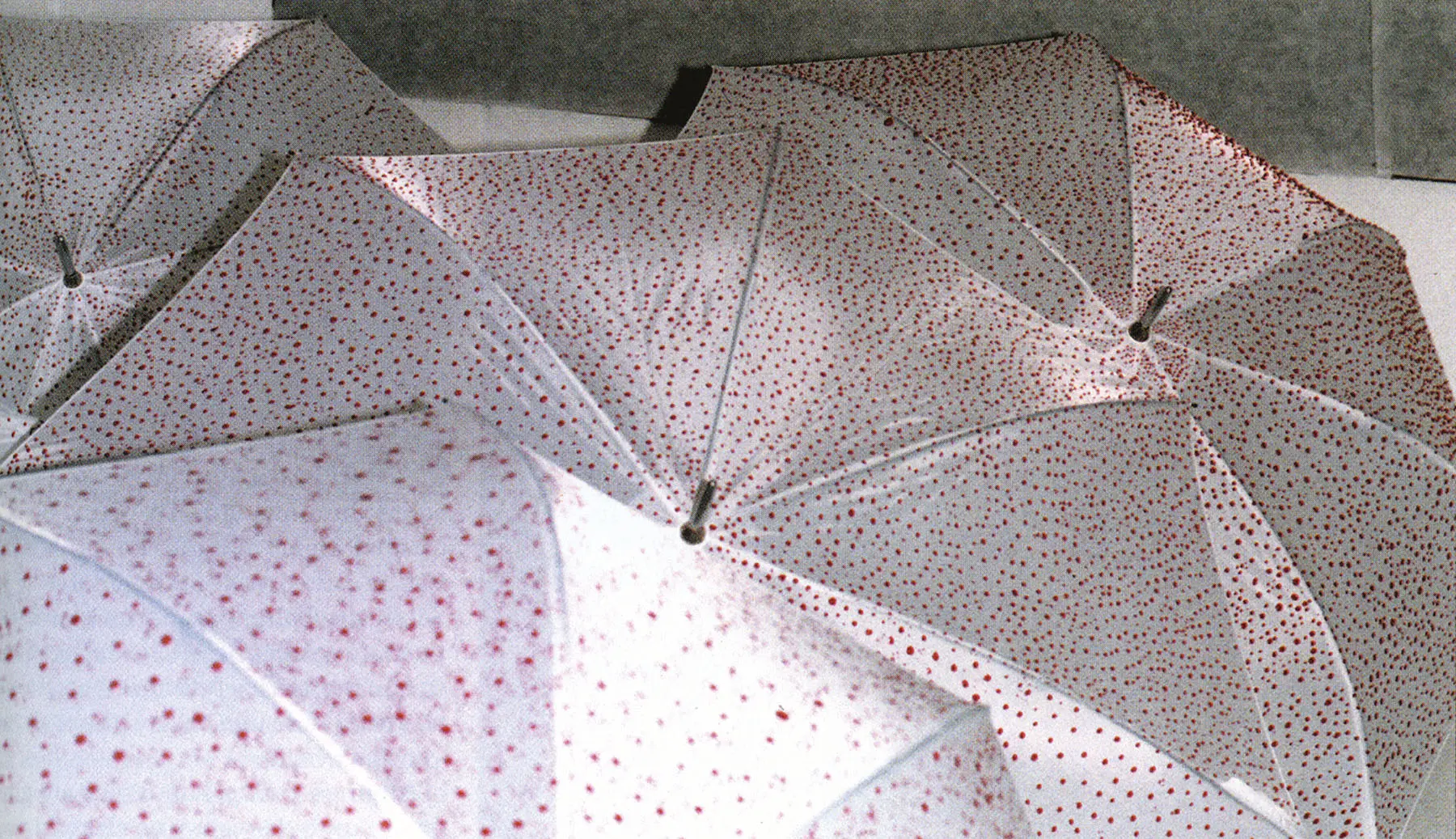
A viewer at an exhibition in Colombia can stumble across ten parasols on the floor, which are white and spattered with red paint; this work by Germán Martínez is titled Qué manera tan horrible de llover (What a horrible way to rain). His interest in recovering hedonism, pleasure, and the stimulus of the senses in these objects is obvious, typical of a period that no longer wishes to invent itself because it no longer believes, in an ideological discourse on what is happening. But in any case, it synthesizes the country’s daily violence. It is a game of language that uses daily conversations like the sentence “what a way to rain,” in a pragmatic fashion, in order to turn them into a plastic act and thus allow the permanent bloody war to appear.
A viewer in Colombia may also visit the multitudinous exhibition full of garish objects in a museum, and find the space pierced by a line of minute coca leaves, cut as if they had been devoured by ants, and stuck on the edges of the walls and floor, one after another, as if an army had transported them persistently through all circumstances. Georg Simmel had already emphasized the fact that truth is not in the solid, in the institutional, but rather in the networks that run through it. According to him, the human experience is lacking the objectual, and the deepest currents of individual life and history are invisible common threads. The piece is by Miguel Ángel Rojas, who for some time now has been concerned with making visible the unequal link between the countries that produce coca and the countries that consume it. As always, he is interested in materializing a concept that may make the viewer reflect on his cultural conditionings, experimenting with the most pertinent materials, thus creating impeccable images.
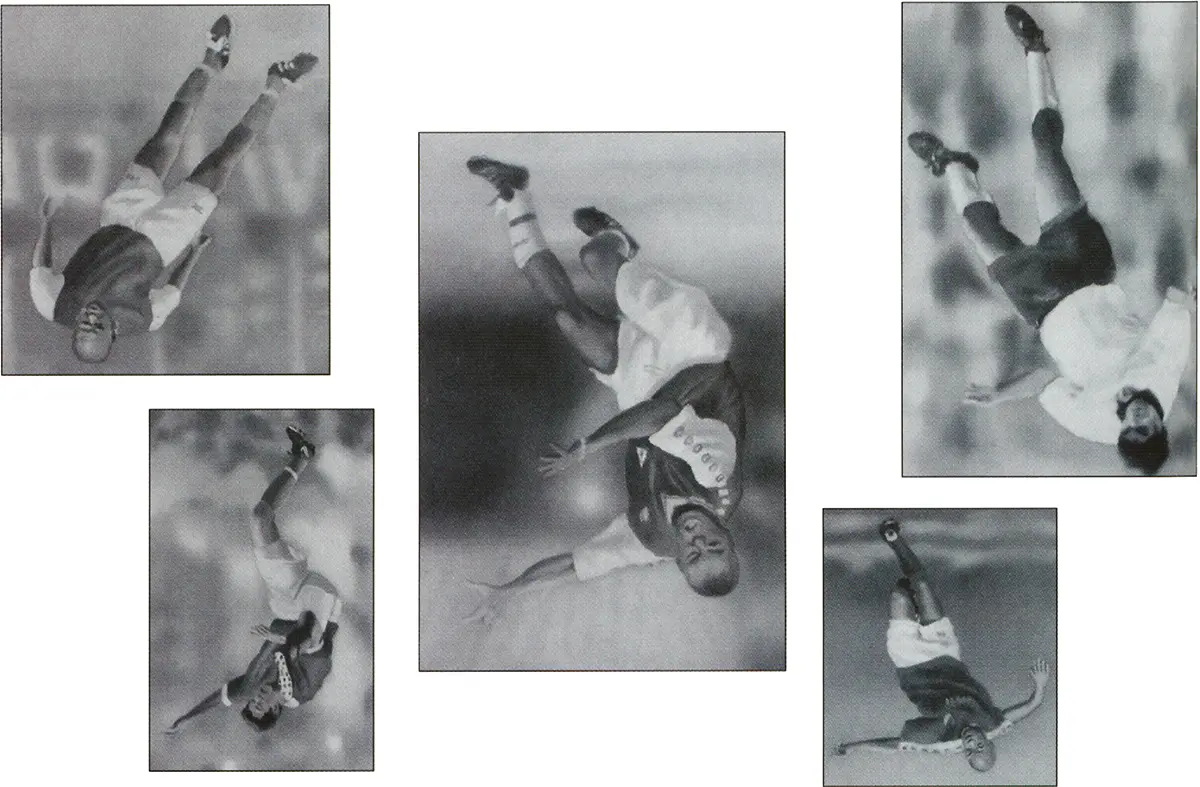
A work like Deportivo cae (Sports Fall) by Beltrán Obregón can sum up the state of mind of Colombians in a way that is both fun and pathetic at once. It is composed of nineteen oils on aluminum, grays, and ochers in a small format based on the photographs of each one of the players of the Selección Colombia. According to the artist, he sought out the image, the cliché of the moment that captures the soccer players in the air. Each one is mounted upside down, they are falling into the void.
Some videos have taken a turn in their point of view and in their construction. They reveal accidental, yet significant, human attitudes, and they allow the situation of the country to leak out with the combination of small, almost literal elements. María Margarita Jiménez created a video titled Mientras pasa una bolita (While a small ball goes by) in which a small white ball on a black background crosses the center of the screen twice per minute. It resembled suprematist pictures and was set to relaxing music, perhaps best described as lounge music. Meanwhile, on a white strip on the edge of the screen, the country’s birth statistics appeared with commentary by the artist: “In 1 minute 2 Colombians are born, 144 are born in an hour, 2747 are born in a day, 989,071 in a year. The majority are born in order to prolong the tradition of violence. In the year 2000, 42,321,386 Colombians. In the year 2013, 51,120,164. Living in the same area of land and with the same amount of water…”
This was followed by statistics on the percentage of Catholics, abortion practices, etc. The contradiction between that type of subliminal order of music emitted in public spaces meant to relax and the succinct statistics constructed the drama of this work, in spite of its minimalism. In addition, with very few elements, it was able to allow the country’s problems to leak out, seen from another perspective, beyond the stereotype of the press, since the question was not “How many died in Colombia today?” but rather “How many people were born?” The artist’s commentaries clearly remind us that they are born in a country with power structures that perpetuate violence.
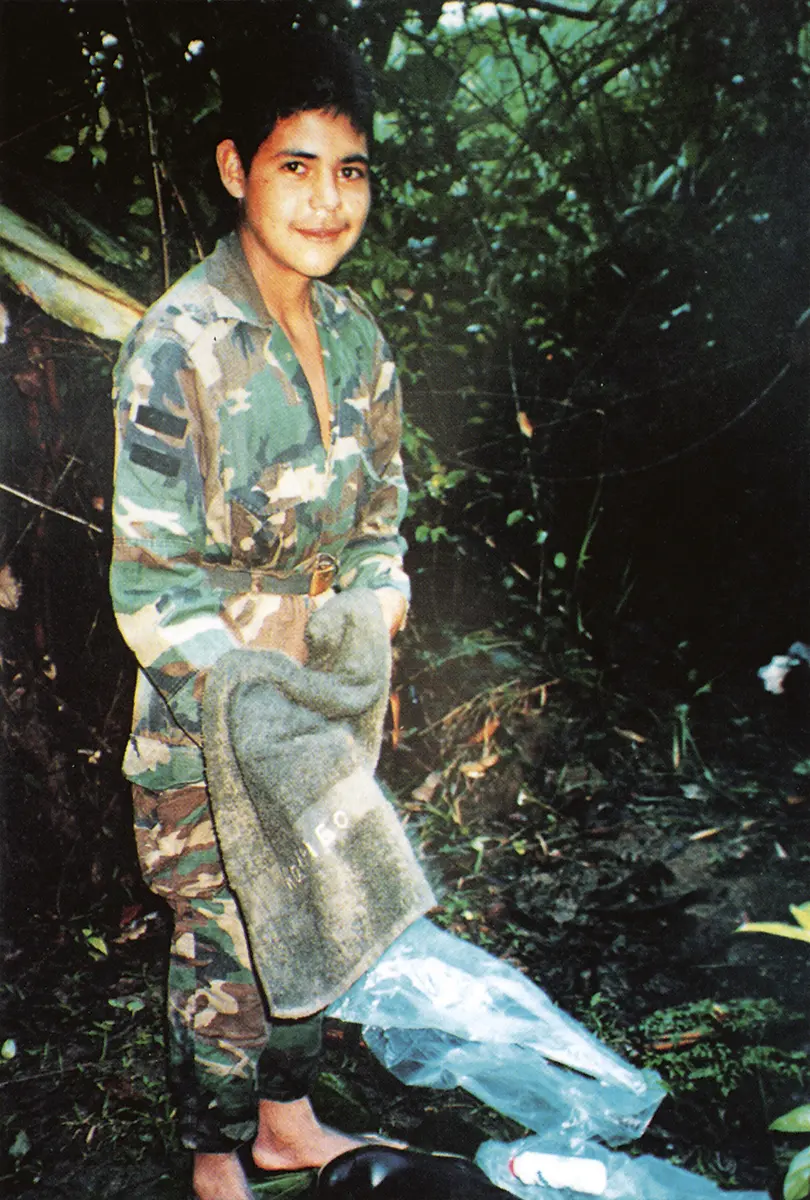
Baño en el cañito (Bathing in the canal) is a video by Wilson Díaz, an artist invited to visit the so-called “clearance zone” created for the dialogues between the Colombian government and the guerrillas in San Vicente del Caguán in Caquetá. The artist was aware of the fact that this is the zone where most images have been filmed in recent years and that they almost always show the same point of view without contributing anything new to the discovery of what is happening in the country. The bus trip allowed him to discover a place called Los Pozos, and he found a group of guerrillas of the FARC (Colombian Revolutionary Armed Forces), teenagers between fourteen and fifteen years old, taking their daily baths in the river. The theme of the bath, according to the artist, has been constant in art history, and it thus provided a reason to make a recording where nothing is happening in terms of mass culture, that is, there are no political discourses or showing of arms. Nothing happens in the video. These boys merely bathe in the river, they comb their hair, they look at themselves in the mirror, and they tidy up with great care. It is an intimate, delicate image, as the artist says, but it is also painful in its contradiction. Some forms of perceiving have a greater ability to capture the whole. The most superficial sometimes allows the viewer to come into contact with the affection and the inner world of individuals.

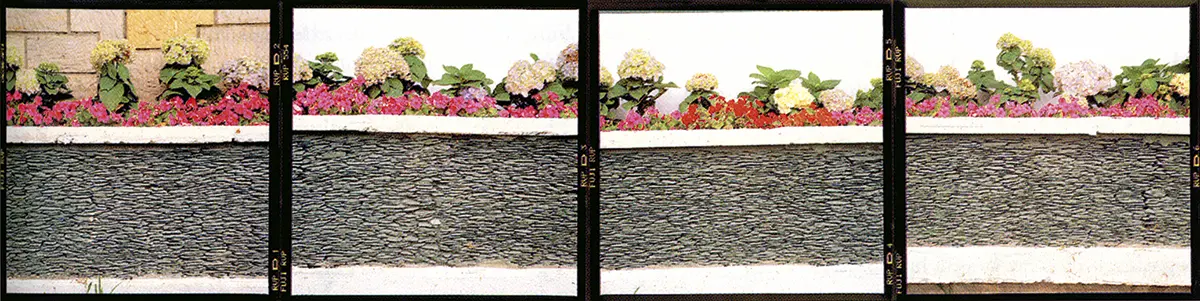
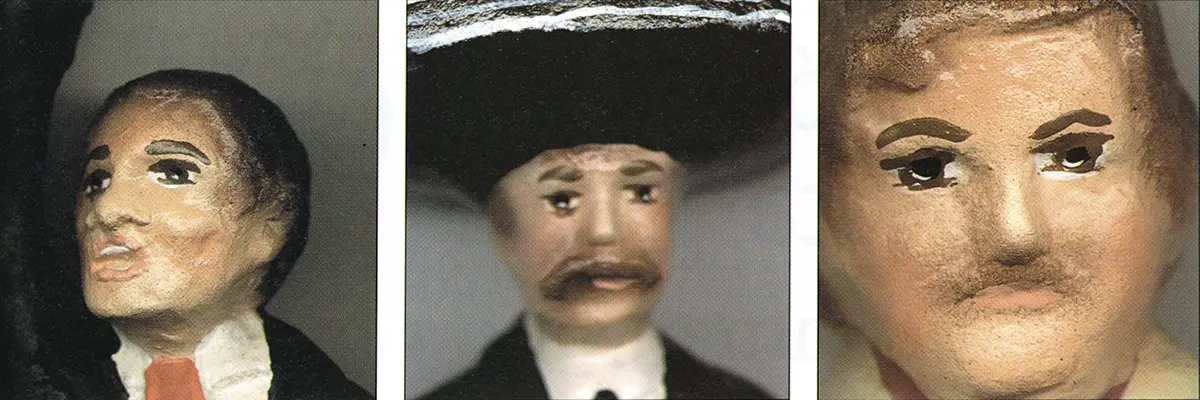
There are works that have stopped questioning technical reproduction as art and, inversely, have decided to proclaim it as a way of making. They come straight out of photography and the computer, but they also open independent networks of distribution outside of the market because they are given as gifts. Thus, in any house, we may find a folding print with photographs of a garden. Matera, by Andrés Fresneda, is a still life worthy of any collector, because it records the gardens of Bogotá in their primary state—fatigue on account of permanent negligence in spite of their original splendor. But also worthy of the collection are the portraits of Pablo Escobar, Jorge Eliécer Gaitán, and Emiliano Zapata. In this case, it is a small folding print by Juan Pablo Fajardo with photographs of these characters taken from the sculptures in painted plaster, also modeled by the artist. This graphic piece, as he calls it, in addition to its light appearance, casts an ironic and convincing wink at history by arbitrarily mixing, as in politics, different types of caudillos and the networks of art, because if it is a matter of collecting works of art that at times have exorbitant prices in Colombia, here we find the obligatory presence of the “political portraits,” and they are free.
NOTE
The works referred to in the article were shown at the Valenzuela & Klenner Gallery and at the Museo de la Universidad Nacional.
NATALIA GUTIÉRREZ
Anthropologist and History of Art teacher at the Universidad de los Andes, and at the Universidad Nacional de Colombia.