
Consuelo Gómez’s show, held at the Galería Diners during July and August, was made up of 13 pieces, some on the walls, some on the floor. On the one hand, they put in evidence the lesson learned from formal purity —a legacy of modern art, particularly of abstraction and minimalism. On the other, this refinement is transgressed by the presence of the everyday and the language of some of the materials used —fórmica, felt, and rabbit hair, elements that open another dimension in her work.
Since her beginnings as an artist in 1986, Consuelo Gómez has constituted her work based on a reflection on form, which she knows, and a respect for the principles of geometry, which she investigates in the structure of cylindrical and spheric shapes, giving place to a game of opposing elements, of the negative and the positive, fullness and emptiness, fragility and heaviness. Also, it is evident that in her pieces there’s a great compenetration with the language of the materials used —woods, different metals, and glass. For their handling, the artist has preferred to use artisanal processes, but also industrial ones, allowing her different possibilities to mold, assemble, and shape her works. The artisanal and the manual gives her the opportunity to utilize accidents and chance as part of the process, while with the industrial —for example, with the exactness of a lathe called “numerical control” that’s utilized to make screws— there is a more precise relationship between form and idea.
More than following a precise method, the formal purity of her objects (columns, obelisks, tops, chairs, and gates, among others) has always followed a process of free association. This is clearly the case in her last exhibit, titled Al otro lado de la superficie (On the Other Side of the Surface), in which the everyday —her own domestic environment— meets the hat-making process. The quotidian began to be part of Gómez’s work in 1995, after her son’s birth. At that point, she becomes interested in the ritual of food and home utensils such as silverware, glassware, and chairs. Besides making her own objects, she begins to intervene chairs with metal and glass, as it was seen in the show held at the Galería Garcés Velásquez. In this reflection on the domestic, the sense of the form and the materials used become even more patent. For example, in some of her iron silverware pieces, the simplicity of the form and the language of iron, very dark, result in truly moving objects, mostly due to their essence and the respect for the metal.
In her latest show, the domestic is introduced by different means, particularly through architecture, as evidenced by the piece titled Hall, which is made based on a sort of consciousness of the apartment in the building in which she lives. It is a building from the 1950s, with an architecture privileging ample and orthogonal spaces that in their common areas have grey granite and dark marble. The apartment’s design follows a simple grid whose dividing lines are of golden metal. In this fashion, Hall, with its fórmica base evoking the granite, the bronze lines, and a marble cube, comes forth as a volumetric rising of the floor plan, turning the apartment into a sculpture that celebrates the values of modernity. Another reflection on architecture stops at the niches appearing on her apartment walls. The void denting the walls that were conceived to display objects unfolds itself and becomes three white reliefs, one of them titled Extendiendo el vacío (Extending Emptiness). These unfolded reliefs give place to a volumetric game that reminds us of abstraction’s and geometry’s best lesson, which structured architectonic spaces and gave room to the pictorial surface and modern art’s volumes.
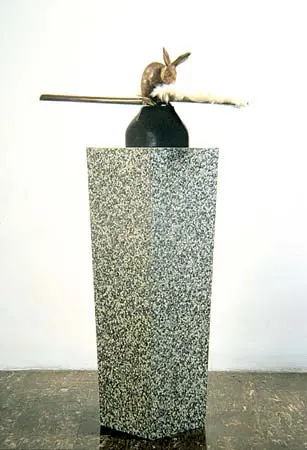
On the other hand, this show is conceived from a visit to Barbisio, a traditional hat factory located in Bogotá, where Consuelo Gómez learned about the process that changes rabbit hair into felt. The visit was motivated by an interest to know what’s behind things or where things come from; in other words, a question searching the origin of things. Her experience at the factory allows her to see, step by step, the transformation of a being from nature (in this case, the rabbit) through an elaborate and complex manufacturing process that turns it into something useful to humankind. Impressive are the huge rooms in which rabbit hair is preserved, and the enormous steel machines that modify it to make possible the existence of felt in its different degrees of density and thickness. The experience with the material and its origins spawned a series of strange and unsettling pieces. The different materials used in them—some of them elaborated in the same factory, as in the case with Campana de luz (Bell of Light)— are evidence of the free association with which Gómez weaves her personal experiences with the manufacturing of felt. In Conejo (Rabbit), the rabbit’s natural white hair coexists with a rabbit carved on wood perched upon a fórmica-covered pedestal that reminds us of the texture of granite. The convergence in this piece of the author’s reflections and experiences both unsettles and seduces the spectator. In a particularly disturbing piece titled La fábrica (The Factory), the different surfaces of the materials used are geared toward the tactile and the visual. It’s a geometrical structure attached to the wall; it has been built from painted wood and fórmica, both very smooth surfaces. On one of its parts, we can see a plane made up of slightly pressed rabbit hair, whose surface and texture contrast violently with the other materials.
This game of contrasts can also be found in Jardín de río (River Garden), where the surfaces of felt, fórmica, and river stones and combined in a round format; and also in Vasos (Glasses), a sort of mural made up of 36 glasses, some wooden and some made out of felt, in which multiple aspects motivating the show appear to converge. Her interest in the everyday and the domestic becomes manifest through the presence of the glass —the Coca-Cola glass, with its characteristic silhouette, so intimately linked to everyday life around the world. On the other hand, there’s the game of opposites, of the smoothness of polished wood against the rugosity of felt. This last material carries along the experience of the factory and the reflection on materials and surfaces. Also, the essence of the glass is transgressed by the non-transparent materials, but in spite of them, a glass continues being a glass, the Coca-Cola glass. What’s on the other side of the surface? Above all there is —in the glass, the rabbit, the factory, the process of elaboration of things; in Gómez’s whole oeuvre and the pieces making up this show— a fine and acute sensitivity that takes into account materials and shapes, as there is a particular care in their design. A sensitivity that feeds off its surroundings, of life’s experiences. A sensitivity that knows no other manifestation but the artistic one.
MARTA RODRÍGUEZ