
Argentine curator Carlos Basualdo’s clearly defined objective in this Paris show is to ask a fundamental question: what is the answer that Latin American artists have contributed to modernity during the second half of the 20th century? As the curator himself points out in the catalog, this is the beginning of a reflection to build a conceptual perspective of criticism and to propose a new history of art in which Latin American art will finally appear separate from what is called a “neocolonial typology,” differentiating itself from the “dominant categories” imposed by Western Europe and North America. To prove his point, he has chosen artists from different generations whose common point is “to have responded similarly to the experience of adversity,” and he takes as reference the work of Hélio Oiticica in Brazil and Víctor Grippo in Argentina. The “fragile axis” that must turn this event into a “space for reflection” is the impact of adversity as vindicated by Hélio Oiticica as the force behind his work, inscribing it (under the form adopted by the show’s title) in one of his first shows in 1967. According to Basualdo, the show’s objective is to resist a Eurocentric or North American reading, thus avoiding an oversimplification (Minimalist, Conceptual, or Arte Povera).
A hybrid between theoretical, manifest, and “tale” shows, Da Adversidade Vivemos seeks to modify the gaze that Europeans (and North Americans) have fixed upon Latin American art, a gaze that has not freed itself from old postcolonial cliches and supremacist categories. The moment has come to question such a gaze from considerations arising from specific political and social realities shared by the Latin American countries as a whole. As such, Basualdo’s proposal is totally innovative and it should inaugurate new tracks of reflection for the analysis and understanding of artistic production in Latin America during the second half of the 20th century, characterized by decades of bloody dictatorships that all but murdered the continent. Utilizing different types of discourses, the show is an open door to ask several questions. The curator asks the first one as a postulate: “adversity” as the detonator to search for the sense and function of the art produced by Latin American artists. The second one provokes a reflection on the nature of the show itself. I will concentrate on this last question. The dialectical adaptation of two types of discourse (the theoretical and the artistic) generates a third one, which is the show and what it says (its “tale”). The “authorized tale,” constituted by the catalog’s theoretical body, is “indispensable so that the esthetic statements survive the material, both symbolically and socially.” That’s why the show could not survive without it. But given that the works displayed cannot be reduced to the dimension of the peripheral discourse, it asks, once again, the question regarding the nature and function of art. We find ourselves between the relevance of the theoretical discourse over “adversity” and the interrogation over the intrinsic (esthetic? political? conceptual-ideological?) discourse of the works shown. The show’s discursive dimension (the show as work that makes sense) should not make us forget the works themselves, and here we should ask ourselves in what measure the strength of the pieces shown corresponds to the strength of the discourse, of which they are object and pretext.
French theoretician Jean-Marc Poinsot notes that since the 1960’s, the production of an exhibit comes before the works it will show. He writes: “The exhibit is a situation with a complex discourse that has a set of rules in constant evolution, but it lacks a history of its own, independent from the esthetic statement it updates.” Nevertheless, what seems to happen in this case is that the show’s value threatens the value of the works shown, and we are witnesses to the supremacy of the exhibit (as a theoretical concept) over the art it is supposed to bring forth. On the other hand, why a theoretical argumentation such as Basualdo’s couldn’t have based itself —at least for history’s sake— upon a wider selection (beyond the exclusive installation we have here), at least to the extent that the art produced in Latin America or abroad takes extremely varied forms. Here we must remember the case of painters that had to go into exile for political reasons, such as the Chilean José Balmes or the Argentine Felipe Noé, to mention just two. This real and concrete “resistance” that Carlos Basualdo rightly so speaks of has expressed itself in manifestations linked to as much a certain realism as to the recovery of popular and pre-Columbian art in the Neo-Mexican movement of the 1980s or other forms of ideological or ecological recoveries, or those based on identity, which are not mentioned here.
Carlos Basualdo justifies his eclectic approach by saying that it is "'fundamentally to be able to distinguish these productions from international supremacist references, without having to lose their relevance in various specific contexts.' He underlines that what brings together so many different artists is 'only a conceptual resonance that goes less through personal contact than a sort of historical fatalism.' For him, 'the works gathered in this show have as common thread the fact that they rest on a critical analysis —different in each context— of the conditions under which they have been produced,' and that the artists respond to those situations through the 'content of the works,' 'the implementation of artistic strategies,' and the 'specific materials.' Furthermore, he invites us to continue reflecting when he writes that it is a matter of 'conceiving, through these works, an ethical space dedicated to artistic production. Better yet, it is about imagining an epistemological perspective in which we could separate ethics and esthetics. Paradoxically, as an existential category, adversity would become a productive matrix, and from this operation we’d have practices consisting of, above all, making the artistic work a gesture of inventiveness and, simultaneously, of resistance.'”
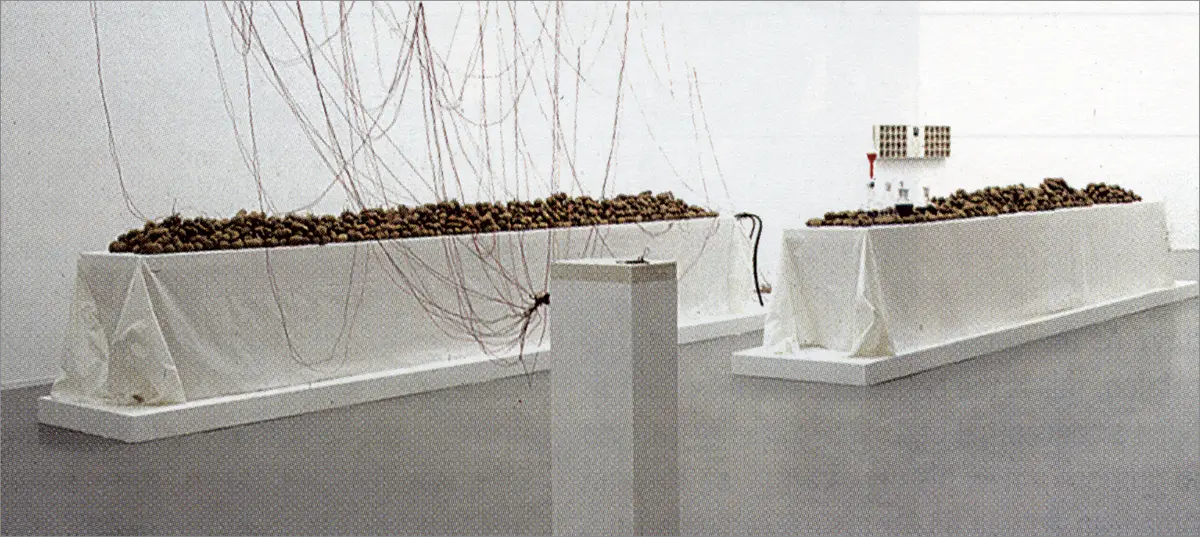
The installations by Víctor Grippo [Analogía I, versión I (Analogy I, Version I), 1970 and Analogía I, versión II (Analogy I, Version II), 1977] and Hélio Oiticica [Eden (Eden), 1969] are presented as paradigmatic proposals for a history that must be rewritten taking into account adversity as conceived by Basualdo as a “productive matrix” that turns artistic work into “resistance.” In regards to later generations, the curator has chosen fourteen artists, most of whom took part in the exhibit titled Eztétyka del Sueño (Esthetics of Dream), that he organized last January in Madrid within the framework of Versiones del Sur (Versions of the South). All these creators share with Basualdo that “adversity is a state of things inseparable from daily life that ends up turning into a psychic state,” despite the fact that this reflection goes beyond the problematics of defining Latin American creation.
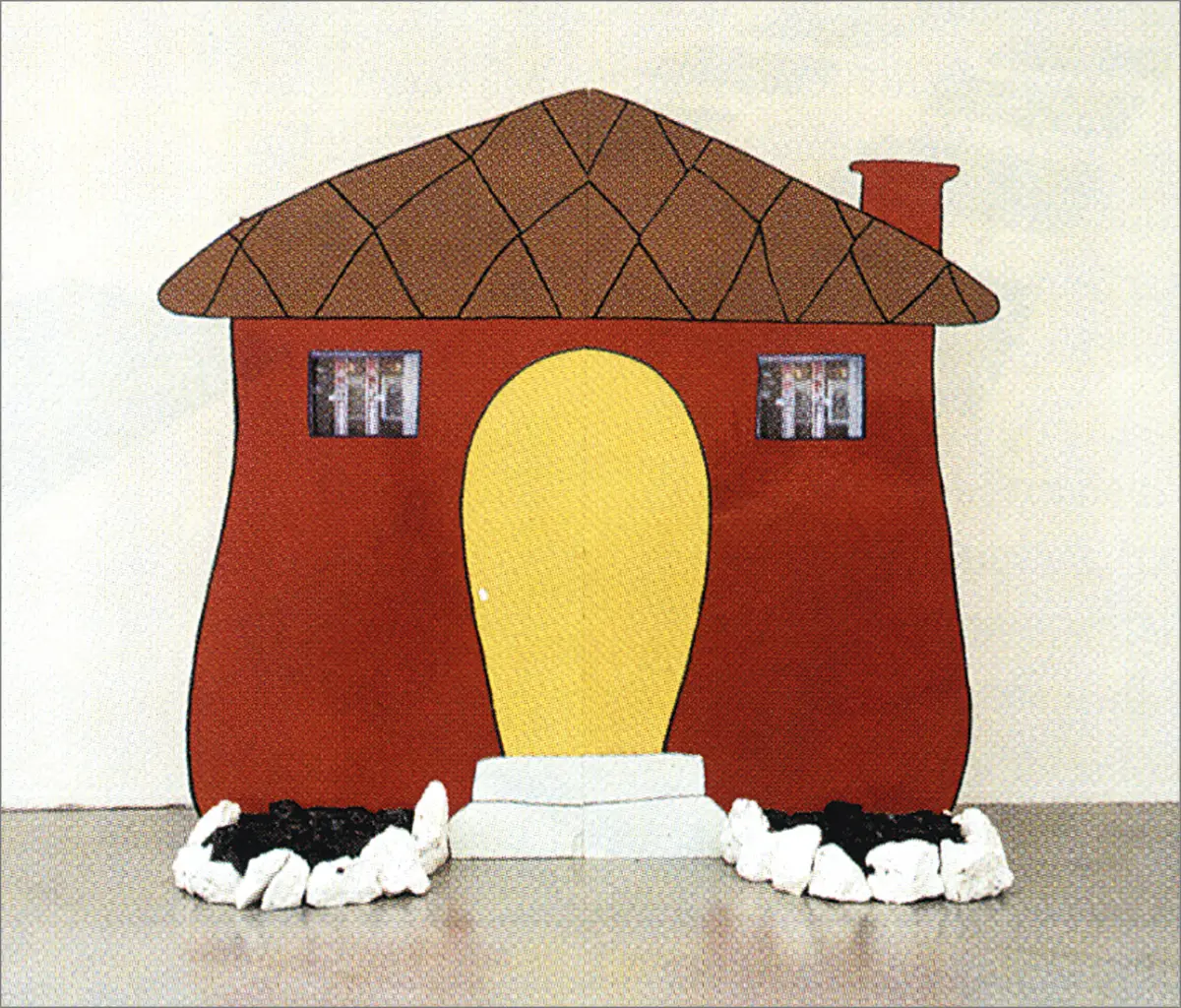
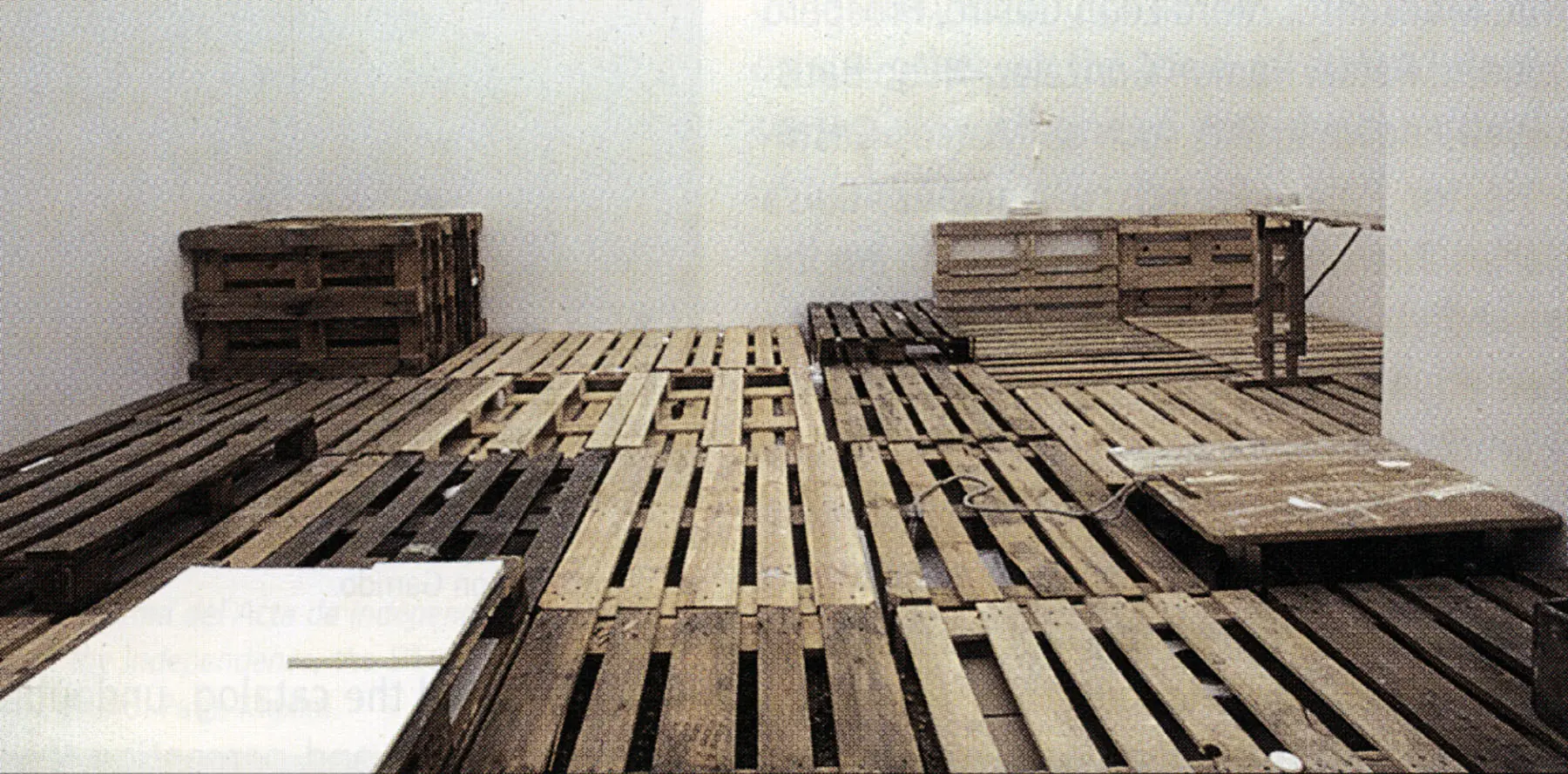
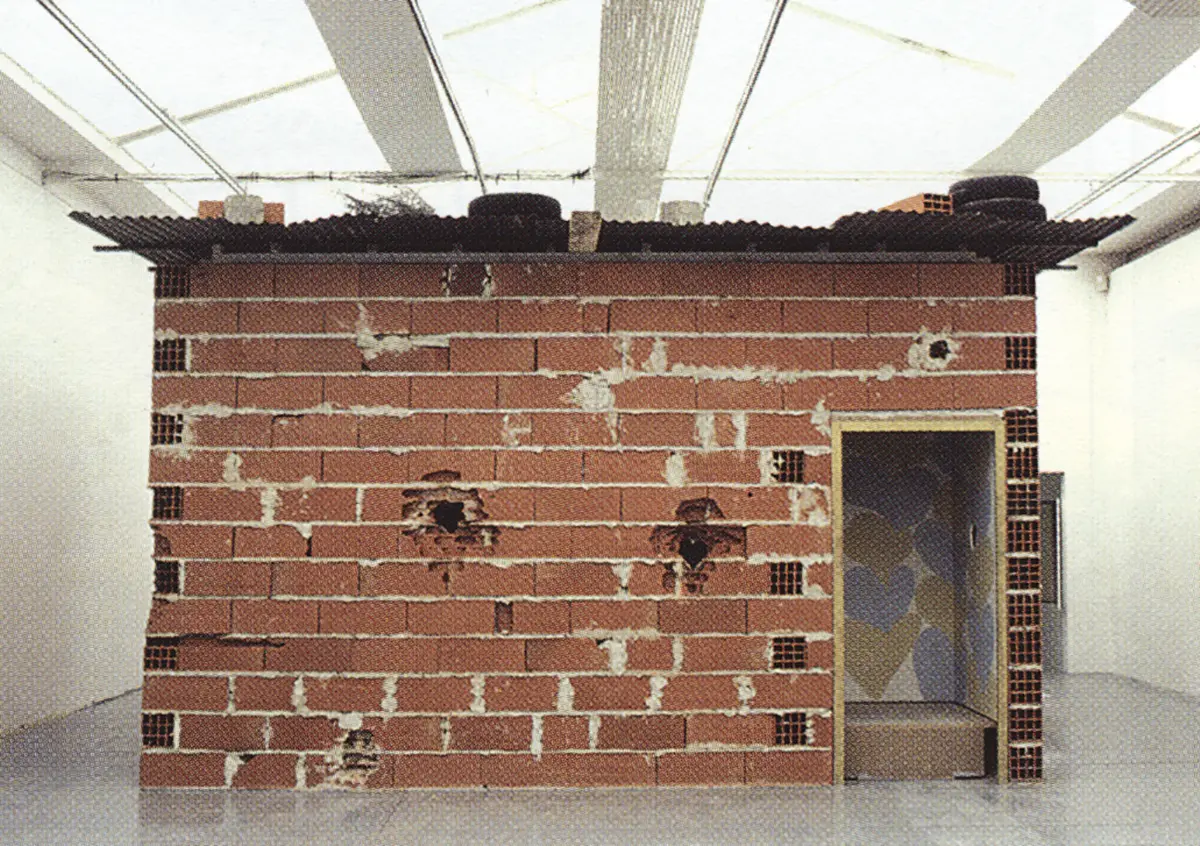
The Colectivo Cambalache (Cambalache Collective) proposes Museo de la Calle (The Street Museum, 2001) as a marketplace in which diverse objects are exchanged, inviting the public to participate actively. Arthur Barrio is present in two places, with an experimental intervention on one of the museum’s walls [Pared o experiencia No. 19-20 (Wall or Experience #19-20), 1970-2000] and a series of transparencies [Regist(R)os (Registers), 1969-1980], referring to the artist’s freedom before the institutions. With Tristemente célebre (Sadly Famous, 2000), Chilean Christian Silva makes reference to the dictatorship with a maquette of the Santiago stadium, while José Hernández-Díez includes skateboards directly in his Sin título (Untitled, 1993) installation, making an emblem of the sport so esteemed by city youth. Francis Alÿs, the Belgian artist residing in Mexico, presents a video titled Cuentos patrios (Patriot Tales, 1977) in which he makes reference to the 1968 student riots in Mexico and introduces a reflection on time and political power. With Fallas de Origen (Source Faults, 1997), Wilson Díaz talks about the difficulties of habitat in Colombia and presents a sort of tropical “Sam-suffit.” Meyer Vaisman, with Rojo por dentro, Verde por fuera (Red on the Inside, Green on the Outside, 1993), “builds” a typical middle-class Venezuelan home in which he keeps the memory of his adolescence. With Sin título (Untitled, 2001), Fernanda Gomes offers a space for reflection based on common objects and raw materials such as boxes, over which the public is invited to walk.
Artists such as the Mexican Minerva Cuevas (with the Mejor Vida Corp. [Better Life, Inc.] desk) or the Colombian Juan Fernando Herrán (Cajas fucsia [Fuchsia Boxes], 1996-2001) —a piece dealing with the corruption of former president Ernesto Samper’s administration— would be more difficult to understand by the French public since the social and political situations alluded are little known in France, and the translations cannot effectively explain the reality of the context.
María Teresa Hincapié’s performance Divina proporción (Divine Proportion, 1996) —which went largely unnoticed on opening day— creates a space of silence and reflection on the resistance of nature in the city. Undoubtedly, the work that awakened the public’s interest is Cildo Meireles’ spectacular installation Desvio para o Vermelho (Red Shift, 1967-1984), presented for the first time in France, in which red and black, worked over spaces of single color in order to survive, play a dramatic and unsettling role.
CHRISTINE FRÉROT