
The young Argentinean artist Elizabeth Aro opened last July, in the exhibition hall of the Rivadavia Cultural Center of Cádiz, Spain, a new show titled De la gente y el paisaje (Of People and Landscapes). This title touched only indirectly upon the show’s real topic, which was immigration. Yes, immigration, that recurrent phenomenon in Western history which in recent times has acquired a new, conflictive profile in Spanish society: now the issue is not the hundreds of thousands of Spaniards who emigrate, as they did through the 19th and 20th centuries, but the hundreds of thousands of Latin Americans, Asians, and Africans (not to mention Eastern Europeans) who crowd at Spain’s gates, hoping to enter a country that only yesterday was poor but now counts itself among the rich nations of the world.
In fact, Elizabeth Aro could hardly have found a better locale for her show than Cádiz; this city, founded more than 4,000 years ago by the Phoenicians, is among the most worried about the unstoppable tide of illegal immigrants arriving from Zagreb and Sub-Saharan Africa, people who every day risk their lives and defy the coast guard in their attempts to cross, aboard their zodiac boats (colloquially called pateras), the neighboring Strait of Gibraltar. According to data collected by the Spanish authorities, only in the first half of last July, 1,561 illegal immigrants were intercepted by the Coast Guard while crossing the Strait; not all of them were so lucky, though: on July 15th, right in the middle of a month that saw historic records in cross-Strait immigration, six people died after their perilous journey through one of the world’s most dangerous sea passages. Four of them perished when their boat crashed against the reef, and two more suffocated after inhaling the toxic gasses emanating from their own precarious patera.
Elizabeth Aro has wisely avoided the sensationalism and melodrama often found in mass-media treatments of this issue. Her attitude is, in contrast, restrained and subdued, entirely averse to the voyeuristic focus on the illegal immigrant’s hardships and suffering. She concentrates on a muted, elliptical evocation of the migrant’s interior experience. This is why her show at Centro Rivadavia opened with a dozen portraits of immigrants photographed casually in the streets, with a simple camera. The subjects’ heads and faces could be discerned only if the spectator came close to the piece; what at a distance had seemed just a black rectangle, revealed itself to be an actual photograph, soft and masterfully lighted. “The immigrant’s first drama,” the artist points out, “is to be among multitudes and to remain unseen. Immigrants are like ghosts, or rather like shadows: only the Other’s gaze brings them into the world and gives them a face.”
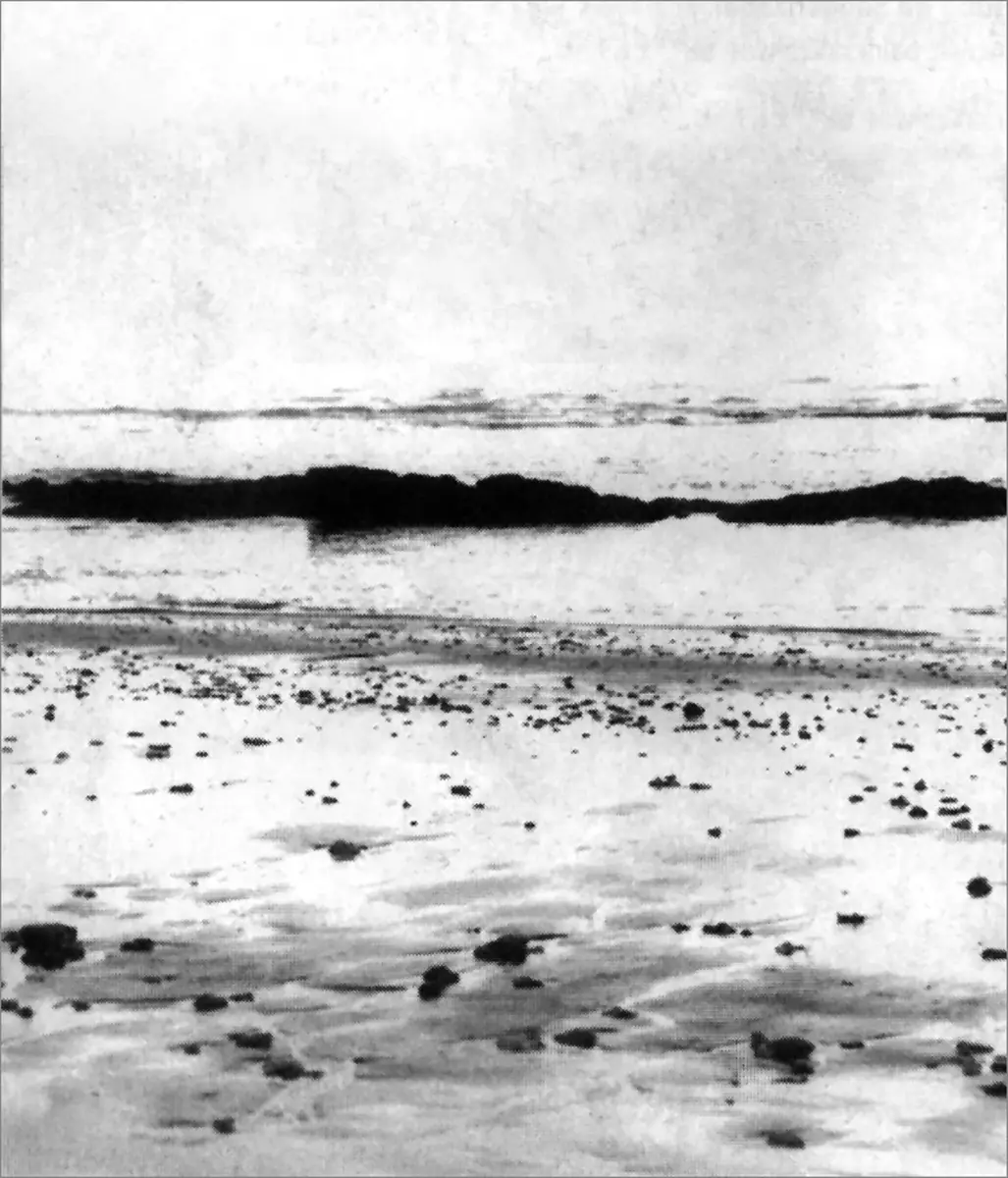
In contrast with those pieces, dominated by black, the same hall housed six “white” works. These were also photographs, but instead of human subjects, they captured an unnamed empty beach, where waves came to die enveloped in a deadly silence —not unlike that of a patera voyager as the boat sneaks toward the Cádiz coast, where the gates of what they imagine to be Eden await— or, often, the border patrol, detention, deportation, and even death. When such tragedies occur, the Spanish media shows without qualms the bodies of the drowned, but Elizabeth Aro chooses not to. Characteristically sober and restrained, she prefers to avoid the pathetism and instead present—as in her show’s third segment— not the drowned but the figures of three men molded in the sand directly on the ground, figures that could perfectly be part of a classic Greek or Roman fresco, or just some sleepers given to rest after an exhausting feast.
The third segment of the first hall housed large-format prints depicting a forest (perhaps Pine trees, Oaks, or Redwood) similar to those found on the hills that border the Mediterranean. These photographs have a blue bias, diluted, grayish, and they evoke —in the artist’s words— “the interior forest,” that Hollywood which ciphers and veils the immigrant’s lives, feeding their nostalgia as much as it feeds their hopes.
In the second hall, however, the limpid intensity of the first works was not sustained. The main motif here was the table, which for Elizabeth Aro symbolizes the generous invitation to share that the best among the natives extend to the new arrivals in their land. Seating at the table is to partake not only meals, but also friendship, mutual understanding, hopes, and dreams. It is to weave a clear and well-defined familiarity. For that very reason, Elizabeth Aro wanted the people of Cádiz to participate in this installation, and she asked them to loan her tables, any table, for the piece. Many joined in, but the end result, the installation of about twenty very different tables along with large-format photographs of forests, lacked the intensity of the other works. A pity.
CARLOS JIMÉNEZ