
The Wexner Center’s Suite Fantastique, an architecture and design exhibition curated by Jeffrey Kipnis, surprised viewers with its extravagant multi-media configuration. Mixing postmodern positions in drawings and diagrams of theoretical architecture with contemporary digital art forms and popular “rave” culture, the show included music, DJs, film screenings, an exhibition layout structured like a musical form, and an overall concept of “performance” that shifted attention from the material object to electronic design processes.
Featured among the architects and designers was Argentinean painter Fabián Marcaccio. Apart from a smaller “paintant” shown in the "Trio" section together with sculptor Scott Burton’s furniture and diagrams by architect Greg Lynn, Marcaccio’s main contribution was a commissioned collaboration with Lynn, titled Predator. Since the presence of a painter in Suite Fantastique was unexpected, I want to look at his work here in the context in which it was shown.
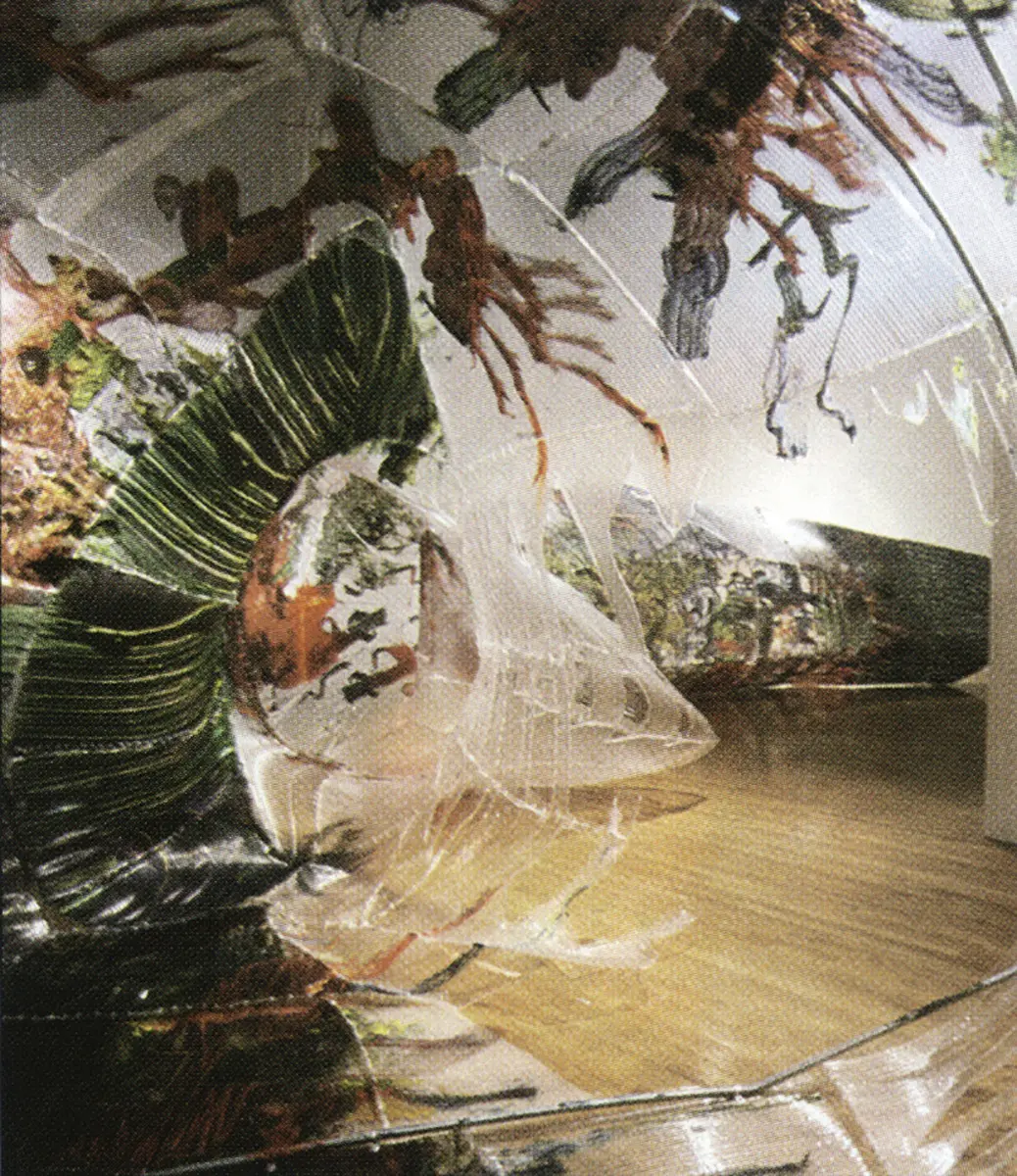
After the visually stunning Overture, in which the Los Angeles-based motion graphics firm Imaginary Forces displayed a continuous loop of opening movie credits bursting with virtuosi editing, metamorphic imagery, and pulsating font animation, it was the middle section, “Perfect Acts of Architecture,” that determined the tone of this exhibition. These “acts” pointed to the conceptual world of theoretical architecture and diagram diaries by some very well- known artists, including Daniel Libeskind, Peter Eisenman, Rem Koolhaas, Thom Mayne, and Bernard Tschumi. On the walls and in glass cases, we could study the abstract lines and indecipherable marks of Libeskind’s Chamber Works: IV Horizontal, drawn in ink on paper, Tschumi’s collages and graphic experimentations, and Koolhaas’s savagely ironic and fictional montage Exodus, or The Voluntary Prisoners of Architecture, while increasingly noticing the unusual forms and design constructions of Burton’s sculptural furniture that was distributed across the space. At the end of the Suite is a tropical room full of color and sound (DJ Spooky’s remix). Our eyes had to get used to the unusual shape and texture of the raving thing or blob that seemed to have grown here. The fantastic whale-like vacuformed plastic that snaked around the room was Marcaccio and Lynn’s architectonic-pictorial construct or “set” apparently inspired by the setting and digital special effects sequences of another Predator, Arnold Schwarzenegger’s sci-fi movie. The whale-house had an opening through which one could step, glancing into the belly of this enormous hollow object which appeared to be a kind of “transgenic species,” as Eduardo Kac might call it.
Predator is a hybrid of painting, architecture, and digital technology that has come alive as a vigorous and visceral organism, spreading through space. The reference to genetics is not accidental. Marcaccio’s earlier works, such as The Altered Genetics of Painting (1993) or 560 Conjectures for a New Paint Management (1996), and the more recent large-scale installations of The Tingler (with Greg Lynn, Secession Vienna, 1999) or Paintant Stories (Kölnischer Kunstverein, Germany, 2001), all point to manipulations and mutations of the “code” of painterly form and material boundaries. Computer manipulation techniques, like the processes of sampling, layering, and mixing in techno music, influence thinking about heterogeneous materials that goes beyond well-known categories of collage and montage. In Marcaccio’s plastic installations, hybridity defies a sense of original materiality but is steeped in the culture of video games and digital information. Brushstrokes and LaserJet ink float on the plastic skin of the Predator’s huge carcass, bonded to the curvilinear surfaces of Lynn’s translucent resin panels that were produced from digital models with the new rapid-prototyping design process. The panels are stitched together to build the architectural shape without a mass or body, but the shape gains a biomorphic gestalt. Marcaccio seems to revel in the contradictions between media: he is a process-focused, time-based, cinematographic mannerism that extends “painting” as we once knew it into architectural panoramas. The panoramas are largely abstract and spotted with hyper-intensive colors, animate forms that flow in thick streams, and extended blotches.
Marcaccio’s installation invites the viewer to move into and through the pictures, to discover painting-in-motion as a continuous architectural environment. At the same time, a close-up look at the structure of Marcaccio’s collaborative Predator reveals production processes that hint at a new building technique: rapid prototyping from digital design sculpts a trans-formal space in which we quite literally see through the painted skin of a realized virtual reality model. The model is a precise metaphor for the re-definition of materiality in the digital era.
JOHANNES BIRRINGER