
Juan Roberto Diago was able to insert, for a few days, a piece of dilapidated Havana inside one of Coral Gables’ impeccable exhibit spaces.
With a proposal indebted to arte povera and nurtured by his entorno povera, he created a contrast that aroused the artistic (and even nostalgic) curiosity of a large group of spectators, many of them from the Cuban community settled in South Florida. His art served as a messenger that brought in the latest news from the other side. Many went to receive the news without necessarily having to agree with them. The most important one said, My history is your history.
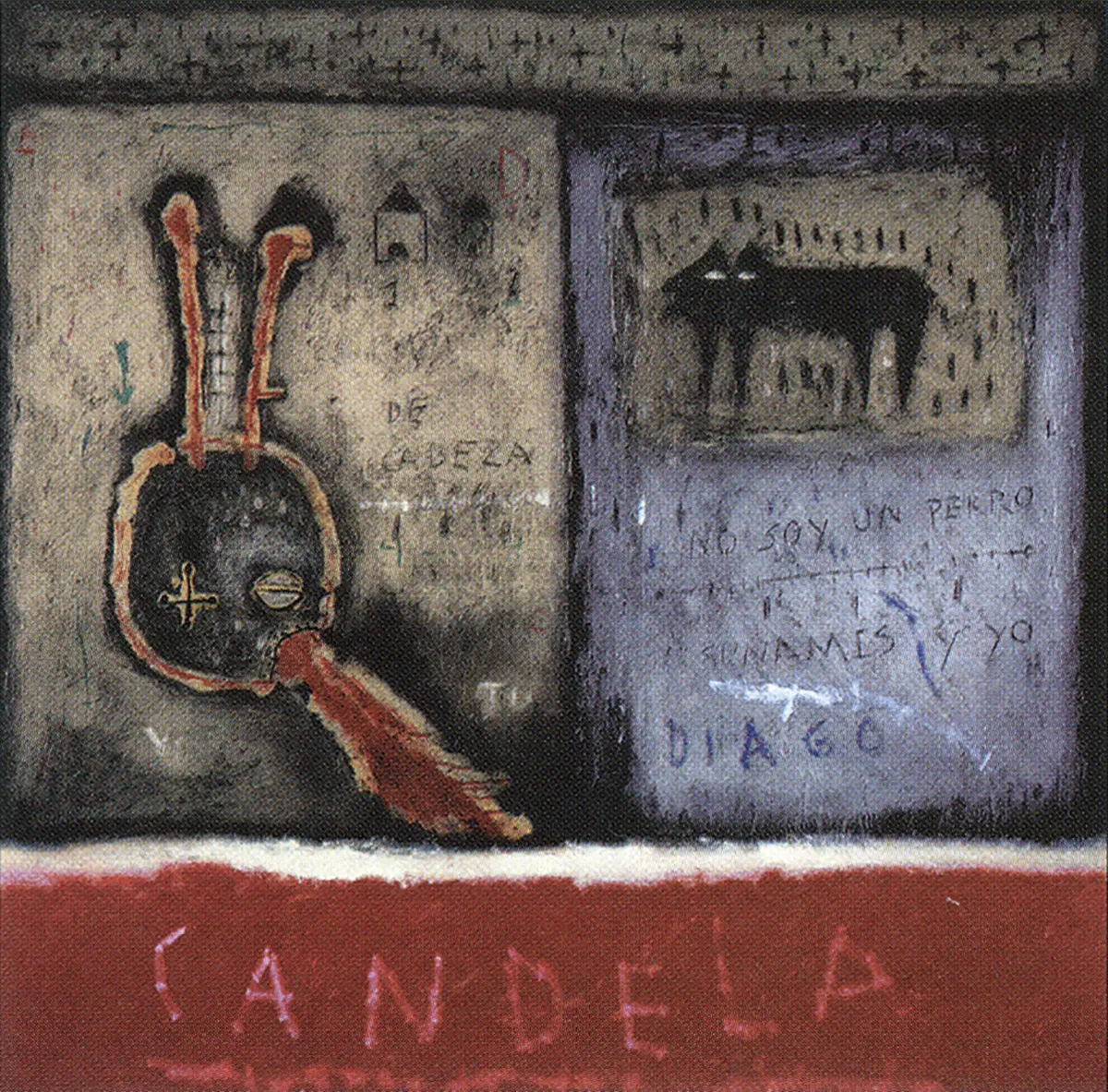
The assumption of identity based on his immediate surroundings is the way Juan Roberto Diago has found to talk about his environment. He turns his work into a chronicle of the island; the repeated references to Cuban reality with words such as "discourse, land, I cannot talk, bad times, I’m looking at you," create a dialog between his pieces and a conceptual continuity that is supported by the repetitive presence of houses, faces of Elegguá, cages, and birds. With this simple restatement, the artist gets closer to everything he knows and makes up his space. His ideas remain completely contextualized with words and images inherent to anything happening in Cuba. His canvases become pieces of walls, where graffiti, poor materials such as jute, gray tones, and texture support the drama of reality.
Diago mixes high and low culture supported by references such as dialogism and anecdote. These take him to a strong social recurrence, which he changes and then elaborates the points for reflection structuring his works.
Candela (Fire), one of the show’s most representative pieces, synthesizes many of the meanings found in the artist’s work. In Cuban popular jargon, the word refers to extreme situations, very difficult to solve. Backed by a red background, it also reinforces the idea of something that is burning and has been set afire by a flame growing out of an upside-down figure. By its side there is a dog, and further down, a text that reads, No soy un perro - Sunamis y yo (I’m not a Dog — Sunamis and I). All these elements combine like in a stew, but they also reflect chaos, anguish, and, of course, uncertainty. By being structured in segments, the painting’s disposition also reinforces this idea. Each segment constitutes a piece of the everyday history of Cubans, and it can be seen as an “insulated” entity (no pun intended).
The painter also came to remind us that here, “el que no tiene de congo tiene de carabalí” (Loosely translated, “He who is not from one African tribe is from another African tribe,” alluding to the fact that blackness in Cuba is unavoidable). The constant quoting from Afrocuban cult elements reaffirms him as an inescapable expounder of blackness in Cuban painting. The constant appearance of the saint who clears or blocks roads marks a pessimistic reading when we find him locked in a cage. But at the same time, it points to the infinite hope of resorting to the supernatural to get answers for those issues that humans themselves do not dare to answer or solve.
Another concept present in Diago’s work that establishes a continuity with painting —and so with the artist’s knowledge of Cuban art history— is the presence of subtopics such as flower vases. With a totally modern and contemporary recreation of it, he pays an implicit homage to his grandfather, the important painter who was also his namesake. En Flores para dos (Flowers for Two), Diago, á la Magritte, adds the word flowers to the icon. Is it a pregón? The artist goes beyond that and “paints” a flower vase inside another piece [No estamos solos (We Are Not Alone)]. Also, on the piece that closes this collection, Diago conjures up the word by softly writing with graffito this phrase-sketch with a wise message: The world needs flowers.
MARISOL MARTELL