
Immediately upon entering Lucía Warck-Meister’s exhibition in Diana Lowenstein’s large open space, the viewer is surrounded by what appear to be beautiful blue glass objects and delicate webs of plastic. Upon closer inspection, one realizes that the blue objects have been broken and repaired and are trapped in acrylic/glass boxes and that the web of plastic is as claustrophobic as it is fragile.
The paradox of delicate materials and violent confinement appears often in Warck-Meister’s work. She has long been interested in the ideas of destruction and reconstruction and the inclusion of broken and reconstructed objects in labyrinthine and boxlike forms. Her chosen materials are plastic, silicon, Mylar, and glass, and the most distinctive elements in her work are the result of her very inventive use of a hot glue gun. The glue gun releases threads of Mylar that vary in width, fragility, color, and texture for different degrees of opacity. The threads can be woven like the fibers of a spider web to create sensual veils that are as inviting as they are menacing. They can also be applied on surfaces to form words and letters. Warck-Meister uses the glue gun with the facility of a painter for extraordinarily complex effects.
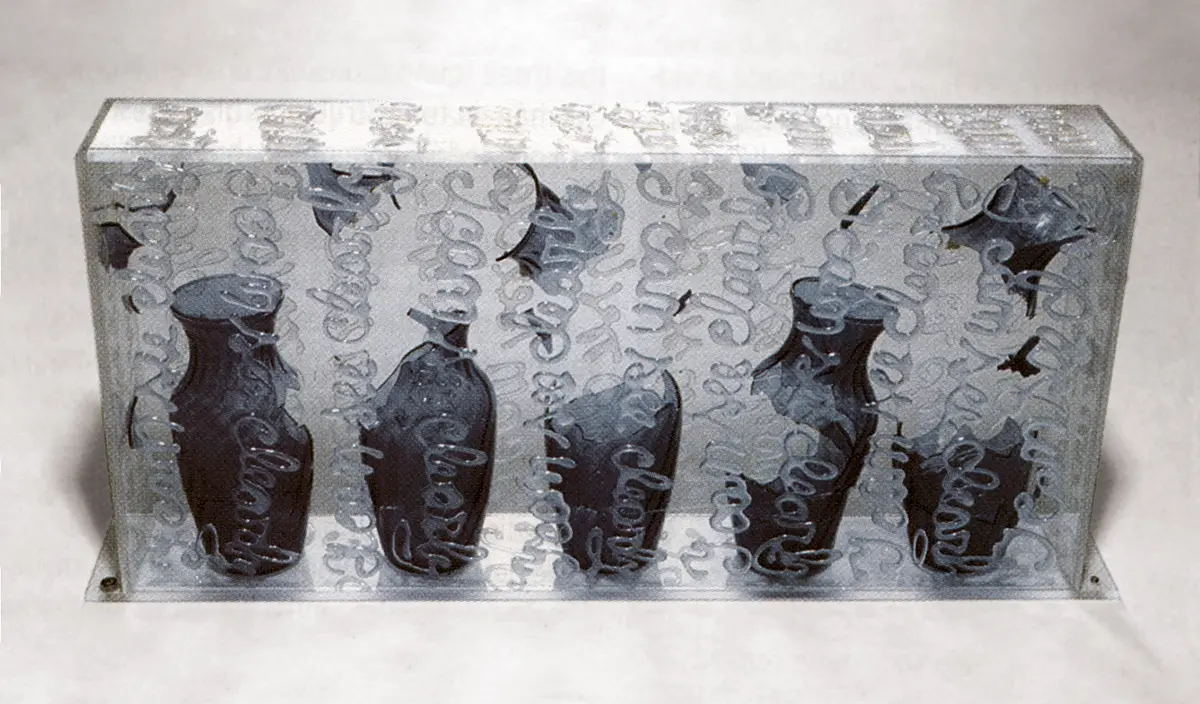
The spider web is used as a metaphor for life’s dualities. It appears fragile although it is very strong; it is attractive and also a trap. It is an illusion that can be deceptively seductive, and it can be rewoven over and over. The transparent web of the spider also serves as a departure point for Warck-Meister to use the threads as a written language. When the web is removed from walls, from hanging or from objects, it is like the metamorphosis of the animal into something new. She becomes the artist-spider constructing new abodes for objects she traps within transparent or semi-transparent acrylic boxes and marks with the swirls of the Mylar as words and letters. The shadows produced by the Mylar letters interact with the vases to impart mysterious effects that hark to the past. Inside the boxes, she arranges blue vessels reminiscent of ancient glass. She has smashed the vessels and repaired them. The process of breakage, not always easy, is integral to the conception of the artwork and symbolic of the feminine– fragile yet strong and not easily broken. The contours and colors of the vessels inside the box Untitled - Wall Box, 2001, appear as a still life, carefully arranged for display. The hourglass shapes in particular evoke the feminine. However, the writing and the broken condition of the objects disturb the picture. A narrative emerges for the viewer to decipher as each piece provokes a personal response.
Veils of transparent webs, balls of flexible threads, wall boxes containing mended vessels, and two-dimensional works on paper embossed and marked by glass work together to create an ambiance of cobalt blues and pale whites, the reflection of the web against the colors of the sky.
CAROL DAMIAN