
In the prologue to The Hours, North American writer Michael Cunningham narrates the moments preceding Virginia Woolf’s suicide. He gives a detailed account of the landscape; more than being a mere backdrop, it is an atmosphere that through its multiple nuances fuses with the writer’s anguished state: "She walks purposefully toward the river, certain of what she’ll do, but even now she is almost distracted by the sight of the downs, the church, and a scattering of sheep, incandescent, tinged with a faint hint of sulfur, grazing under a darkening sky. She pauses, watching the sheep and the sky, then walks on. The voices murmur behind her (…) Patches of sky shine in puddles left over from last night’s rain. Her shoes sink slightly into the soft earth. She has failed, and now the voices are back, muttering indistinctly just beyond the range of her vision (…) She wades awkwardly (the bottom is mucky) out until she is up to her waist. She glances upriver at the fisherman, who is wearing a red jacket and who does not see her. The yellow surface of the river (more yellow than brown when seen this close) murkily reflects the sky. Here, then, is the last moment of true perception, a man fishing in a red jacket and a cloudy sky reflected on opaque water."
The section ends by describing how the writer’s lifeless body floats by a tree, on the river whose surface reflects the inverted image of a bridge with a truck and a child with his mother passing by.
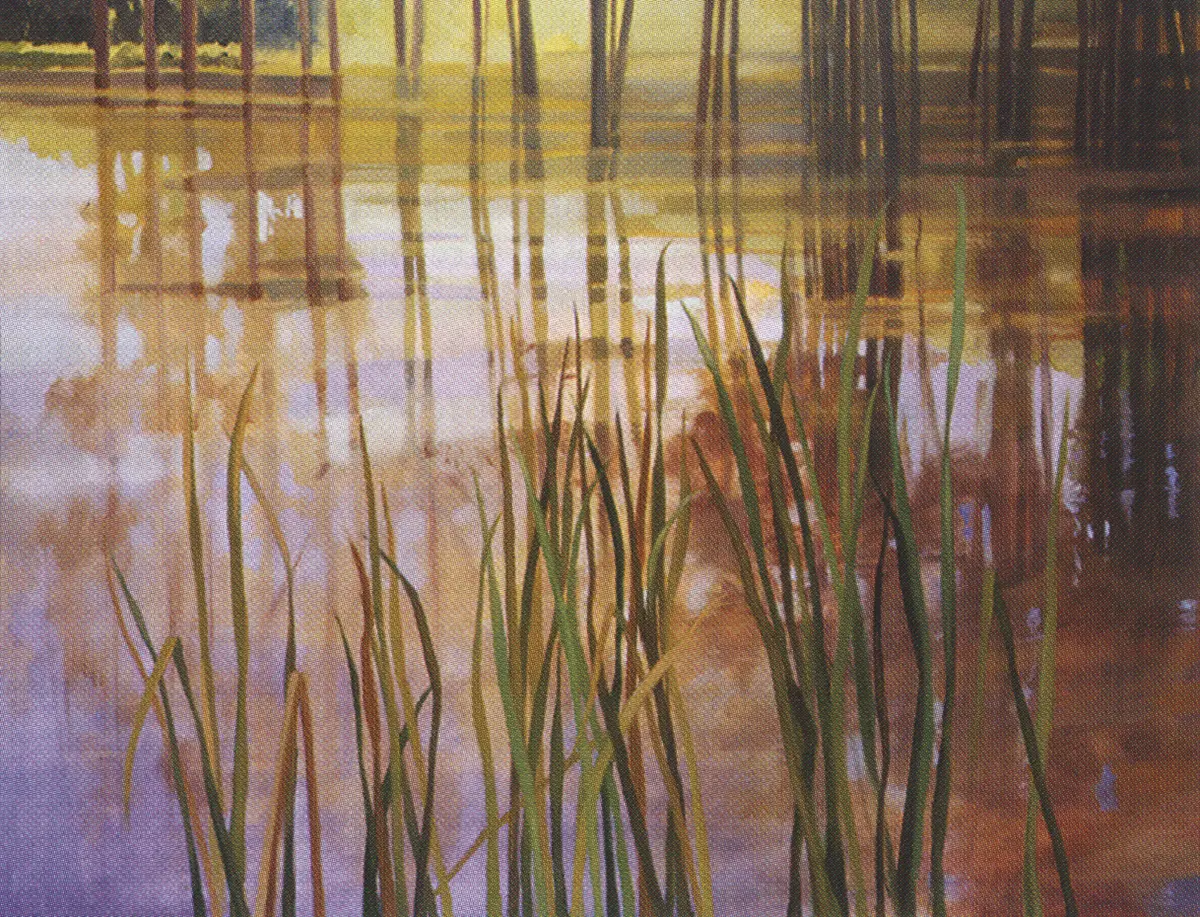
Despite the fact that the nature of literature is different than that of pictures, the excerpt reminds me of María Cristina Cortés’ painting. Above all, literature is a narrative fact suggesting an image that each receptor visualizes in his or her own way. On the other hand, painting resists narration, it affirms itself as a purely visual phenomenon. It’s a physical, corporeal object, a fixed image, invariable, imposing itself before our eyes. Nevertheless, I think that the above excerpt shares with the genre of landscape the possibility of referring, through nature, light, and color, to a certain emotional state or “emotional atmosphere.” It is for this reason —and for the way that attention is placed on the water, the color or the description of the puddles and the reflections, and particularly due to the mention of “the “incandescent sheep”— that I associate it with Cortés’ work, who says: "Nature, always mysterious and moving, despite being so fragile and ephemeral as life itself, continues being my excuse to create. More than anything else, what motivates me is the organic and changing character of each of its elements: light, with its capacity for infinite transformation in terms not only of shape and color but also of atmosphere, both emotional and visual; or water, creator of reflections or multiplier of images, reproducer of life. And it is from there that painting comes —where light exists due to color and water exists thanks to the shape or space, and the final result is no more than a living VISUAL FACT."1
Since 1997, María Cristina Cortés has been working on the subject of chambas, or trenches dug in the countryside to separate the different lots. The trenches fill up with water, and when the water is clean, they become watery mirrors that pick up the colors of the sky, sharply reflecting the landscape, foliage, and the changing light. But due to contamination and the unhygienic nature of modern life, these extensions of water have become floating garbage bins, carrying within their banks broken boxes, pieces of wood, sticks, jars, and useless utensils. Cortés’ painting reflects both of these aspects; some of her works allow us to see the limpid water reflecting inverted landscapes, where nature and life manifest themselves in all their splendor as if they were a manifestation of life itself. But she also paints the contaminated chamba, filled with all sorts of objects that attempt against life. Both realities are used as a pretext, a challenge to face when dealing with the problem of painting.
Cortés’ latest show, held at the Galería El Museo from May through June, put in evidence the increasingly solid understanding she has established between her craft and the subject of the landscape. Through montage, she highlighted the importance of the different formats and the relationship each one has established with the wall. Some of the pieces are elongated, and the large-format ones reached 40 x 50 inches. Others were formed by painting oil on 12 x 16 inches paper. Each format allows for the exploration of several possibilities. On the larger works, for example, the compositions are generally more complex, and more loaded with elements, as is the case of Chamba No. 48, Homenaje a Carlos Rojas (Chamba #48, Homage to Carlos Rojas), where the chromatic surface is crisscrossed by a series of lines forming an orderly grid that reminds us of the older painter’s works. In the small-format pieces, we observe a clear, nuance-rich surface intervened with a sort of essential stroke that carries along the movement of a branch —a reminder of the simple delicacy of Japanese landscapes.
Also notable is the chromatic exploration performed on each piece. In some of them we find oranges contrasting with blue-grays, creating an atmosphere that reminds us of the sulphurized tones found in Cunningham’s excerpt; in others, ranges of violets or pinks predominate, showing a universe where the color of the sky fuses with changing tones of water. It seems like each piece in the show is a fragment of a larger, more global perception, captured through a continuous landscape (Bogotá’s Savanna). The different moments of light allow this exhibit to reveal itself as a pictorial fact that is continuously investigating the possibilities of color through the reflection of puddles left over from last night’s rain or a cloudy sky reflected on opaque water.
NOTE
1. María Cristina Cortés, on the show’s invitation card. Galería El Museo, May-June, 2001
MARTA RODRÍGUEZ