
Olfato visual (Visual Sense of Smell), Santiago Pol’s show at the Carlos Cruz-Diez Museum of Drawing and Print, offers a generous selection of posters, postal stamps, sketches, and notebooks created in the period between 1968 and 2001. This show, curated by Juan Carlos López Quintero, distinguishes between three important moments in the artist’s career; the 1970s, marked by the influence of Pop and kinetism; the 1980’s centered around the exploration of tridimensionality and the use of photography; and the 1990’s, dominated by the presence of drawing. As a whole. the works exhibited here avoid easy solutions and are characterized by their ingenuity, economy of resources, and graphic coherence.
Pol was born in Barcelona, Spain, in1946, but has lived in Venezuela since 1954. Between 1962 and 1964, he attended the Caracas’ Cristóbal Rojas School of Visual and Applied Arts, where he studied with Jacobo Borges and Régulo Pérez. In 1966, Pol moved to France and attended Paris’ Advanced School of Fine Arts, returning to Venezuela in 1968 to begin a career in design, teaching, and executive positions at the INCIBA Design Workshop and, later, CONAC. His work has been praised and awarded at important international events, such as the Warsaw Poster Biennial (1968, 1976, and 1978) and the Toyama (Japan) Triennial (1994).
Pol’s early years are framed within the strong impulse that graphic arts in Venezuela received by the creation of several creative and formative spaces such as the Neumann-Ince Institute of Design, the Associated Artists Workshop (TAGA), and the Center for Graphic Learning (CEGRA). In Latin America as a whole, this was also the time of Cuban graphic art’s greatest influence, and Polish poster art constituted a global point of reference. These fertile terrains greatly influenced Pol’s work, where different elements of the world’s visual culture are synthesized.
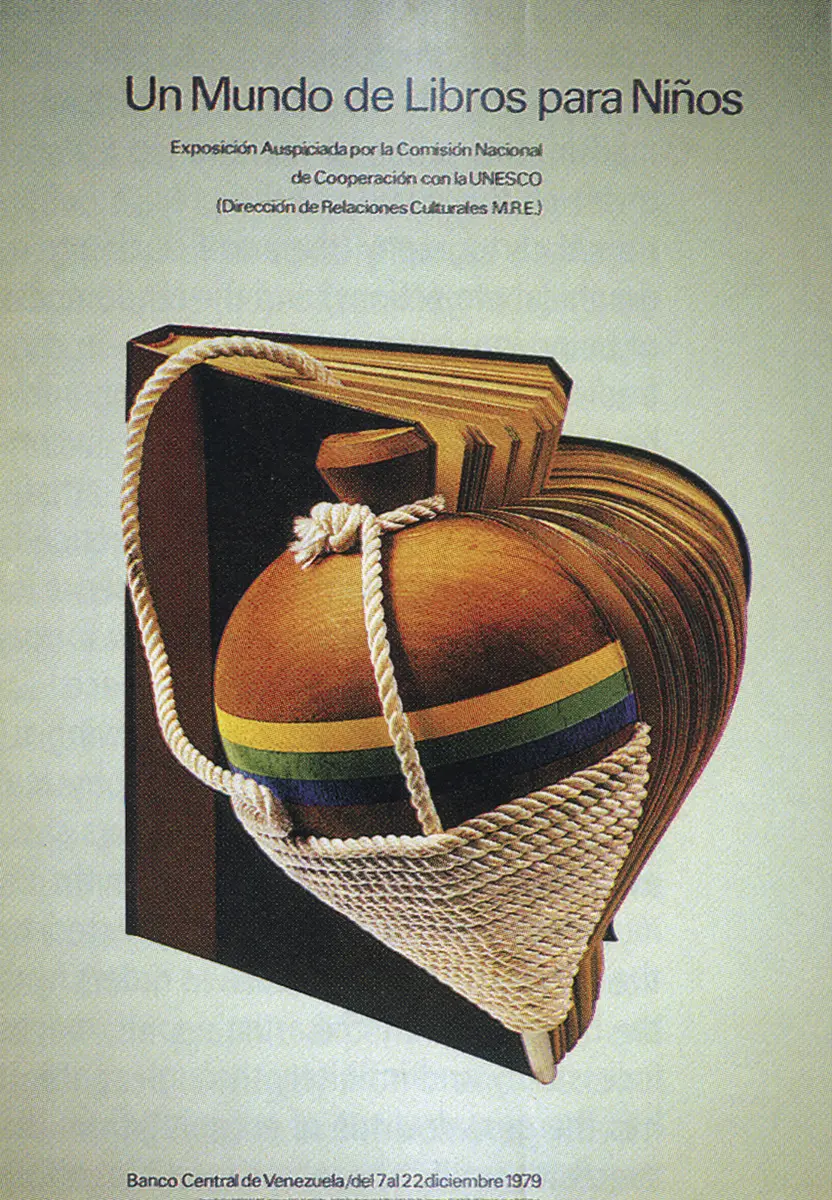
Regarded as one of Venezuela’s most important designers, Pol has centered his activities around the creation of posters that enjoin communicative and aesthetic principles. Among his works, we find the series Objetos imposibles (Impossible Objects), which incorporates elements of humor, absurdism, and critique. Combining sculpture and photography, the artist is able to transform pieces of film into a nest, a pencil into a spear, or a handful of toy soldiers into a number. These images are grounded on a poetics that, as in the Dada tradition, alters an object’s original function to generate new meanings.
Pol has also explored the possibilities of multiple posters. This strategy allows the artist to transcend traditional formats and create complex forms to be displayed in space. Using a repeating matrix, the poster becomes a graphic mural; a kind of “amplified” shout on a wall. This procedure involves the conquest of larger scales and the reinforcing of the piece’s communicative function.
Another salient element in Pol’s graphic alphabet is his refined sense of color, from straight, highly contrasting planes (inherited from Pop Art), to the combinatory vibrating tones (reminiscent of Op Art), including subtle and sober chromatic variants such as those that dominate his volumetric objects. These elements, used sensibly and intelligently, appear in every area in which Pol has been active, from posters for festivals, art shows, biennials, and institutional campaigns, to record covers, postage stamps, and logos.
As in the work of Nedo M. F, Gerd Leufert, and Álvaro Sotillo, in Pol’s work the notion of the designer-as-artist is manifest. Currently, authorship in design is not a dominant concept —we rather talk about wide-scope schools, strongly conditioned by the machinery of industry and the impact of computer programs; Pol, however, is among the last of those designers who cling to the use of manual craft and develop highly original graphic languages.
For this artist, design is not one of the “minor arts,” as it was normally assumed before the advent of the 20th-century avant-garde. Pol’s visual erudition and his creativity have determined the creation of authentic works of art that, nonetheless, respect the medium’s communicative demands. Like few designers in Venezuela, Pol brought the creation of posters to the level of an autonomous language, without abandoning its links to painting, drawing, sculpture, and photography —disciplines from which he borrows various elements as they serve his purposes. Pol’s work responds to the client’s needs without losing sight of the public at large as a spectator.
FÉLIX SUAZO