
Culturally and socially, Argentina has always generated points of reference of historical importance. This is certainly so regarding the arts: Argentine artists in every discipline have been part of international movements and have gained renown for their quality and persistence. This is how in the 1950s Argentina generated a solid tradition of geometric art, and a decade later a number of Argentine artists became prominent players in neofigurativism as Pop Art spread through the world.
Towards the end of the 1960s, a cohesive group of young painters emerged under the influence of neofigurativism to become known as The Other Figurativism. Its members were Luis Felipe Noé, Jorge de la Vega, Rómulo Macció, and Ernesto Deira. The group's characteristic strength and expressive intensity were adopted by later cohorts, and the work of new Argentine artists has become better and better known beyond the country's borders, to the point that they have processed international trends and adopted them as support for their expressive needs.
Cecilia Lueza belongs to the latest generation of Argentine artists in the continued tradition of figurativism. Perhaps such continuity lies in her standing right there, uncovered and wounded before the empty canvas, with her generous load of historical and personal feelings and questions.
There is a persistent difficulty in the analysis or the enjoyment of contemporary painting; it is hard to apprehend human-figure painting, before an active space, without mention of Francis Bacon's sincere paintings. Bacon's anguishing relations of space and figure, of love and hate; Bacon's aesthetic of heavy psychological charges; and Bacon's passion for punishment and isolation; all need to be brought to bear.
Cecilia Lueza's work is also founded on an unknown relation of figure to space. It turns toward the possibility of an anguished freedom, where fear could be the center of events. Never before in recent decades had we seen so dramatic an experiment on a fear-based culture, on lives terrorized by isolation. It would perhaps be correct to uncover such a link between Lueza's figures and their surroundings, but it would also mean the destruction of her work's true essence, exposed to an unnecessary light. As Francis Bacon said: "If you can talk about it, why paint it?" That is if you can't put it in words, paint it!
In general, the subjects of figurative painting are established not only through the figure's expressiveness but through that of the space in which they exist. Space in Lueza's work feels like an ambivalent mass of transparency, turbulent liquid currents, and vapors that envelop a gaseous congregation of spirits or beings longing for danger. These beings seem to be pushed forward into a vacuum where, with long movements, they float or swim in a current of disquieting desire.
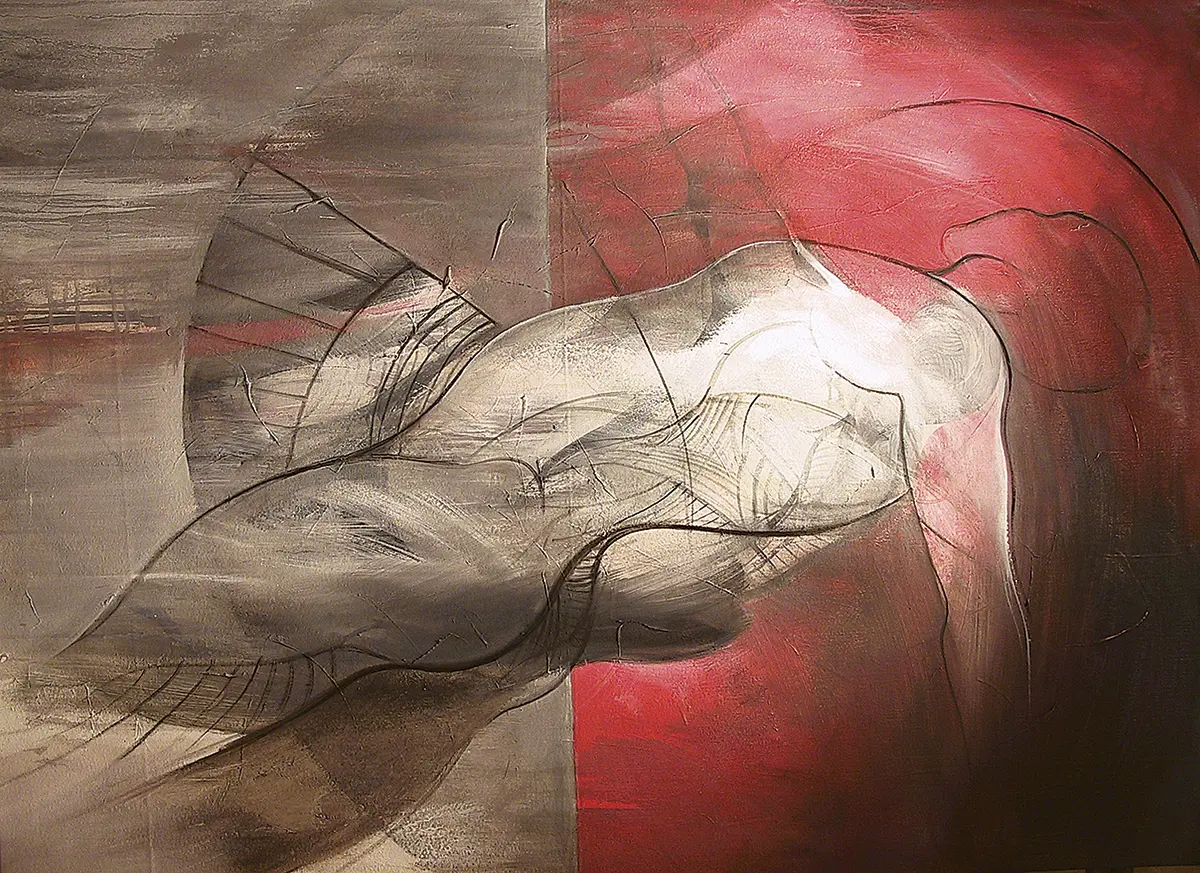
Cecilia Lueza believes firmly in the narrative power of painting. She wants to salvage or find the humanist dimension of art. Perhaps the apocalyptic tone of recent years forces her to meditate on human spirituality and develop neo-romantic ideas, thus establishing a fleeting connection between William Bouguereau and the somnambulist vision of aerial actors floating up or down in a celestial space, or hastening into a search for the Apollo we barely discover among the vestiges of a fortified construction.
Cecilia Lueza's art is constructed on the basis of a pictorial atmosphere spreading on the totality of the canvas, dominated by a graphic force in which color is sometimes suppressed. The drawn line is the one building a painting's hallucinated directions, the one fueling the character's form. Lueza's figures seem caught in the attempt to escape purgatory, but they also give the impression of moving in a space where torment is associated with the divine. In this way, her work connects with the Old Masters, who saw the essence of their art in drawing.
Color is suggested by a descent of grays and reds covering the canvas. There is no intensity or contrasts between these colors. Both reach into one another to create centrifugal movements or large spiral forms that perhaps represent the baroque space used to fill in the viewers' own emptiness.
Cecilia Lueza is not drawn to reality as such, but to the passions reality generates, to the splendors of a new humanism, including the mystery—or the mirage—that is the universe. Are just angels those characters floating in Lueza's canvases? They could also be the spirits of a human tragedy. Is that what drives a new humanism?
EUGENIO ESPINOZA