
Today, we can say that the Mercosur Biennial is a fundamental event for coming to know the contemporary art of Latin America. In its third edition, with a collection of 400 works of art and over 120 artists, it presents a survey of the production of visual art in the different countries present at the show. Open from 15 October to 16 December 2001, the 3rd Biennial, which takes place in the Brazilian city of Pôrto Alegre, in the State of Rio Grande do Sul, offers the visitor a circuit of masters who are distributed across different venues of the city, invading the urban life in a healthy way.
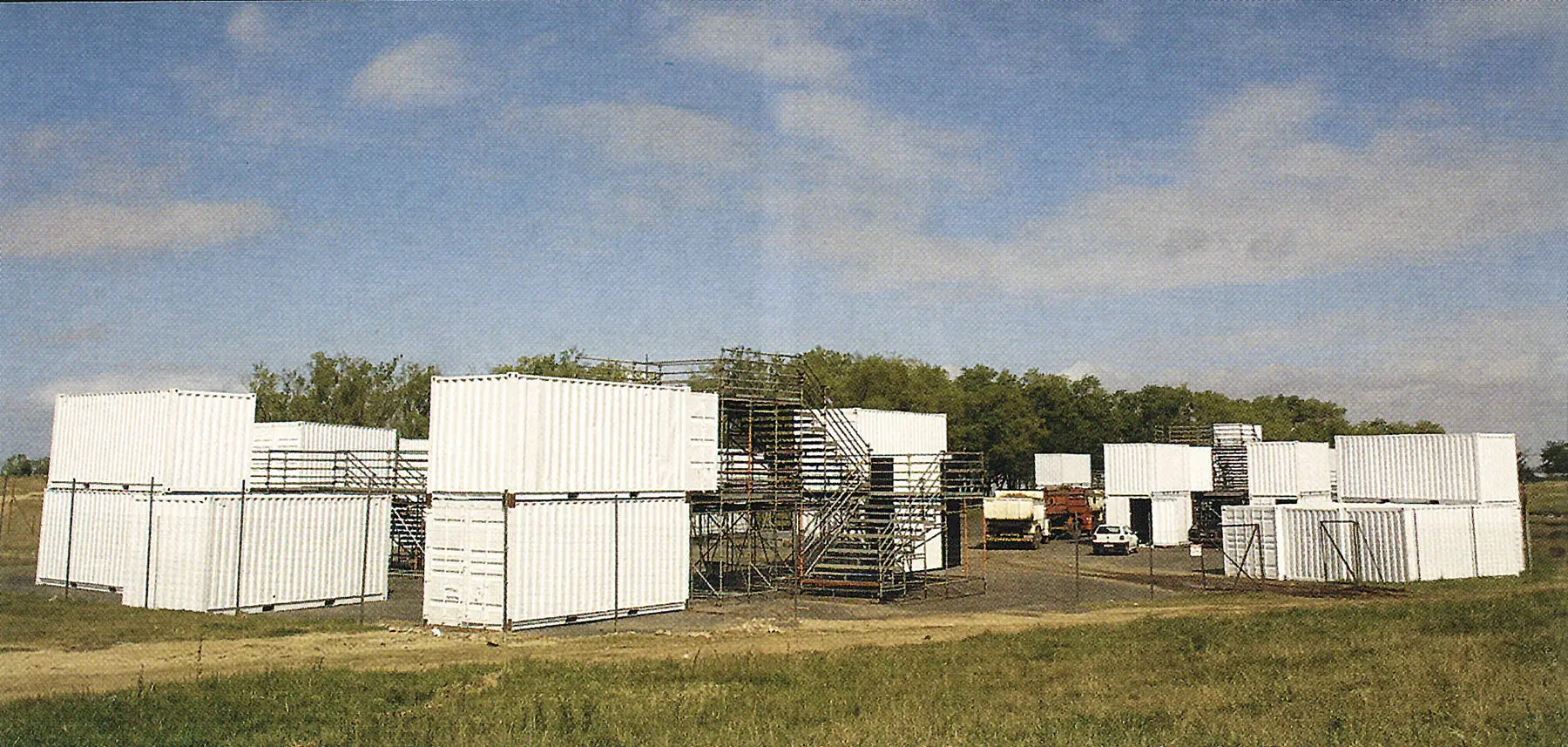
The great novelty of this 3rd Biennial lies in the curatorial conception articulated by Fabio Magalhães (Brazil), the general curator, a project developed with the support of Leonor Amarante (Brazil), adjunct curator, as well as curators Jorge Glusberg (Argentina), Pedro Querejazu (Bolivia), Justo Pastor Mellado (Chile), Ticio Escobar (Paraguay), Ángel Kalenberg (Uruguay), and Gustavo Buntix from Peru, the guest country in this third edition. Fabio Magalhães conceived of a group of five shows to make up the 3rd Mercosur Biennial. One of them, planned for the presentation of the installations, was identified as The city of containers. It took up a vast area of sixty-thousand square meters in Mauricio Sirotsky Park, also known as "Sunset Space," an area near the Guaíba River, whose geographic presence is decisive in Pôrto Alegre.
The city of containers was constructed as a very special stage by architect Joel Fagundes, who put into practice the curator's idea, gathering sixty-two containers, like those used to transport cargo, that were 6 meters long, 2.45 meters wide, and 2.60 meters high. The architect created four large groups of containers: directly placed on the ground, in structures accessible by stairs or elevators, thus forming a true urban fabric in order to house contemporary art. The containers, following the conception of the general curator, were painted white on the outside, and on the inside, they were freely used by the artists, with special works made for them.
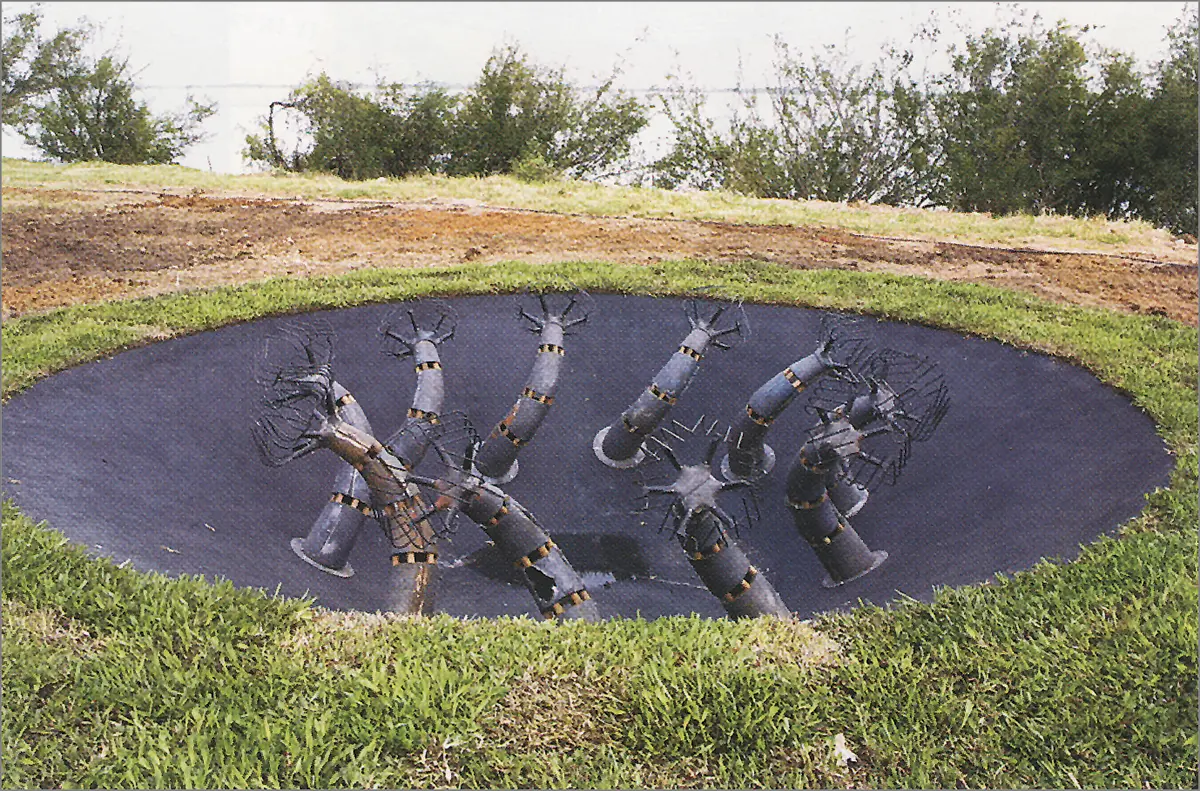
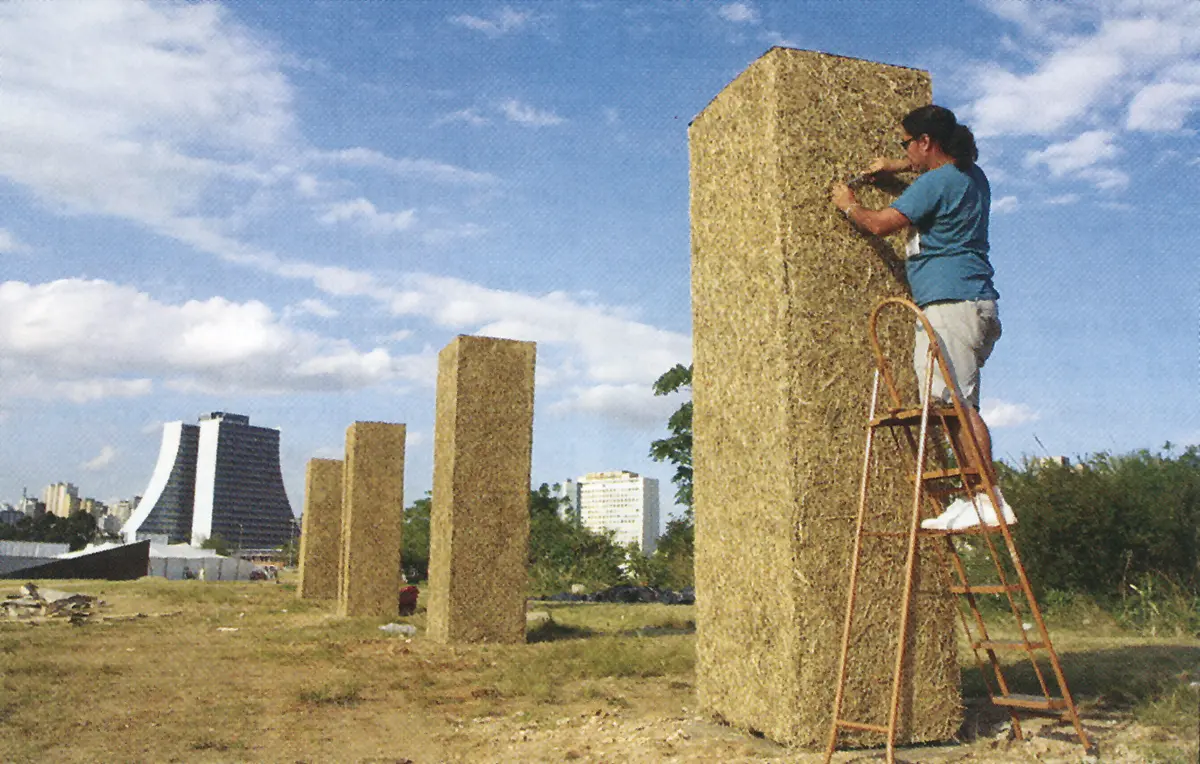
In addition, the space near the river received works conceived as "landscape interventions," both on its banks and in its waters. Here we find the works of José Resende (São Paulo, Brazil), Felix Bressan (Rio Grande do Sul, Brazil), José Cirillo (Espíritu Santo, Brazil), Fernando Pla (Argentina), and others.
Another event of the Biennial gathered into one performance program of twenty visual and scenic (theater and dance) artists. The development of the works took place in the San Pedro Psychiatric Hospital, filling with art the patios and large doors of the old, six-story architectonic complex (an area of 133,155 square feet!) located in a 37-acre park. This is a twenty-first-century construction.
These buildings, quite deteriorated by the passing of time, have been progressively abandoned, and their inhabitants have been transferred to therapeutic residences. Some places are still occupied by 673 residents who receive treatment there. The show Performances of the Biennial used two of the abandoned buildings of this Psychiatric Hospital. The idea of curators Fabio Magalhães and Leonor Amarante was to create visual and scenic experiences that are not only performative presentations but rather "a performance understood as participation," says Luciano Alabarse, general director of this performance show.
Twenty artists are presented to the public throughout the first week of the event, every night between 9 p.m. and 11 p.m., staging eighteen simultaneous dramatizations. Each artist or group thought up a particular project, but all the works addressed the problem of the relationship "art / madness," in spite of the fact that there was no curatorial guidance in a strict sense. For those in attendance, it was an experience of strong tension where the contents of the messages and of the stage charged with history were reflected. A situation was created in which everyone participated in some way, highly sensitized.
Another sector of the Biennial occupied a cultural center that was recently created by the Banco Santander in Pôrto Alegre, called Santander Cultural, which was located in an imposing building of eclectic architecture. Its two floors were occupied by works that largely possessed a common denominator: they were aesthetically positioned at the intersection of different media of plastic expression. For example: sculpture and installation, painting and photography, engraving and objects, and others. In order to exemplify better, I shall mention the works of Alex Flemming (Brazil) and Marco Maggi (Uruguay) which were found in this sector of the Biennial.
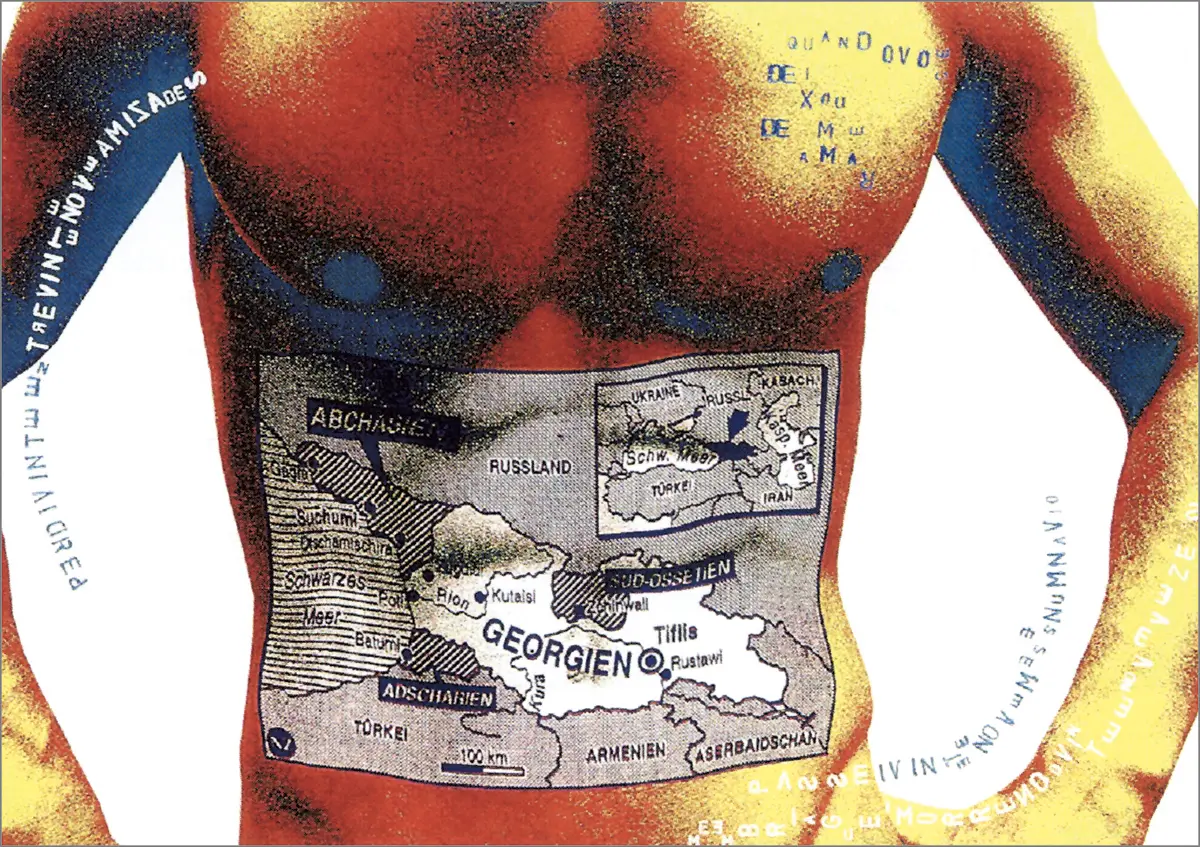
Flemming's works take the human body as a referent in order to work the questions of history. The artist uses photography, realized with computers; he records young bodies, and on them he designs maps of areas of the world where there were or still are conflicts and wars. He creates enlargements of the photos on plastic (210 x 160 cm) and he mounts them as if they were canvases. Above, texts are written which allude to the historical question that he is demonstrating.
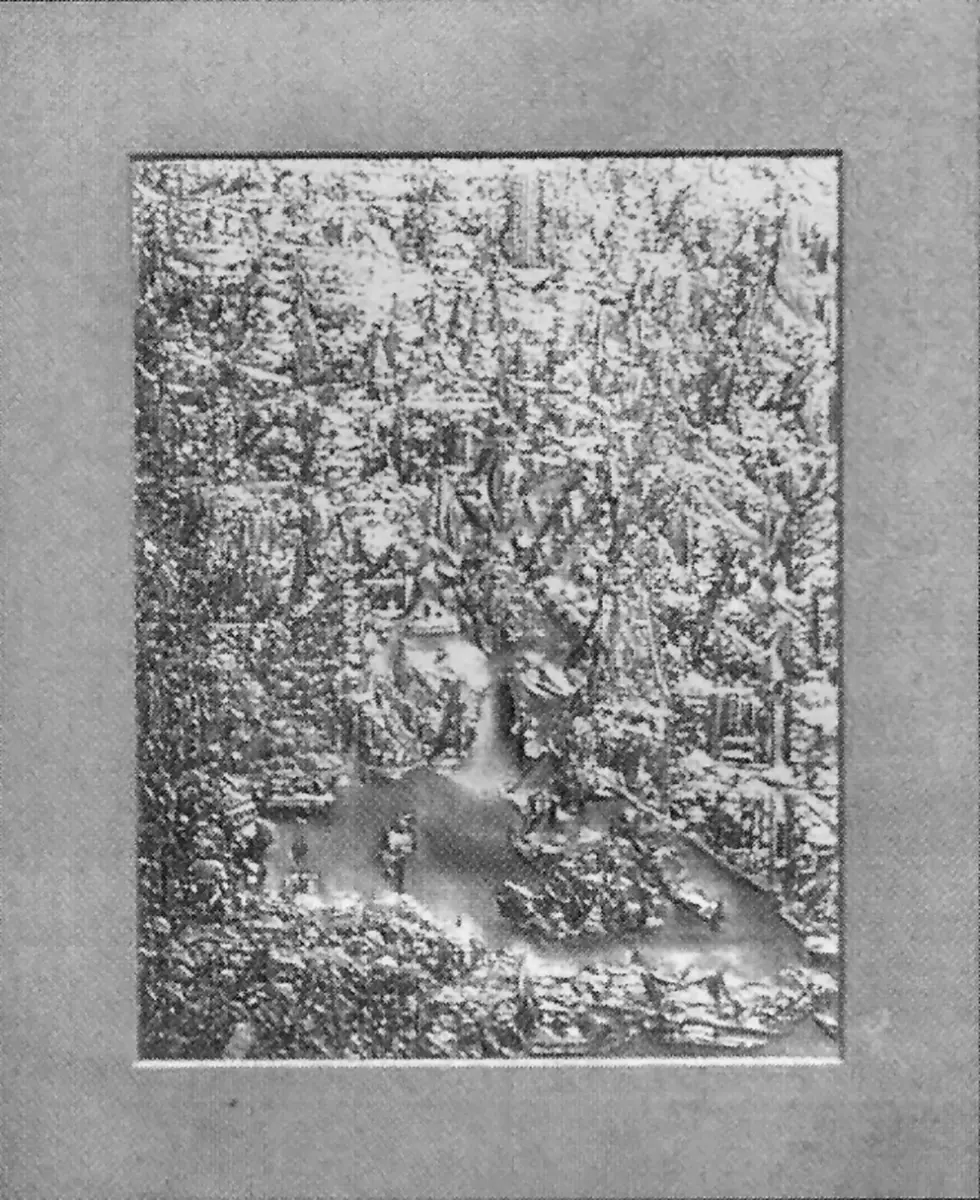
Marco Maggi, a Uruguayan artist who has been living in New York for some years now, uses supports like clay, natural apples, sheets of aluminum, and paper of different origins in order to inscribe or design or engrave with drypoint, or work three-dimensionally, always creating an enigmatic visual field where the viewer can find various suggestions and carry out different readings. "They could be an aerial view of a city, a type of map, computer circuits, old ritual centers of lost civilization," comments Alicia Haber, referring to the work of this artist in an article that she recently published. In this Biennial, the public's eye was particularly caught by a work that Maggi titled Hot Bed, composed of 25,000 sheets of sulfite paper (i.e., common white paper) piled up in different groups, creating a serial construction installed on the floor (180 x 220 x 17 cm). Above each one of these groups, Maggi placed elements of small paper cutouts, as if they were sculptural miniatures, emerging like three-dimensional forms. Could they be writings that emanate from the paper?
The space of the Biennial dedicated to the historical rooms was centered in the Museo de Arte de Rio Grande do Sul MARGS, offering the public two important shows: in the first place, a show of painting and engravings of the precursor of expressionism, Edvard Munch; and the other, a show of fabrics and designs by the Mexican muralist Diego Rivera, as well as other works from different periods, showing pieces from his cubist experience.
Rafael Franca, one of the pioneers of video art in Brazil, who died at the early age of 33 in May 1991, received a special homage in another cultural space of the city, the Memorial de Rio Grande do Sul. Presented there were some of his video installations in which the artist explored the electronic image.
Parallel to the 3rd Mercosur Biennial, other international shows were promoted: one of the contemporary Chinese artists, called Chinese without China, and the other, a show of recent work by the Israeli artist Tal-R, both organized by the special commissioner, Jens Olensen.
One of the determining characteristics of this 3rd Mercosur Biennial is the fact that it offers the public the possibility of coming into contact with the work of young contemporary artists, together with the current production of a generation already recognized on the international stages. Another relevant point to underscore is the persistence of certain directions of the current artistic search, among which we may count: the questioning of the subjective or social identity. The human body often appears as a code, and the facts of social reality emerge as keys to the construction of the aesthetic discourse. Questions related to the female world appear constructed in metaphors, especially in installations. The dimension of violence, poignant in the existence of humanity, is also present in many senses. Contemporary art is shown to be—in this case, quite strongly—a "critical art." Another course that was also present is the one that allows us to articulate the question of the language of art in itself, as a discourse, proposing to the visitor unexpected plays of relations among the signs, thus opening a great space for the construction of meaning.
* Photographs by Edison Vara.
LISBETH REBOLLO GONSALVES
Professor in the College of Communications and Arts at the University of São Paulo, and current president of the Brazilian Association of Art Critics.