Before entering Fernanda Gomes's recent installation at Baumgartner Gallery one must walk past a busy lumber yard on a city block that seems to be a constant work in progress, perpetually rebuilding and reinventing itself. Amidst all the construction and raw materials, Gomes's accretion of wood beams, scaffolding, and random found objects can almost go unnoticed. But its initial innocuous transparency soon yields to a more intense scrutiny, and this turns out to be one of the more intriguing gallery shows this fall.
In what has turned out to be a strong Brazilian tradition, Gomes has found a way of evoking poetic possibilities from the humblest of objects and most subtle of arrangements. Given the loosely placed sheets of paper, rickety scaffolding, and seemingly discarded tools and planks of wood one could possibly read this as a scene of abandoned construction or even demolition. Yet the meticulous arrangement and evocative moments allow for a feeling of creation that overrides any sense of destruction.
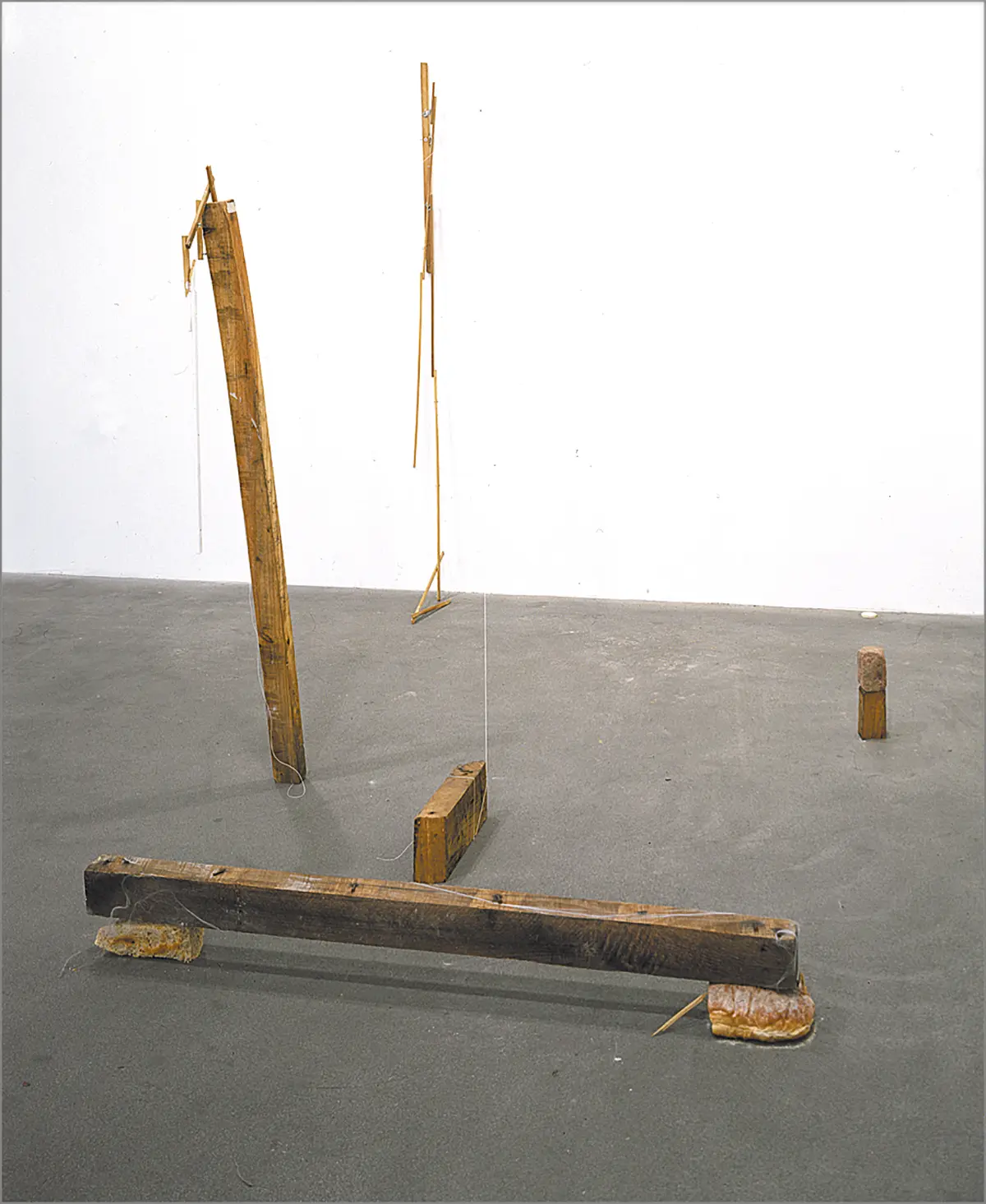
Gomes lists the objects in the gallery as if they were separate sculptures, although it is hard to imagine any of these parts separate from the whole. Some of the details are large and have a strong theatricality to them. Elements like the large scaffolding that reaches the ceiling but looks abandoned and a wooden door that leads nowhere and is adorned with cardboard molding suggest the sets to an action that has already played itself out. Other elements, such as dull butter knives that balance in the air, hung by a single string or a razor blade stuck into the back wall, impossibly small but seizing their own space, suggest potential movement not yet enacted. Still other details, such as the glass of water and sheets of translucent white paper that catch the abundant natural light in the gallery and soften the overall impact of the installation, seem to exist largely for their visual effect.
Admittedly there can be a frustratingly unavoidable sense of missed narrative. At times Gomes also seems to be relying heavily on references to what has now become the history of finding the inherent potential in the everyday object. She particularly seems to be referencing Duchamp, the father of the found object, with the door that leads to nowhere and the inclusion of a suspended glass lens that is a reminder of his To Be Looked At. One also thinks of Juan Muñoz in the sense that one is moving through a theater piece of shifting referents and scale. Other artists like Susan Sze and Jason Rhoades, as well as numerous artists from Gomez's native Brazil, have made extensive use of finding the fascinating in the quotidian. Unlike many other arranged environments that one finds in art today, the work by Gomes remains raw and precarious enough to avoid falling into an empty formalism. Yet it remains full of small pristine touches and human interventions that we are constantly reminded of the deliberate mastery of its execution.
I hesitate to add these final thoughts since they are anachronistic and call into question the issue of artistic intent, which tends to fall outside of the scope of an art review. However, it is impossible to look at and think about this work in New York City after the events of September 11th and not see provocative parallels: the residual detritus of some destructive event; the random miscellany of daily life suddenly fetishized; evidence of human presence now vanished; even the potential threat of airborne knives and razors sticking out of walls all have their unavoidable associations with the grand scale theater of Ground Zero. Perhaps the most compelling aspect of this new and admittedly unplanned reading of Gomez's piece is how in life and art we can experience a new set of possibilities in the very midst of collapse, violence, and decay.
JHON ANGELINE