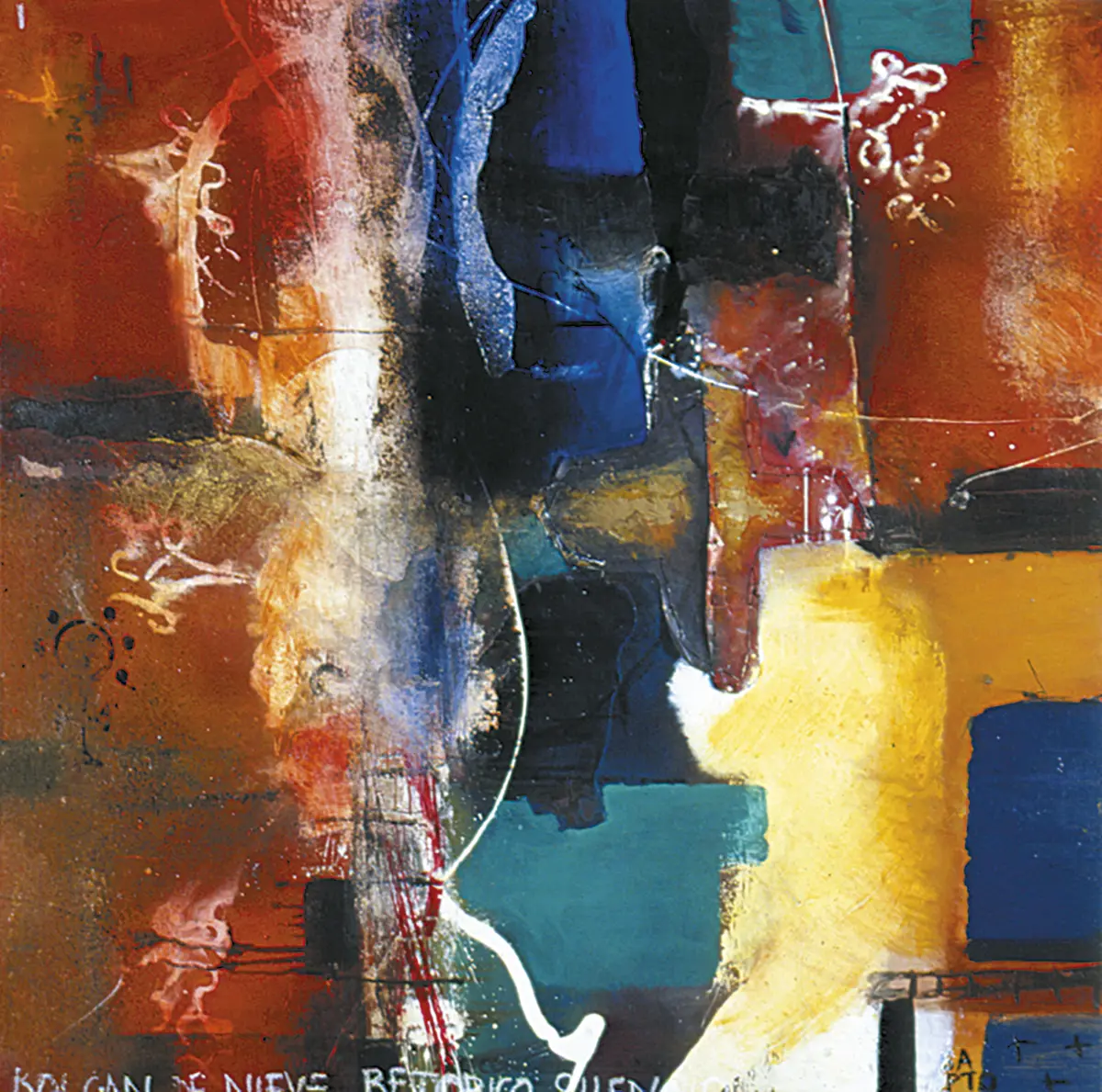
In his show at Galería Diners, Luis Luna revisits themes he has explored at various points in his career, regrouping them randomly and creating from there a sort of collage. The need to assume painting as a matter of context-building has been one of his main interests; in this way, he situates himself in the position of those who incorporate collage — one of the most important achievements of 20th-century visual thinking — to a medium like painting, normally characterized by perceptual illusionism.
Luna sees juxtaposition as a mode of thinking, and it is present throughout his work: "A sensitivity for the heterogeneous, the unexplainable, that which is not accompanied by linear discourse, that which branches out to follow unexpected courses, that which is adopted out of sheer love, which is not doubted, which is intuited. Duchamp noted that all painting is an assemblage. He nevertheless is identified with the context of Modernism. Collage and juxtaposition go beyond the modernist mixing of media. In my case, it is not an issue of experimenting for the sake of an 'ism,' but a way of being in the world. It is a matter of accepting difference without demanding an explanation."
Luna seeks to displace certain words or concepts related to the history of art, or to specific cultures and places, in order for them to achieve new meanings — meanings determined by the work's own context. He is careful, though, not to let these new meanings become a closed issue, but to allow for their continuing construction in the interaction between viewer and artist.
In this show, Luna juxtaposes subjects he has dealt with extensively before, such as Goya's engravings, Schwitter's The Cathedral of Erotic Miseries, the rituals of indigenous cultures, or the intricate hallways of colonial architecture. His exploration returns to ideas such as displacement — common to the series of routes he realized during the last decade in various geographic locations — and at the same time he reinforces the notion of narrative construction through the editing of gathered materials.
The show, titled Los archivos de la Catedral (The Cathedral's Archives), not only gathers thematic constants of Luna's career like the ones just mentioned, but also various materials the artist has worked with at different times, such as glass (in his series Amazonas [Amazons], where he needed to find a smooth, cold surface akin to the river itself) and copper (in his explorations of places associated with warmth, or in his search for an apt vocabulary with which to name ways of life and of knowing such as alchemy). Upon these materials Luna works with varnish or ink, exploring the frontier between painting and drawing. The superimposition of ink graphics on a piece of glass located at some distance from the wall creates a relationship between the spilled ink and the shadow it projects, altering the medium by means of the two-dimensional tradition. In this way, Luna creates a second drawing, which changes as the viewer moves — thus reaffirming his intention to maintain a sense of unfinished work.
Here we also appreciate a reappearance of the written word (present throughout Luna's career) which transcends the level of textual meaning to become a plastic element. "Language has been very important. It may come, as in Twombly, in the form of graphic tracings and suggested words; it may come as illustration or recontextualization, as in Goya. It's a medium I use in order to think about language per se, to cut off syntax and simply throw it in without taking responsibility, to demarcate territory, one color, in composition, or simply to generate another level of meaning in my painting." In Luna's work, the meaning of words, like the meaning of images, is built through use; it is particular to every case. The different meanings are defined as relational; multiple meanings may emerge as different contexts are created and as different "readers" approach the work.
CARMEN MARÍA JARAMILLO