
In Montevideo, the year 2000 has been called the year of Manuel Espínola Gómez. In an unprecedented act, the city has seen three retrospective shows of the Uruguayan master whose high-level expressive career spans sixty years, but who, by choice, shows only sporadically and remains isolated from the circuit of museums and galleries. The shows take place throughout the year in the Centro Municipal de Exposiciones, the MAC (Museum of Contemporary Art), and the Galería Latina. The three will be presented consecutively and each highlights diverse aspects of this conspicuous creator. The show at the Centro Municipal de Exposiciones is the most extensive as it gathers the artist's most noteworthy pieces created between 1939 and 1982.
The exhibitions have been well received because this is a much admired artist and a figurehead in the Uruguayan cultural and artistic life on account of his multifaceted creativity and the role that he has played as union leader of the artists, collaborator in numerous public projects, and art teacher sui generis without a professorship. Moreover, there is always great interest in seeing his work because it is usually out of public reach. He has only shown a total of about ten times in his life. His art cannot be found in museums or private collections (with a few exceptions) because he refused to sell, and he will bequeath his work to the artistic heritage of the nation. The last time his artistic production could be seen partially collected was in 1980. And in his own house/studio he keeps it wrapped up, unhung, and with no possibility of being seen.
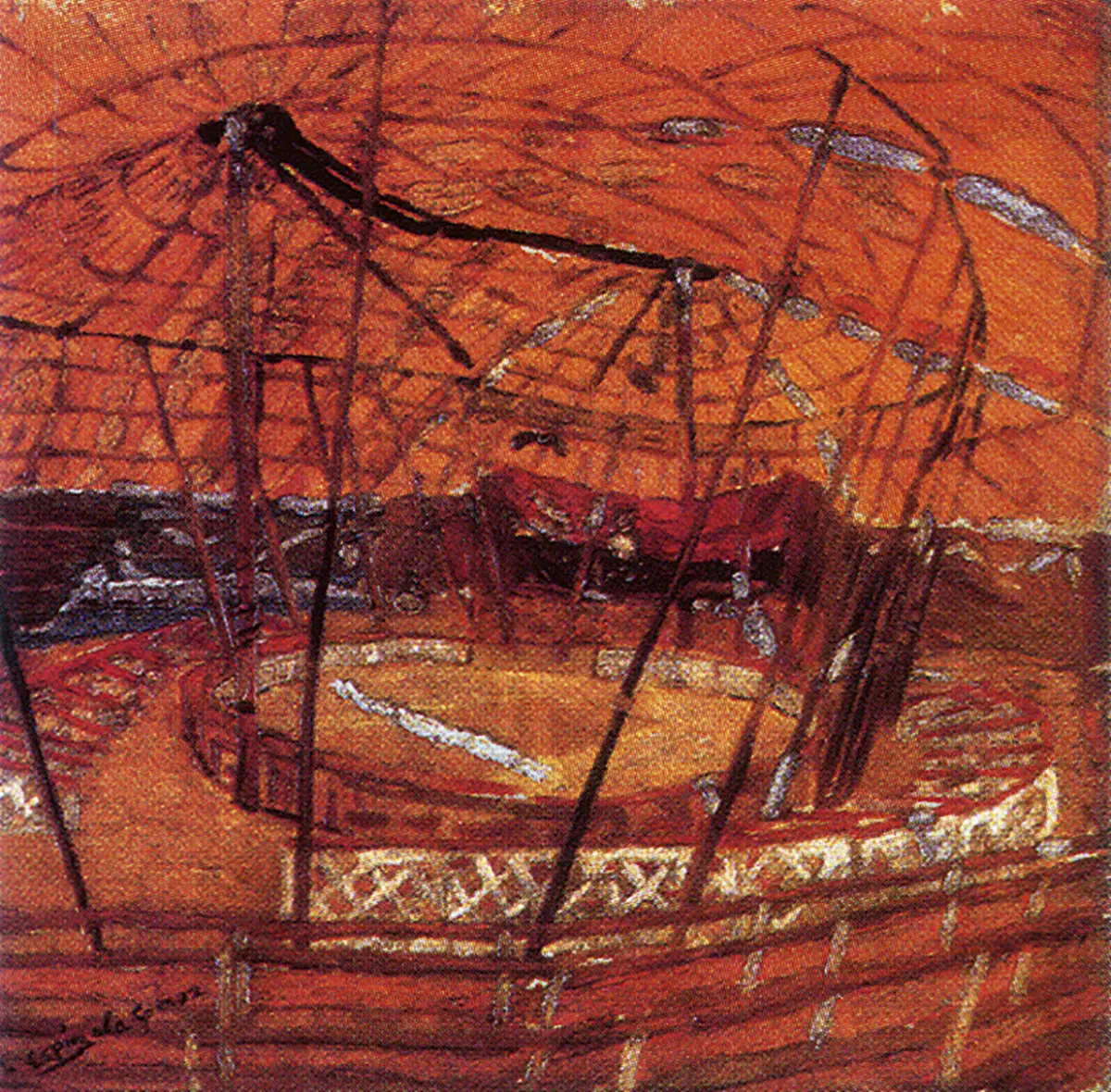
Espínola Gómez was born in 1921 in Solís de Mataojo, a suburban area in Uruguay's hinterland. In 1936 he met the great Uruguayan composer Eduardo Fabini, who encouraged him to devote himself seriously to painting. At the early age of 17, he painted a small masterpiece, the oil painting titled Circo al mediodía (Mid-day Circus, 1938). At that time he was a self-taught artist, and he continued to be one despite his later moves to Montevideo and then this city.
There is something of "entrails" and "limits" in the works of Espínola Gómez. The terms are not random. With them, Espínola Gómez designated one of his paintings (1955-1956). Those aspects of the visceral and the intellectual, of tremulous interiority and control, referred to in the title, dialogue in various ways in his production and could be a metaphor for his artistic path. Sometimes, one of the elements dominates another. At other times, they alternate or touch each other tangentially. Throughout his creative life, there are phases of great serenity and others of great trembling. In his production, there is a large dose of improvisation, but there is at the same time a sense of control that does not disappear. There exists a point of departure more or less defined, or more or less undefined, depending on the case. But a "structural germ", as he calls it, always prevails.
From the formal point of view, the relationship between the intellectual and the visceral is established through peculiar contrasts between gesture, the use of stain, the use of material, the choice of a definitive vocabulary of things, and the preferential adoption of some of those forms of expression for a series. Espínola Gómez is an imaginative being who possesses a fabler's ability and a great ability to reason. Alternating between passion and serenity, he is simultaneously sensual and voluptuous, and calm and reflexive being.
In his way of devoting himself to painting, his fluctuations become evident. Feverish periods of creation are noticed in which the great impulsive man explodes, and the intuitive being spreads out in order to create. In contrast to these stages, there are others in which Espínola Gómez establishes pauses during which, with a certain calmness, he affirms the cerebral and he dedicates himself to reflexive tasks that are expressed in his writings, in radio interviews, in the occasional conferences, in the analyses on culture and art that he has carried out verbally day by day for decades, and in the multiple clubs and Montevidean kaffeeklatsches that have absorbed him and which continue to engage him as a parishioner and unusual, informal teacher of art theory and aesthetics. Those streaks may be observed in the way in which he visits a studio or exhibition, in the manner in which he devotes himself to studying the work of his colleagues and meditating out loud on them before his interlocutors, and in the effect that he has on his colleagues because of his great charisma. He has always turned down any kind of formal encounter in university or teaching circles. He never taught a class in his studio and, at most, he gave some chat or interview on the radio.
Motivated by creative fervor: multiplicity and polyfacetism
Throughout his life, Espínola Gómez has demonstrated that he is a creator with profound internal needs for a change in his language. He works this way because he has no other conditions. He is the antithesis of the artist who produces for the market, and in that sense, he is a real example: his work is motivated only by creative fervor. The economic proposals of the marchands, gallery owners, and collectors do not move him, nor does what he calls the "slaughterhouse of the market".
He suffers through the processes of art making. From each stage emerge seven or eight specimens created in a febrile state. When he begins a series, he feels that it is his most authentic expression. He stops creating for variable periods that, at times, last for two to four years, and other times make up longer pauses. A different stage then emerges. He rarely feels the need to continue the previous series, and he reappears with a different proposal. Alternation, linking, and the cohabitation of the abstraction of diverse aspects with the figuration of dissimilar veins are revealed in his production: neoimpressionist, expressionist, and oneiric-metaphysical. There is no style or school that identifies him, and he has changed a lot in each of the series that he has created. When he pursues other goals and travels across other paths in his creation of a new series, he seeks out different techniques, and his production thus finds conflicts of language, vocabulary, and syntax. Espínola Gómez has an open mind and is in favor of a plurality of solutions.
Constants in the mutations
Nourished of dissimilar aspects and based on that communicative and expressive urgency, as well as on silent pauses, his production has echoes that change with the different stages, although it maintains some constants. One usual element is that he plans out the realization of a large series. Such was the case with works like Los teatros (Theaters), Los gordos (Fat People), Los polifocalistas (Polyfocalists), Las interrupciones (Interruptions), and other temperas, material-abstract pictures, and portrait drawings.
Espínola Gómez paints in oil and also uses graphite, crayon, and pen. He feels a great attraction for the spatula and for the handling of materials "because the material has always been one of his great passions" poured into a pasty and dense form with which he constructs, gives rhythm to, and engages in dialogues with his admired Uruguayan artists Alfredo de Simone and Juan Ventayol, whom he believes felt very deeply about materials.
Another important element is his link to perceptible reality. As a point of departure, something referential always exists, sometimes it is reality itself, other times it is photos or X-ray plates. Espínola Gómez considers that he has freedom of conception if he has a model, that he can then launch himself into abstraction and flight.
He has also increasingly turned to poetry and lyric eloquence in his titles. And this is another of the constants that unite his task. He has always had a relationship with literature and writing, feeling a particular predilection for poetry. He has written poems and reflections since he was very young. He uses words in a creative way, with unusual associations and the creation of neologisms in his essays, prologues, and unedited writings as well as in his oral language. Poetry, what he calls "poetic fixations," added to his reflections, makes up a written heritage. Around the "'60s, he increased his use of neologisms, the need to link unusual words together, and to use them as titles for his paintings.
The multiplicity of creative, extra-pictorial aspects is another identifying feature of Espínola Gómez's work. The interregna in which he neither paints nor draws is full of another kind of activity in areas in which creativity is required. Actually, he lacks totally static periods. Following his somewhat "Leonardoesque" Renaissance spirit, when he is not painting or drawing, he creates set designs, graphic designs, sculptural projects, standards, logotypes, stages for political parties, exhibition montages, easels for paintings, and graphic work for political advertising. He outlines municipal and urban "interventions." He organizes exhibitions and does film consulting and counseling; he formulates evaluations of the local artistic scene. In his period of left-wing political militancy (1964-1972), he became very intensely active. The same thing happened during the first five years of the return to democracy (1985-1989), this time related to the government of Dr. Julio María Sanguinetti. The enthusiastic turns of his personality must be highlighted. He is a man who, when faced with challenges, makes an enormous amount of things with great energy. He then enters into stages of lethargy, but not of total calm, because he dedicates long hours to reflecting and talking about art in the kaffeeklatsches.
Traveling through figuration and abstraction
After 1954, and following an initial stage of a neo-impressionistic style, Espínola Gómez began the realization of his most significant and enduring work. The Second São Paulo Biennial was decisive in Espínola Gómez's process of emerging as an original creator of great importance. That year, Espínola Gómez went to visit the exhibition (he arrived at São Paulo when the Biennial, inaugurated in 1953, was still open) and was dazzled by Picasso's Guernica. On his return, he opted for a path of white, gray, and black chromatism. The chromatic reduction is due to the influence of that vision of Guernica, but also to his admiration for the work of the Parisian artist Henri-Georges Adam, who lived in Ville de Bois and whom Espínola had seen in the Second São Paulo Biennial.
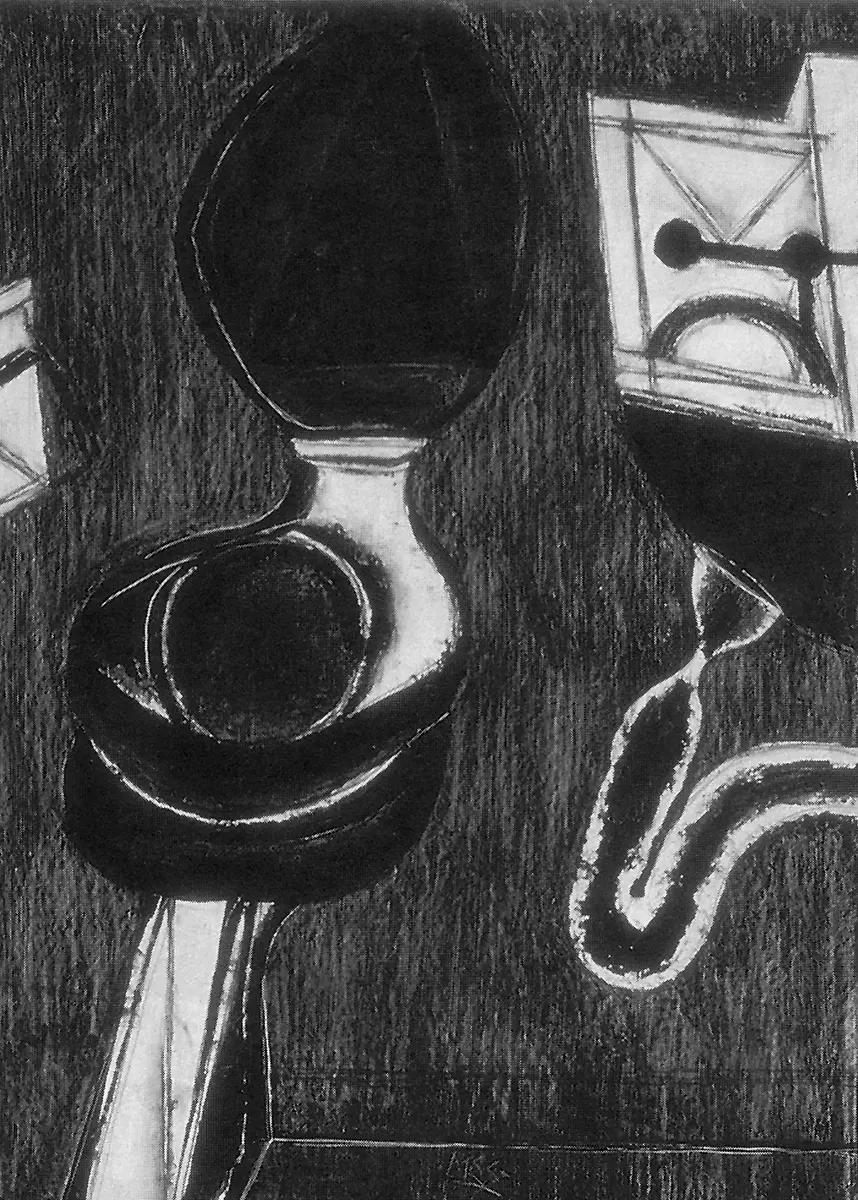
In Sifón (Siphon, 1954), created under the spell of Guernica, Espínola Gómez created a straightforward and expressionist vision of the most intimate space: that of the bathroom. He disarticulated the representation of a space in order to shape it from a subjective and personal point of view. This carefree and disquieting work, in which a toilet and a sink are represented, begins to denote a degree of frankness and unusual rawness in the Uruguayan art of the time. The expressionist distortion of the objects projects a biomorphic quality that acts as a metaphor for individual experience.
The play of triangles, curves, ovals, and the organic geometry that he achieves transmits ideas of intestines and entrails. Sifón connotes radical solitude and privacy because it refers to hygiene and bodily functions. It points in an oblique manner to the order of the abject (in the sense used by Julia Kristeva). Painted in oil on fiber with colors scraped by spatulas, the work possesses a dramatic sense that is achieved through the image and the three colors. Espínola Gómez discovered that white, gray, and black have a dramatic power when they are well handled.
Exploring assorted languages (1955-1963)
Around the mid-1950s, Espínola Gómez's language pointed toward abstraction. In effect, between 1955 and 1963, he devoted himself to abstraction, although he also made an important incursion into the territory of figuration. He developed assorted lines of abstraction, some material, others very lyrical, and others with organic references. He likewise profited from the contrast between the bouncing of the brush and the flowing of the brush.
In the majority of the abstract series that made him stand out in the panorama of Uruguayan art, Espínola Gómez turned away from color and adopted blacks, whites, and grays. On account of this reductionist use of color, he coincides with abstract painters from the abstract expressionist movement, and from the material art of the '50s and '60s, like Franz Kline, Robert Motherwell, Clyfford Still, Mark Rothko, the Spanish materialists, the French painter Pierre Soulages, the Londoner Sandra Blow, the German Willi Baumeister, the Uruguayans Américo Spósito and Hilda López (among others), and the Japanese abstract painters, to name a few examples.
The first series of works realized between 1955 and 1961 have strong organic resonances in some cases, and in others, geometric marks. The artist himself calls this muscular abstraction. He created powerful works, he sought vital echoes and frank qualities. He was inspired by photos and X-rays, although in the end, the paintings detached themselves from those origins, which are only one point of departure.
In the midst of the abstract series and of a local fury in pursuit of informalist abstraction that grabbed the attention of the Montevidean art scene at the time, Espínola Gómez, right at the peak of his own non-figurative stage, interrupted non-referentiality in order to devote himself to the material figuration that became present in the series Los gordos (1961).
Immediately after Los gordos, Espínola Gómez made a material-abstract series. It is a generous work in material, concise in chromatism, and with an unfolding of many low colors, earth tones, grays, blacks, and silvers. Following that spirit, the material series of 1961 is constructed with horizontal brush strokes. Later on, in 1962, he created a series of medium-format compositions with tempera.
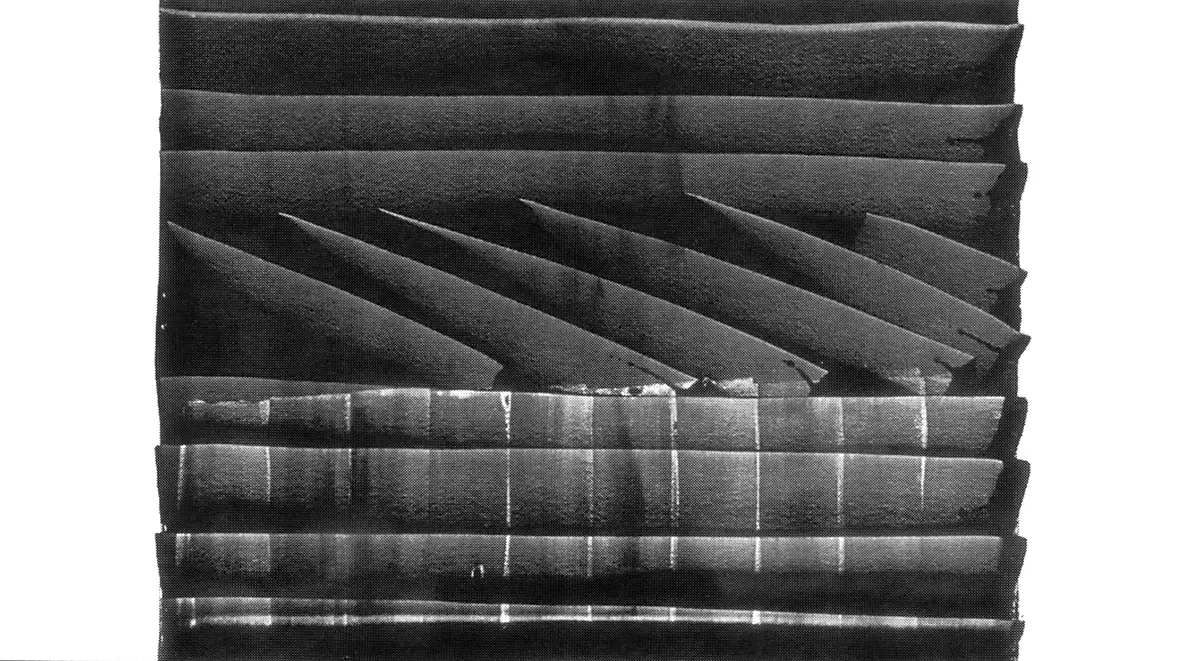
Interrupciones (1963) is known as Las persianas (The Blinds) because the series aroused that association of ideas in the viewers, although these works suggest to the artist evocations of grooved zinc or spines of old books. It is a series of great compositions in tempera in which Espínola Gómez meets controlled improvisation. Highlighted are smooth, superimposed, black horizontal areas, defined by wide, uniform brush strokes of a large and powerful gesture. Interrupciones are ascetic, severe, controlled, sharp, terse, fluid, limpid, elaborate paintings. Full of tension inspected by the attentive eye of their author, they bring about serenity. The optical and luminous effects are notoriously real, and they emerge from the central area of the strips/bars with full force, while the black areas of their borders create a mysterious climate. Flatness and three-dimensionality establish a suspected contrast and the bars give a certain volumetric illusion.
There are white, cut-off empty spaces that separate those vertical and horizontal bars. Although compact areas are defined, nothing is solid because the full spaces dialogue with the empty ones. There are also regular rectangular forms and others that are smoothly irregular and rounded. The artist defines halts, stops, apprehensions of abstract images, suspensions in space, modulations of the unfolding of the brushstroke, and, at the same time, suggestions of openings, allusions to elements that separate, expand, and break the contours and emerge toward a vaster space. Interferences, obstructions, irregularities, discontinuity, and asymmetry are concepts evoked by the artist in the closing and opening of the forms. Something has happened then it stops; intervals, rhythms, suspensions, and fragments are established. In a field of the transference of constant energy, interruptions are generated which materialize through the white of the paper and the forms that stop at a point. The visual articulation that separates the group of bars, and the whites that intervene, creates a special vocabulary.
Facial landscapes and polyfocalist creations
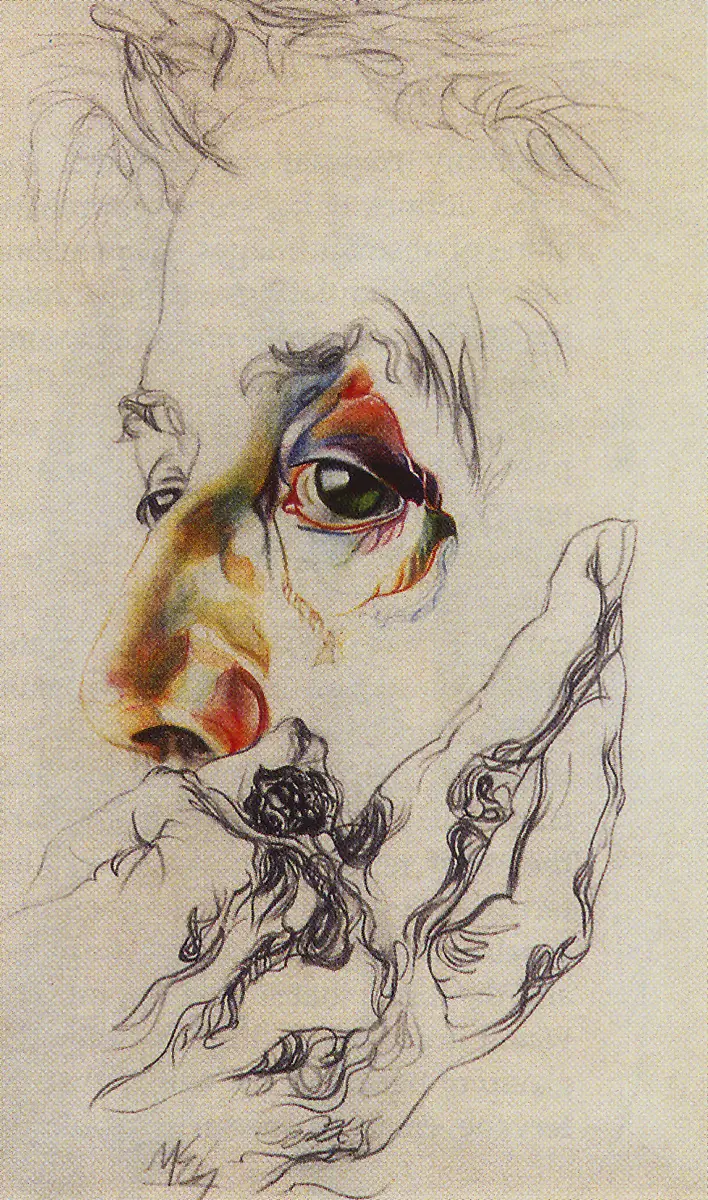
Espínola Gómez returned once again to independent plastic creation in the series of portraits done in graphite and crayon (1972). Under the climate of social convulsion of those years, in full social, political, and economic crisis, he created a disquieting series of portraits, very moving for the viewer and a total symptom of the period that was being lived out at the time. He titled them Paisajes faciales (Facial landscapes). With them, he returned to the iconic image. He concentrated on some elements of the face without re-creating them in their entirety, and in the majority of these pieces, white plays the most important role and serves as the frame that penetrates, leaving the face open. With impetuous graphics and expressionist fury, Espínola Gómez penetrated with his mastery under the skin of the characters, bringing to light the blood and veins. Like scalpels, his graphites and crayons create a dissection, they attempt to unveil the secret that lies hidden behind the face, leaving the eyes, lips, and peeled flesh bare, while they shape presences of great communicative power. The skin, the wrapping of the I and of what lies within, is transgressed, and the cutaneous container is overcome in order to approach what is buried. In this case, the radical interpretation of the Other is important, as is the projection of the artist's subjectivity. The artist simultaneously tries to trap the personality lying in the ambush of the portrayed and to capture his or her psychological behavior. As he painted their portraits, Espínola Gómez began to discover diverse elements of the characters that were previously unknown or more hidden and tangential.
One fundamental element for the artist is the gaze. All gazes are different and each corresponds to a specific personality and temperament: they are individualized eyes. In some cases, Espínola Gómez colored certain areas of the face, like the nose, the eyelids, the ears, the temples, and the lips. He turned to chromatism, which evokes blood, interior, and life, accentuating in that way the visual and communicative power of the works.
This is how he forms the faces of María del Carmen Portela, Jesualdo, Clara Silva, Alberto Zum Felde, Andrés Castillo, Luis Eduardo Pombo, and Luis Nadales, as well as his own face. On one hand, they were outstanding figures of the intellectual and artistic world of Uruguay, and of Montevideo in particular (with the exception of Nadales, who was a union worker). On the other hand, because of their progressive postures, they were able to be censored or persecuted at moments in which enormous political tension was already being produced. There is thus a double homage. The portraits, in showing the subcutaneous in a blood-curdling way, evoke shock, commotion, spasm, convulsion, anguish, agitation, alarm, and aggression. All that is silenced and hidden by the aggressive forces and by the scars of time, as well as an underworld of suffering, is mentioned. The impact that the graphite provokes, the drama that it shapes, the tannic aftertaste it exudes, and the allusions to suffering could all be read as a reference to an altered context, like the one this painter and left-wing militant experienced with particular intensity, and like the one that the artists and intellectuals (as well as the unionist) portrayed suffered with peculiar hardship. But, at the same time, we must not discount the reference to the global suffering of Uruguayan society.
Imagination is present not only in the subjective re-creation of each face, but also in the original, lyrical titles of the works, such as Serenísimo espejo, luneta tibia de lágrimas apenas trasvidridadas (Most Serene Mirror, Lukewarm Window of Freshly Transglazed Tears), Fluencias y regocijos ciliciados (Hair-shirted Flows and Joys), Oscuros pasadizos (Dark Passages), Tocados lucernarios (Skylight Headdresses), Solitaria vertiente sin murmullos (Solitary Angle Without Murmurs), Resplandores casi sin reflejos (Splendors Almost Without Reflections), which invite the viewer to make his or her own associations based on the portrayed figure.
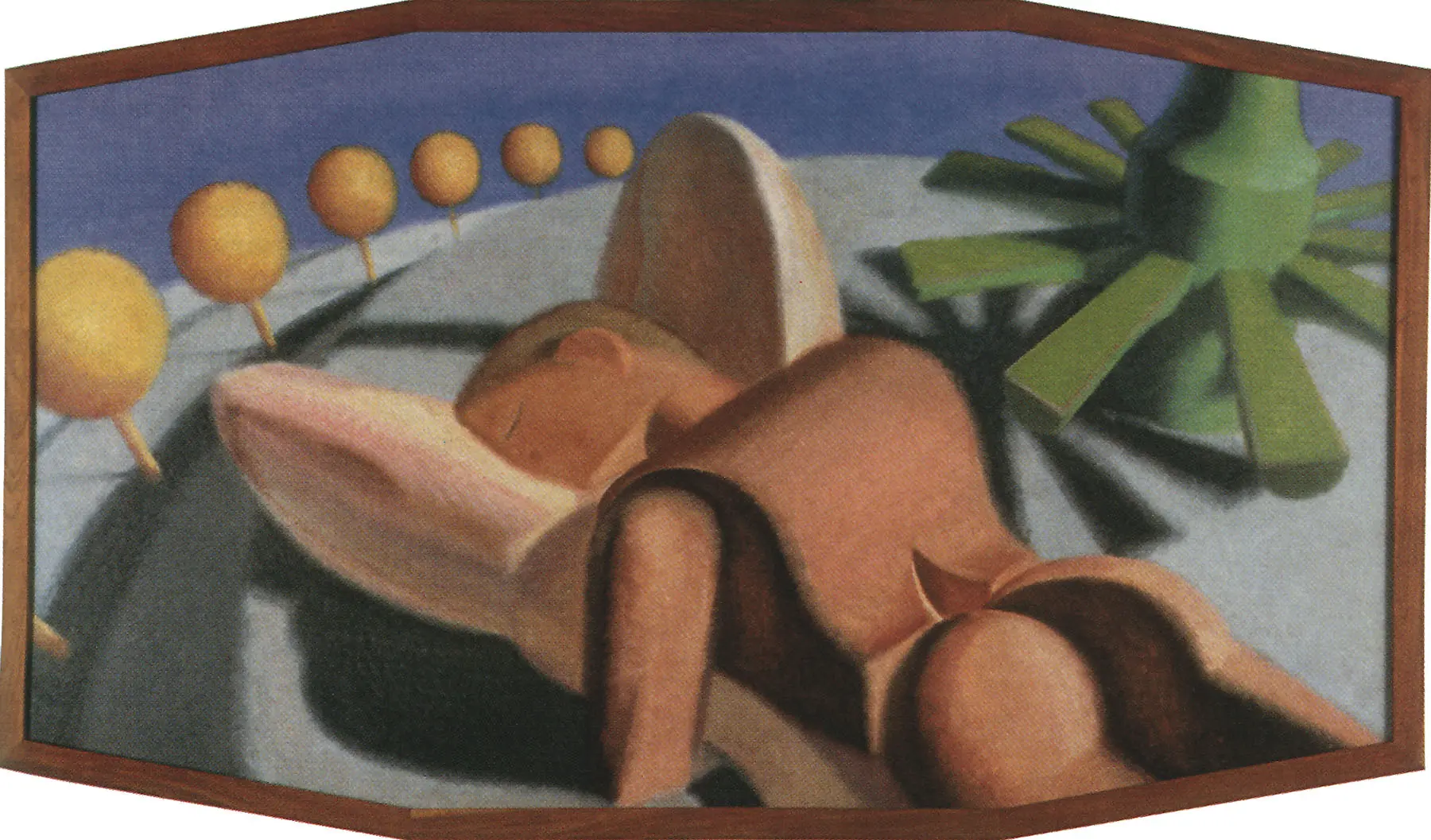
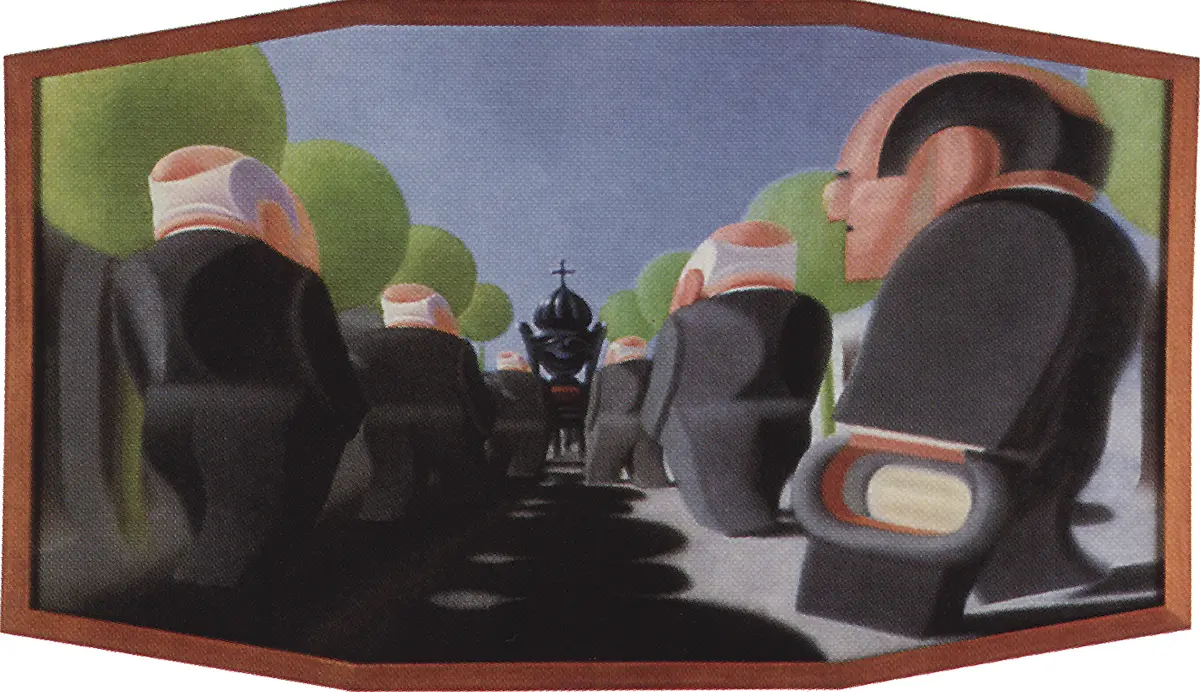
Espínola Gómez carried on in an argumentative mode right in the middle of the Uruguayan dictatorship (1973-1984), creating, like other artists, in metaphor, because it was a very difficult period. Los primeros ejercicios universales emergentes del polifocalismo: nuevo enfoque óptico expresivo ideado por el autor (The first universal exercises emerging from polyfocalism: new optical expressive focus conceived by the author) is the full title of the series shown in 1975 at the Galería Losada. The Polyfocalists are large canvases with an imposing presence that invites the viewer to observe from various points of view, discarding the traditional perspective. Espínola Gómez sought to achieve the possibility of capturing on the canvas the different visions obtained from various angles. When we look, the gaze fixes only on some points and the rest of the work does not appear as clearly. Some elements are seen with total clarity while others are more sketchy. He tried to recreate this vision. The paintings are presented with a special frame, in accordance with their surface structure on eight sides (a controlled and geometric variant of the "shaped canvas" already used by the Madi in the '40s, and which later had its own road in the history of modern and contemporary art). For these compositions, Espínola Gómez considered the rectangle an arbitrary option. He thus searched for octagonal forms. The works are realized with a round, thick paintbrush, which he pounded against the surface, thus achieving unification in the end. The material is thin, the texture is flat, and the colors are controlled.
Of an accentuated oneiric and metaphysical climate, the Polyfocalists are a contribution that distinguishes Espínola Gómez in a very conspicuous way. They have something of a social and epochal criticism, as well as very profound subjective elements. Cresponarios de la media tarde (Mid-afternoon Cresponarios); Serenísimo paisaje encabezado (Most Serene Headed Landscape); La luz, las distancias y las horas (Light, Distances, and Hours); Sonorosas siestas lejaneras (Distant Sonorous Siestas); Alborada en las gargantas (Dawn Song in the Throats); Antiguos rebotes matinales (Ancient Morning Ricochets); and Más allá de nuestros días (Beyond our Days) denote spirits tied to films which in their day impressed the artist, films like Last Year at Marienbad and 2001: A Space Odyssey.
On these canvases, Espínola Gómez generates time stopped. From an absolutely atemporal serenity and calm metaphysics, the polyfocalist pictures show the need to run away from contingencies. They in turn denote the enigma of the real, they evoke the melancholy of a time gone by, they suggest the temporality of the unconscious and of recollection, and they point to certain absurd elements. We find in them the production of a finished synthesis among quasi-oneiric suggestion, static quality, that which remains of an inner world of feelings and sensibilities.
Immobility and stillness are accentuated. Espínola Gómez demonstrates the value of an enchantment that overcomes logocentrism and the rational, the need for a space in which calm reigns supreme, in which he finds himself while allowing the viewer to find himself/herself as well. For him, being overly rational is a limitation, a disadvantage, and he reclaims in this proposal, as in others, the mystery, the power of the imagination, of dream, and of the vision beyond perception. In some works of this series, the mannequin appears, as a "topos" of metaphysical painting, surrealism, Dada, and other aspects of this century seen in the work of George Grosz, René Magritte, Carlo Carrà, Hans Bellmer, Marcel Duchamp, Raoul Hausmann, Heinrich Hoerle, and Oskar Schlemmer, to mention just a few examples.
The most recent expressiveness: Divertimentos
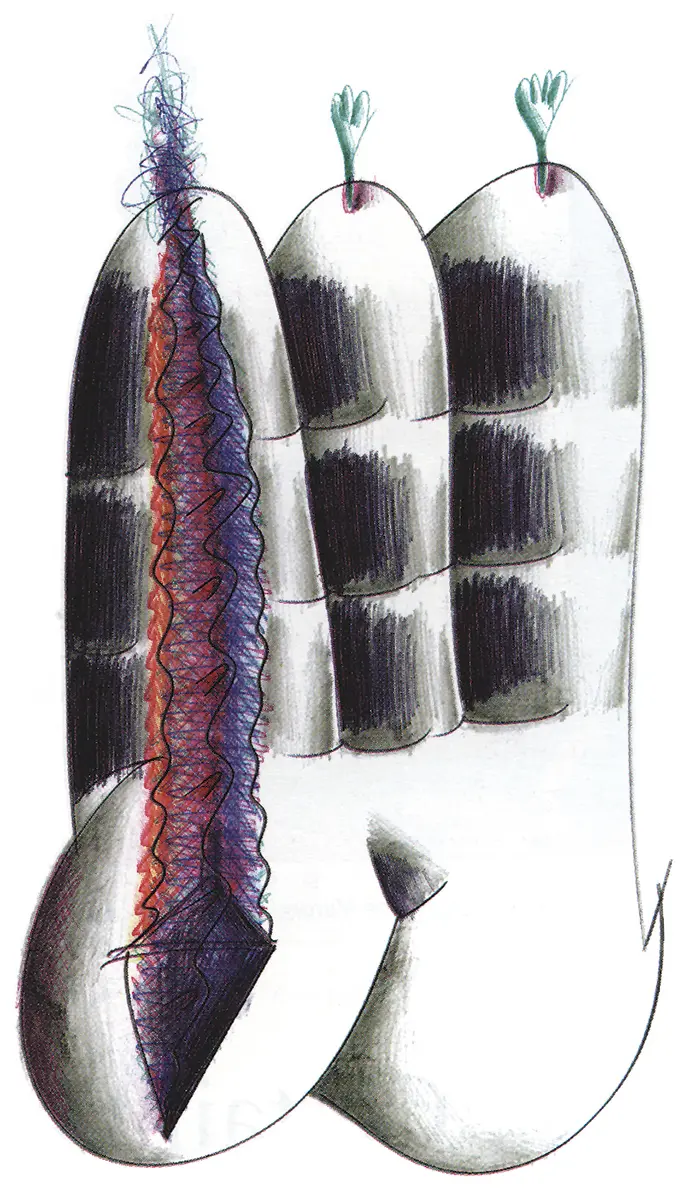
In 1997, he returned to pictorial drawing creation. The result is a series of works created as improvisations and shaped in small format with color and graphite pen. Espínola Gómez calls them Divertimentos. He made eighty and then decided to enlarge some of them in order to see the result. Twenty-five Divertimentos were blown up with a digital system. Espínola Gómez did not participate in the digitalization, and the enlargement process is faithful to the small proposal, maintaining the lines and the color without any modification whatsoever.
They are abstract works with some resonances and elements that are repeated. Chaos, nature, science, and geometry are all intermixed. Espínola Gómez plays with the viewer's projective ability. Espínola Gómez continues to believe that the finality of these latest creations, like that of others that he carried out, is to show what human nature is like in general, and his own being in particular; to show the things that human nature potentially, and therefore explicitly, encloses within. He considers that he, like other visual creators, tends to illuminate man's nature, although he affirms that "everything continues to be a great mystery, in spite of everything."
ALICIA HABER
Uruguayan historian, art teacher, and critic. Artistic counselor and chief curator at the Departamento de Cultura de la Independencia Municipal de Montevideo, Director of the Museo Virtual de Artes El País —MUVA— and art critic for the El País journal. She has published numerous books and catalogs.