
Óscar Machado's gaze was focused on the shortness of reach that man-modified environments have (Jardín interior [Interior Garden], Sala Mendoza, 1995). Then he directed its attention to more distant phenomena, untouched by the effects of humans and whose forms we can only begin to recognize and whose positions we can only begin to map. This faraway gaze has dominated the artist's last two individual shows, Objetos para entender el universo (Objects with which to Understand the Universe) (Sala Mendoza, 2000) and Años luz (Light Years), currently on exhibit. Along with this change in focus, Machado's work has moved toward volumes without surface, turning structures into protagonists and arriving at the weightless, luminous reliefs and assemblages presented now.
Machado has titled his new series Amarres (Ties). It is composed of three-dimensional works created from a two-wire element and a coupling, commonly used in house construction. The laborious chain of intertwined ties works as support and grid for the positioning of multicolored sequins, which represent celestial bodies in futuristic dioramas and three-dimensional plans. In this post-apocalyptic universe that Machado envisions, technology is in shambles and scientific instruments are the work of artisans.
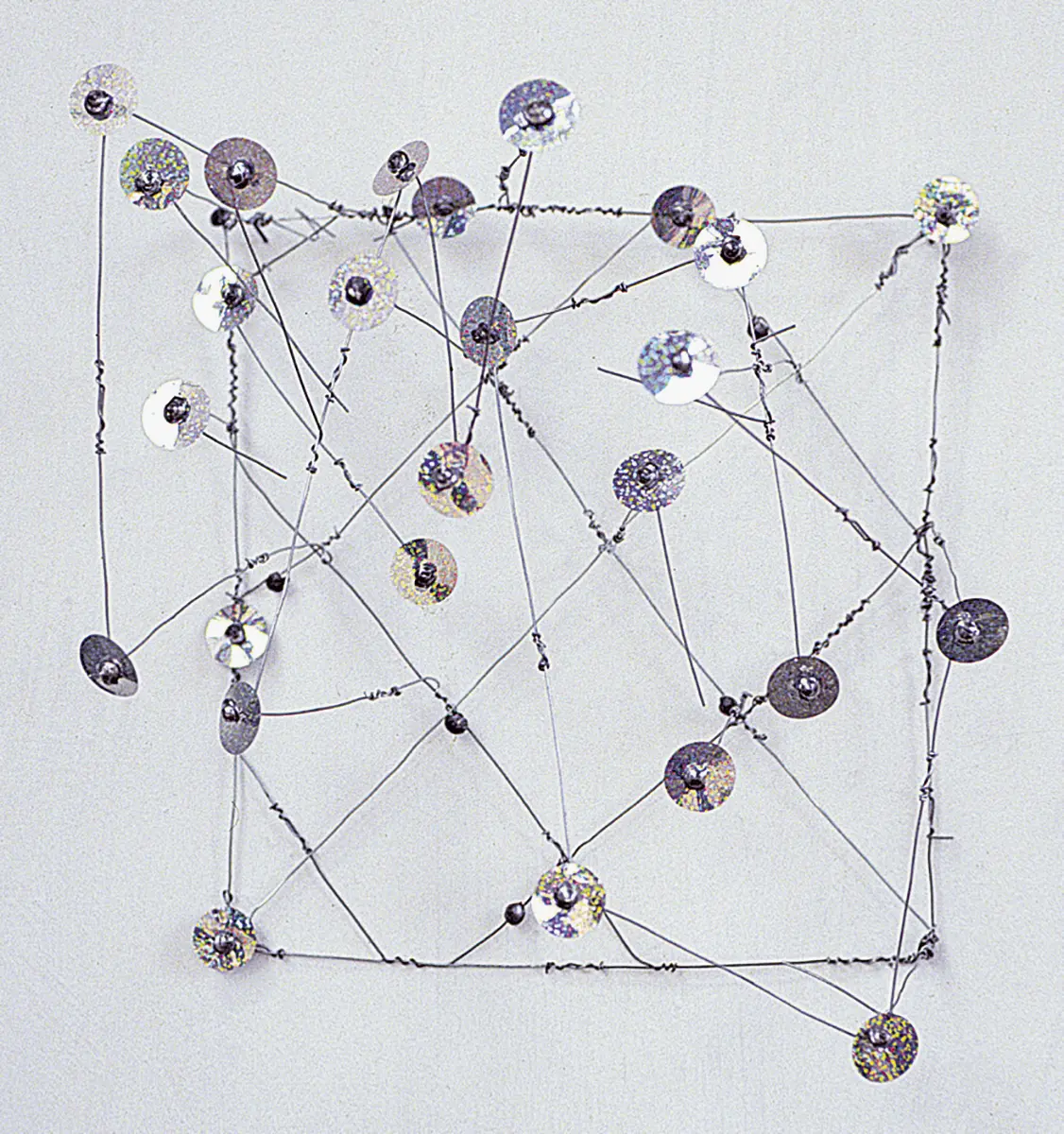
Óscar Machado reinterprets scientific discourses and reflects upon information as a tool of power; he considers the forces that technological advances can unleash, such as those nuclear warheads he created in cement in the early 1990s. In the artist's new approach to the universe and cosmic phenomena in a constant process of creation and destruction, the last decade's large volumes have turned into works that incorporate the surrounding space and light, presenting different aspects according to the time of day.
Machado's wire structures imply a grid, which in turn refers to modern Venezuelan art's geometries —a large influence in contemporary artistic production. However, the orthogonal shape of the early amarres evolve into a greater complexity, in irregular shapes denoting the sensuality of the creative process. The artist works from a place located between vision and intuition, and his perspective is of himself being a bewildered point in an immense universe. Modernity's certitudes have given way to uncertainty, and the apparent abstractions are a way to represent nature in its micro and macro aspects.
Structural, surfaceless sculptures whose volume has been taken over by empty space and luminous reflections —ethereal elements, but not outside the language of three-dimensionality— these pieces signal a new period in the Venezuelan artist's career, a period that, at the same time, continues the "deconstructive" process noticeable since his early solid volumes in wood and cement.
SONIA CASANOVA