
During the past month of August, the founder of Perceptismo, for the first time, expounded his well-known Structural Theory of Color, supported by a series of graphic panels. The Galería del Infinito’s selection shows, in its entirety, the systematization of the artist’s ideas in relation to the chromatic phenomenon as an essential element of concrete painting, developed more than a century ago.
An emblematic trait of avant-garde ideology is the elaboration of powerful theoretical artifacts capable of reinforcing the aesthetic contribution achieved in the material domain. This correlation between the domain of forms and the domain of contents is a constant in Lozza’s work. His language of abstraction does not end in the realm of geometric figures. According to this indefatigable character of experimentation, today at 90, he continues using programmatic writing by means of a continuum of individual manifestos.
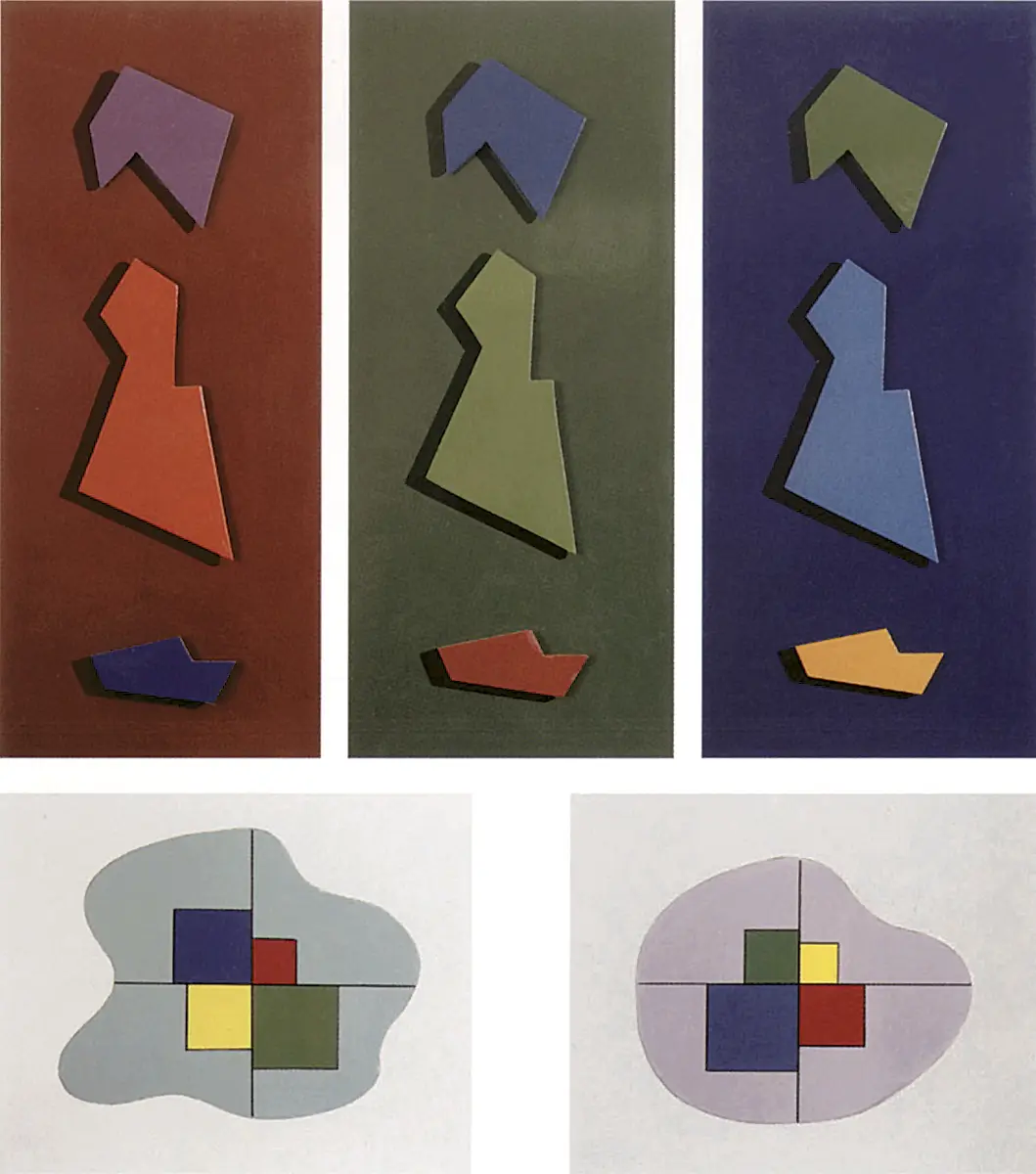
The auto-text reproduced in the catalog that accompanied this individual show provided the spectator with an interpretive key of undeniable efficacy. With a resolved, apodictic tone, the artist declares, "I start preferably with the problem of color, the cause of the last vestiges of representative illusionism." That is why in the "Structural Theory of Color" "which for Lozza is the raw material of painting" one can track his perceptual, epistemological, and functional achievements, opening new ways of aesthetic implementation.
To focus on one of the decisive passages of the document, the artist reinforces the role of "a colorimetry that’s not isolated, immersed in a reciprocal totality achieved by the valuable contributions of science."
This new chromatic paradigm brings together research, changes, inflections, ruptures, and deviations that kept gestating around him throughout the history of figurative and non-figurative painting.
For Lozza, the experience of color lies in an interdisciplinary domain, straddling aesthetic, historical, and scientific thinking.
Are colors entirely utterable in the discourse of art? Do they have an order or hierarchy?
Scrutinizing the graphic panels, the spectator experiences the sensation of facing a succession of concepts that can only be delved into by means of intellectual acuteness. As a matter of fact, this exhibit had no "fetishes" to admire. On the contrary, they were ignored altogether. Instead, there was a body of experimental works Lozza utilized to relate color with the notions of the field (instead of the traditional background), the mathematical measure, dimension and character of the form, extension, open structure, relative potentiality, and qualimetry of the plain form.
Going from the center to the periphery, each stroke is the limit of a color field that starts to emerge. These planes are unrepeatable. How, then, is the imaginary space annulled, the pictorial illusion afforded by the literal use of color? By placing color in the context, to prevent the isolation of its effect.
Colors do not just represent the reality of the body or life. Neither can they be subjected to a law or norm of nature. On the contrary, they are a reflection of an abstraction of nature, an "artifice" that connotes and names the realm of the real.
Basically, colors are "sense figures," that is, structures by means of which ideas and concepts can be fixed.
In his Manifiesto perceptista (Perceptist Manifesto) (1947), Lozza expects the spectator to have a "dynamic attitude towards the active and exalted role of his own creative faculties."
Making use of a very rigorous methodological tool, the artist focuses his interest, not only on the phenomenological and physiological aspects of color, but also on the mental, intelligible, and purely ideal.
According to this view, in the last three decades, the use of color in painting has gone from pure plasticity to literality. According to Lozza, color still makes use of borrowed vestments, still unable to find a structure of its own.
By placing himself against traditional theories that erred by considering color "as the sign of literality in the fine arts," or "the prop of many a whimsical and capricious symbologies of artistic creation," the father of Perceptismo opens up a whole spectrum of radically innovative analysis, placing the chromatic phenomenon in relationship with human context and setting.
CLAUDIA LAUDANNO