
Born in Federal, province of Entre Ríos; exiled in Milan, Paris, and Tarquin; having returned to reside again in Buenos Aires after the resurgence of democracy, Roberto Aizenberg (1928-1996) forms part, along with a few other names, of the canon of the best Argentine variant of the surrealist utopia. Worshiper of psychic automatism as a creative method, Aizenberg was also an obsessive artist when it came to reviewing and redoing "infinitely" his sketches until he found an image that satisfied him. In this double determination —randomness influenced his work as much as rationality— one can find the key to his work, as approached in an exhaustive manner by the curator, Marcelo Pacheco, in the Cronopios Hall of the Centro Recoleta.
One hundred and twenty pieces, selected and placed with precision, took over the extensive hall, amounting to a trajectory of complementary functioning; a coherent structure where drawings, paintings, objects, prints, and photographs appeared empowered by the proximity, beyond the mere chronology of the periods. The presentation of a long glass-showcase dedicated to Aizenberg's craft —abundant visual information about the meticulous y richness of his process— contributed to attenuating the absolute protagonism of his works. With the simple gesture of revealing the back of the finished painting, the curating team, headed by Pacheco, offered an attractive didactic "yet not pedagogical" opportunity; and well-achieved, considering a space characterized by a massive public.
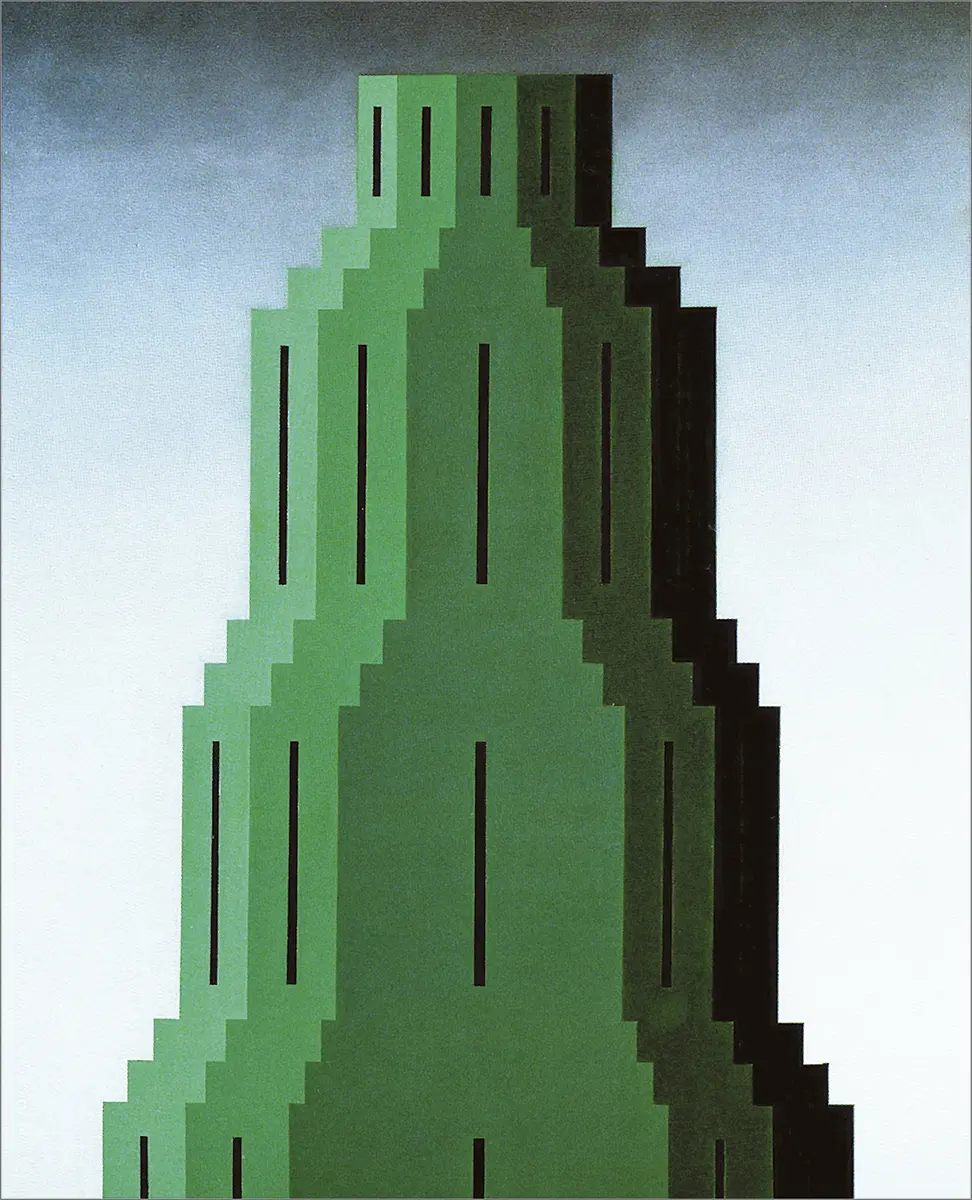
The overwhelming quantity and quality of the works exhibited, permitted a close exploration of the imagination of a master who "in a country where the networks of cultural transmission have been disrupted" is, curiously enough, considered a referential figure by many artists of posterior generations. Parallel to Aizenberg's retrospective, the Centro organized a collective show where two of his favorite pupils —Nessy Cohen and Nicolas Guagnini, presently living abroad— made themselves known, along with several admirers and self-appointed followers. This affinity with Aizenberg can be justified at first sight by his inclination for abstract geometry, greatly valued during the last decade; in opposition to the dominating trends of material neo-expressionism of the 1980's. However, the recognition of personal traits, like his honesty and his intelligence, probably explains part of the phenomenon.
Aizenberg studied along with Berni for a time but, as he has mentioned many times, he achieved his definitive apprenticeship with Juan Batlle Planas, who introduced him to modern art and, particularly, to the precepts of surrealism. An outsider of his time period and out of place, Aizenberg was one of the many followers of that European movement, but being an Argentine who developed his work in the second half of the 20th century, he was able to sift and localize his objectives. In the metaphysical humor and poetry of his first works —with titles such as ¡Abre tus ojos hipotálamo! (Open Your Eyes, Hypothalamus!), or the amazing Incendio del Colegio Jasidista de Minsk en 1713 (Fire at the Minsk Assidean School in 1713)—, in his sad and hermetic torres [towers] of exile, and in the cruel and numbered pinturas of the last period, Aizenberg, immersed in a strictly personal search, displaced and separated himself from any type of mandate that went beyond the pleasure for the harmony of form and color. In pieces, such as Padre y niño contemplando una muralla antigua (Father and Son Contemplating an Ancient Wall) (1962) his evocation was more narrative and lyrical; in the torres of the '70s and '80s, the architectural outline became a visual refuge for what could not be spoken of. The surrealist faith remained behind, way behind, compared to the power of the images and the real contingencies they evoke.
If he was well respected during the 1960s —considered a consummate artist by the retrospective show in the Instituto Di Tella, sent to the Sao Paulo Biennial, and invited to the main neo-surrealist expositions of the time—, Aizenberg, having returned in 1984, was not able to reintegrate himself successfully in the Argentine circle. The pain suffered as a result of the disappearance of his wife's children during the dictatorship, the emergence of the new "stellar artists" in a modest Latin American market, and the lack of theoretical interlocutors like the ones who had contributed to legitimizing his career in the 1960's —especially the critic Aldo Pelligrini— resulted in isolation, only interrupted by sporadic shows and incursions into teaching. In this respect, the exhibit at the Centro Recoleta was "in addition to an excellent opportunity to appreciate a bulk of his work" one of the best well-intended posthumous homages that try to make amends for the injustices of a society that is not governed by the acknowledgment of talent.
EVA GRINSTEIN